
[Paper Review] SEVD: Synthetic Event-based Vision Dataset for Ego and Fixed Traffic Perception
SEVD is a novel synthetic, multi-view event-based vision dataset for ego and fixed traffic perception, generated using the CARLA simulator with diverse lighting and weather conditions. It provides 31 hours of ego and 27 hours of fixed perception data, including event streams, RGB, depth, optical flow, and dense annotations, enabling benchmarking of event-based and frame-based models with strong generalization to real-world data.
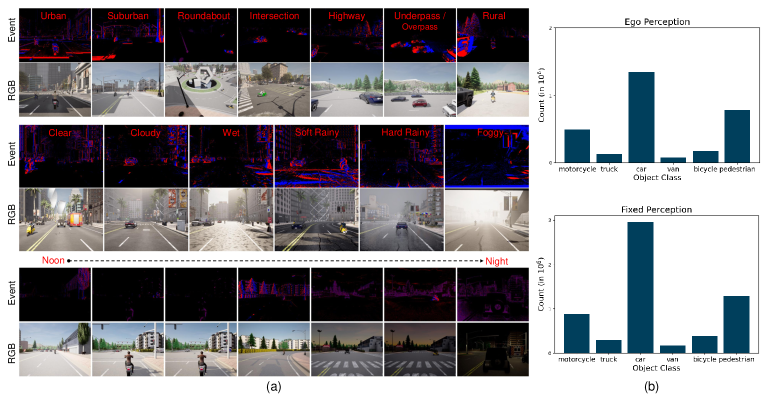
Recently, event-based vision sensors have gained attention for autonomous driving applications, as conventional RGB cameras face limitations in handling challenging dynamic conditions. However, the availability of real-world and synthetic event-based vision datasets remains limited. In response to this gap, we present SEVD, a first-of-its-kind multi-view ego, and fixed perception synthetic event-based dataset using multiple dynamic vision sensors within the CARLA simulator. Data sequences are recorded across diverse lighting (noon, nighttime, twilight) and weather conditions (clear, cloudy, wet, rainy, foggy) with domain shifts (discrete and continuous). SEVD spans urban, suburban, rural, and highway scenes featuring various classes of objects (car, truck, van, bicycle, motorcycle, and pedestrian). Alongside event data, SEVD includes RGB imagery, depth maps, optical flow, semantic, and instance segmentation, facilitating a comprehensive understanding of the scene. Furthermore, we evaluate the dataset using state-of-the-art event-based (RED, RVT) and frame-based (YOLOv8) methods for traffic participant detection tasks and provide baseline benchmarks for assessment. Additionally, we conduct experiments to assess the synthetic event-based dataset's generalization capabilities. The dataset is available at https://eventbasedvision.github.io/SEVD
Motivation & Objective
- Address the scarcity of synthetic event-based vision datasets for autonomous driving and traffic monitoring.
- Provide a comprehensive, multi-view dataset with both ego and fixed perception setups to support diverse perception tasks.
- Enable benchmarking of event-based and frame-based models under realistic lighting and weather conditions.
- Support research in cooperative perception and V2I communication through infrastructure-mounted sensor data.
- Facilitate generalization studies by evaluating synthetic data-trained models on real-world event-based benchmarks.
Proposed method
- Generated event-based data using the CARLA simulator with multiple dynamic vision sensors (DVS) in ego and fixed configurations.
- Simulated diverse environmental conditions: lighting (noon, nighttime, twilight) and weather (clear, cloudy, wet, rainy, foggy).
- Captured multi-view data from six cameras around an ego vehicle and four fixed cameras at intersections, roundabouts, and underpasses.
- Synchronized and recorded event streams alongside RGB, depth, optical flow, and semantic/instance segmentation masks.
- Used frame-to-event simulation techniques to generate realistic event data from high-fidelity RGB sequences in the simulator.
- Provided extensive annotations including 9M+ 2D and 3D bounding boxes in COCO, Pascal VOC, and KITTI formats, with tracking IDs.

Experimental results
Research questions
- RQ1Can a synthetic event-based dataset with multi-view ego and fixed perception configurations support robust training and evaluation of event-based perception models?
- RQ2How well do models trained on synthetic event data generalize to real-world event-based benchmarks?
- RQ3What is the performance of state-of-the-art event-based (RED, RVT) and frame-based (YOLOv8) detectors on the SEVD dataset?
- RQ4To what extent does multi-view data improve perception robustness under occlusion and limited field-of-view challenges?
- RQ5How effective is the SEVD dataset in enabling research on cooperative perception and V2I communication systems?
Key findings
- The SEVD dataset provides 31 hours of ego perception and 27 hours of fixed perception event data, with an additional 186 hours of ego and 162 hours of fixed perception data across multiple sensor modalities.
- The dataset includes over 9 million 2D and 3D bounding box annotations across diverse traffic participants (car, truck, van, bicycle, motorcycle, pedestrian) in urban, suburban, rural, and highway scenes.
- RVT, a state-of-the-art event-based detector, demonstrated decent generalization to real-world data, with a performance drop observed only for the pedestrian class.
- Qualitative results show variability in detection performance, with correct detections even in challenging lighting and weather conditions.
- Baseline evaluations using RED, RVT, and YOLOv8 show strong performance on 2D detection tasks, validating the dataset’s utility for benchmarking.
- The inclusion of fixed perception data enables new research directions in infrastructure-based perception and V2I communication, expanding beyond traditional ego-motion perception.
Read this paper
Open the full text in the Nubint reader and ask about any passage as you read.
Read this paper on NubintThis review was generated by AI from the original paper. Please check the paper before citing it.