
[Paper Review] Seven Failure Points When Engineering a Retrieval Augmented Generation System
The paper presents seven failure points observed in RAG systems across three case studies and derives practical lessons and future research directions for robustness and evaluation. It also provides empirical insights from BioASQ and other domain deployments to guide practitioners.
Software engineers are increasingly adding semantic search capabilities to applications using a strategy known as Retrieval Augmented Generation (RAG). A RAG system involves finding documents that semantically match a query and then passing the documents to a large language model (LLM) such as ChatGPT to extract the right answer using an LLM. RAG systems aim to: a) reduce the problem of hallucinated responses from LLMs, b) link sources/references to generated responses, and c) remove the need for annotating documents with meta-data. However, RAG systems suffer from limitations inherent to information retrieval systems and from reliance on LLMs. In this paper, we present an experience report on the failure points of RAG systems from three case studies from separate domains: research, education, and biomedical. We share the lessons learned and present 7 failure points to consider when designing a RAG system. The two key takeaways arising from our work are: 1) validation of a RAG system is only feasible during operation, and 2) the robustness of a RAG system evolves rather than designed in at the start. We conclude with a list of potential research directions on RAG systems for the software engineering community.
Motivation & Objective
- Motivate robust RAG engineering by identifying practical failure points across domains (research, education, biomedical).
- Provide an empirically grounded catalogue of failures to guide practitioners in RAG design choices.
- Share lessons from three RAG deployments to inform software engineering research on RAG robustness and testing.
- Highlight future research directions in chunking/embeddings, tuning strategies, and testing/monitoring for RAG systems.
Proposed method
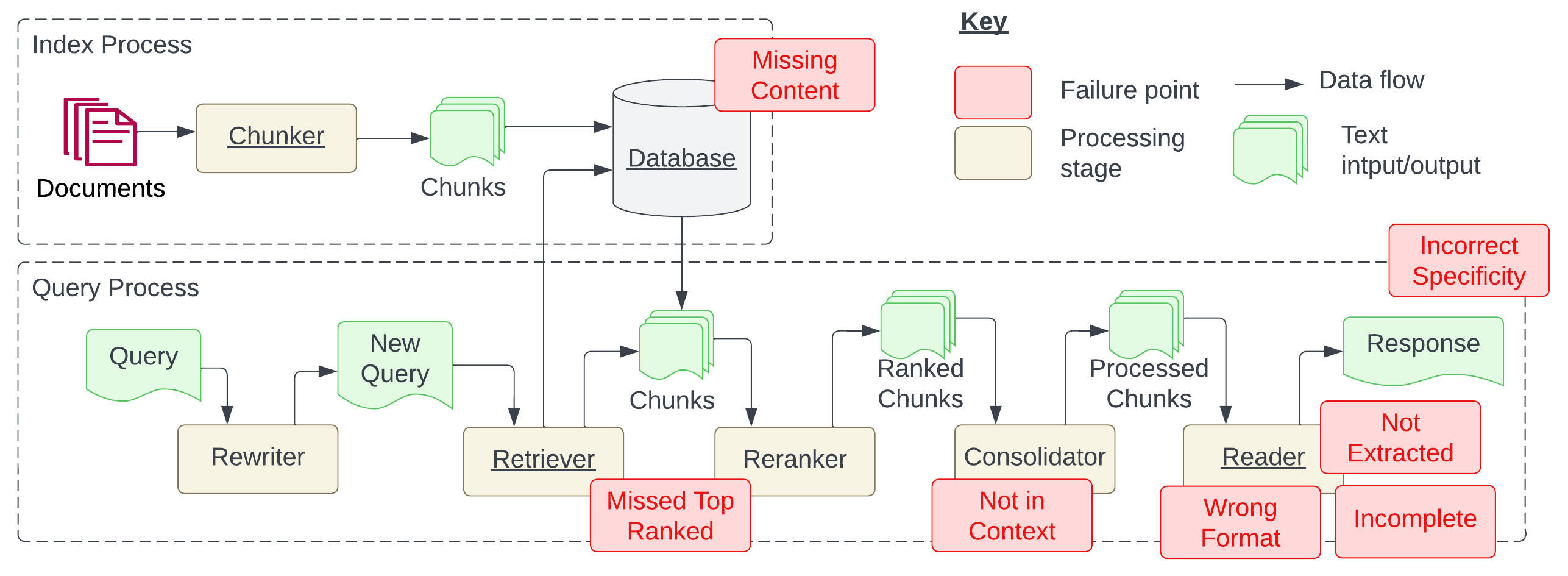
- Describe the RAG architecture and the index and query processes used in RAG pipelines.
- Conduct three case studies (Cognitive Reviewer, AI Tutor, BioASQ) to observe failure points in real deployments.
- Use BioASQ data with 15,000 documents and 1,000 Q/A pairs to empirically identify failures via GPT-4 outputs and OpenAI evals.
- Analyze case study results to enumerate seven specific failure points (FP1–FP7) and derive lessons.
- Summarize lessons in a table linking failures to case studies and potential improvements.
Experimental results
Research questions
- RQ1What failure points arise when engineering a RAG system?
- RQ2What key considerations emerge from empirical case studies for building robust RAG systems?
- RQ3What future research directions can improve RAG deployment across domains?
Key findings
- Seven failure points were identified and labeled FP1 through FP7, spanning missing content to incomplete or misformatted answers.
- An empirical BioASQ-based evaluation involved 15,000 documents and 1,000 questions, with OpenAI evals used to flag inaccuracies.
- Validation of a RAG system is feasible only during operation, and robustness evolves rather than being fully designed upfront.
- Three case studies (Cognitive Reviewer, AI Tutor, BioASQ) illustrate domain-specific challenges and practical lessons.
- Continuous calibration and monitoring are necessary to maintain RAG performance post-deployment.
- The paper provides a catalogue of failures and outlines future research directions in chunking/embeddings, finetuning vs RAG, and testing/monitoring.
Read this paper
Open the full text in the Nubint reader and ask about any passage as you read.
Read this paper on NubintThis review was generated by AI from the original paper. Please check the paper before citing it.