
[Paper Review] Sharp quantitative estimates of Struwe's Decomposition
This paper establishes sharp quantitative estimates for Struwe’s decomposition of non-negative functions in the Sobolev space $\dot{H}^1(\mathbb{R}^n)$ that nearly solve the critical nonlinear elliptic equation $\Delta u + u^{(n+2)/(n-2)} = 0$. It proves that the $\dot{H}^1$-distance from the manifold of weakly interacting Talenti bubbles is bounded by $\Gamma(u)|\log \Gamma(u)|^{1/2}$ for $n=6$ and $|\Gamma(u)|^{(n+2)/(2(n-2))}$ for $n \geq 7$, and shows these bounds are optimal, resolving a conjecture by Figalli and Glaudo on the sharp scaling in higher dimensions.
Suppose $u\in \dot{H}^1(\mathbb{R}^n)$. In a seminal work, Struwe proved that if $u\geq 0$ and $\|Δu+u^{\frac{n+2}{n-2}}\|_{H^{-1}}:=Γ(u) o 0$ then $dist(u,\mathcal{T}) o 0$, where $dist(u,\mathcal{T})$ denotes the $\dot{H}^1(\mathbb{R}^n)$-distance of $u$ from the manifold of sums of Talenti bubbles. Ciraolo, Figalli and Maggi obtained the first quantitative version of Struwe's decomposition with one bubble in all dimensions, namely $δ(u) \leq C Γ(u)$. For Struwe's decomposition with two or more bubbles, Figalli and Glaudo showed a striking dimensional dependent quantitative estimate, namely $δ(u)\leq C Γ(u)$ when $3\leq n\leq 5$ while this is false for $ n\geq 6$. In this paper, we show that \[dist (u,\mathcal{T})\leq C\begin{cases} Γ(u)\left|\log Γ(u) ight|^{\frac{1}{2}}\quad& ext{if }n=6, |Γ(u)|^{\frac{n+2}{2(n-2)}}\quad& ext{if }n\geq 7.\end{cases}\] Furthermore, we show that this inequality is sharp.
Motivation & Objective
- To provide sharp quantitative estimates for Struwe’s decomposition when multiple Talenti bubbles are present, particularly in dimensions $n \geq 6$.
- To resolve the conjecture by Figalli and Glaudo on the correct scaling of the distance from the manifold of weakly interacting Talenti bubbles in terms of the $H^{-1}$-norm of the residual $\Delta u + u^{(n+2)/(n-2)}$.
- To establish the optimality of the derived bounds by constructing matching counterexamples or asymptotic constructions.
- To extend the quantitative stability theory of the Sobolev inequality beyond the case of a single bubble to multiple, weakly interacting bubbles in higher dimensions.
Proposed method
- The authors analyze the asymptotic behavior of functions $u \in \dot{H}^1(\mathbb{R}^n)$ that nearly solve the critical nonlinear equation $\Delta u + u^{(n+2)/(n-2)} = 0$, using the $H^{-1}$-norm of the residual as a measure of approximation.
- They employ a reduction method to decompose $u$ into a sum of Talenti bubbles and a remainder, estimating the $\dot{H}^1$-norm of the remainder via energy and interaction estimates.
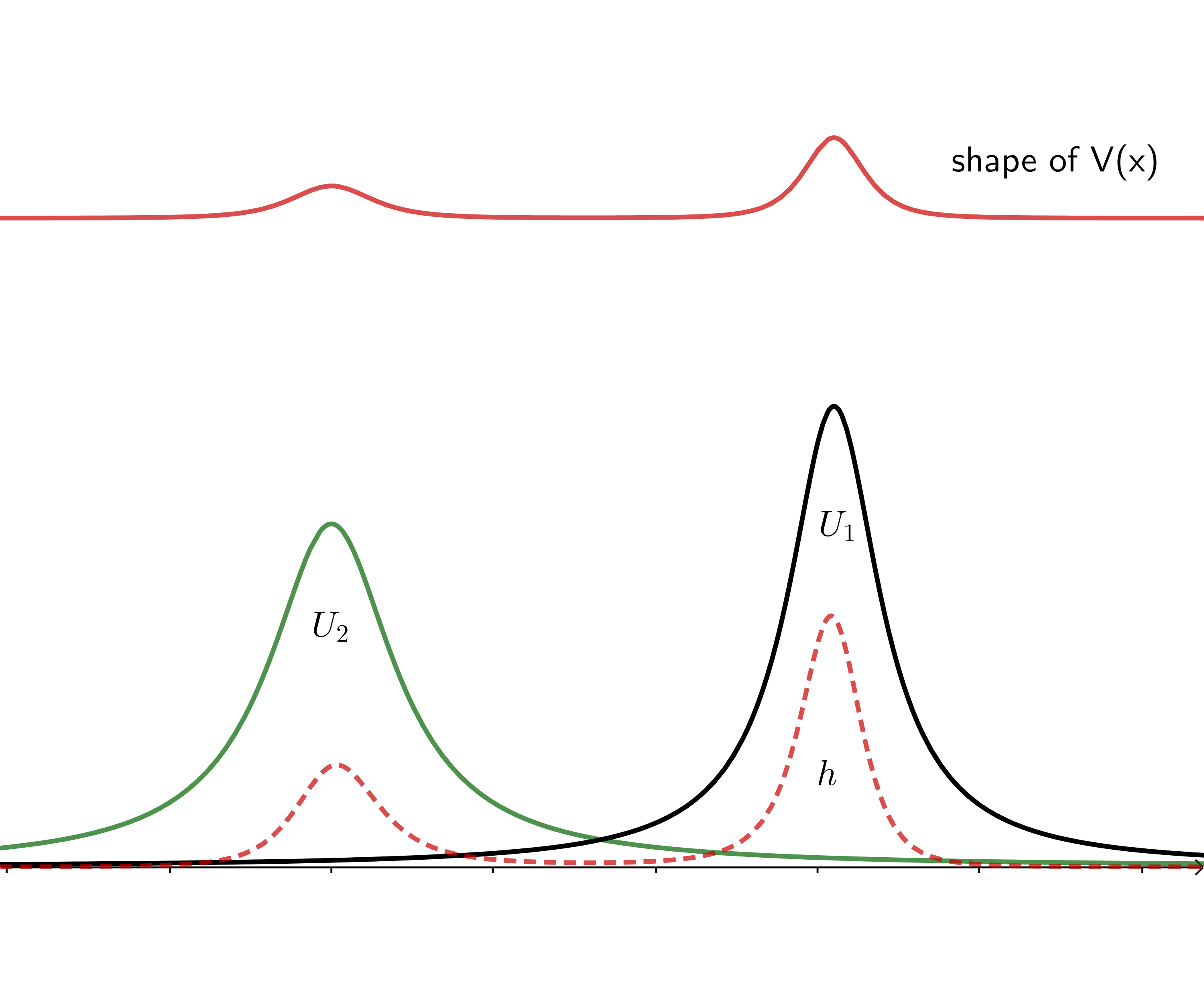
- The analysis distinguishes cases based on the relative scales of bubble parameters (centers and scaling parameters), using dyadic decomposition and scaling arguments to control interaction terms.
- For $n=6$, they derive a logarithmic correction term $|\log \Gamma(u)|^{1/2}$ by carefully estimating the overlap and interaction of two bubbles in the critical regime.
- For $n \geq 7$, they show that the optimal decay rate is $|\Gamma(u)|^{(n+2)/(2(n-2))}$, derived from scaling invariance and sharp $L^p$-type estimates on the residual.
- They prove sharpness of the estimates by constructing test functions that saturate the bounds, demonstrating that no better rate is possible.
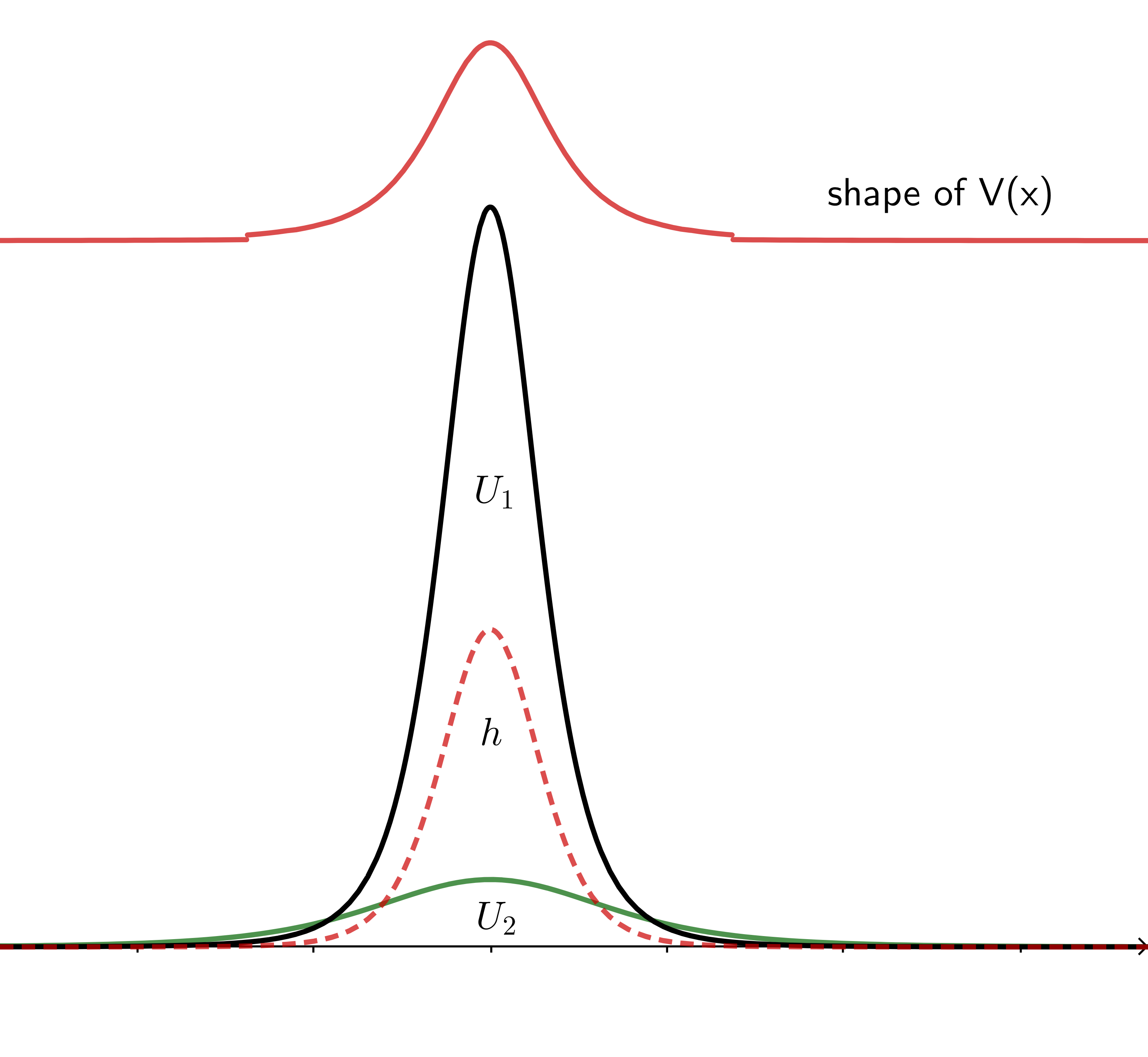
Experimental results
Research questions
- RQ1What is the correct quantitative rate of convergence of $u$ to the manifold of weakly interacting Talenti bubbles when $\|\Delta u + u^{(n+2)/(n-2)}\|_{H^{-1}} \to 0$ for $n \geq 6$?
- RQ2Can the logarithmic correction term $|\log \Gamma(u)|^{1/2}$ be sharp for $n=6$, as conjectured by Figalli and Glaudo?
- RQ3Is the exponent $\gamma = \frac{n+2}{2(n-2)}$ optimal for the decay rate in the $n \geq 7$ case?
- RQ4How does the interaction structure of multiple Talenti bubbles affect the stability estimates in higher dimensions?
- RQ5Can the quantitative stability result be extended beyond the single-bubble case to multiple, weakly interacting bubbles in all dimensions?
Key findings
- For $n = 6$, the $\dot{H}^1$-distance from the manifold $\mathcal{T}$ of weakly interacting Talenti bubbles satisfies $\text{dist}(u, \mathcal{T}) \leq C \Gamma(u) |\log \Gamma(u)|^{1/2}$, and this bound is sharp.
- For $n \geq 7$, the distance satisfies $\text{dist}(u, \mathcal{T}) \leq C |\Gamma(u)|^{(n+2)/(2(n-2))}$, and this rate is optimal.
- The paper confirms the conjecture of Figalli and Glaudo that the $H^{-1}$-norm of the residual $\Gamma(u)$ controls the distance to the bubble manifold with a logarithmic correction in $n=6$ and a fractional power in $n \geq 7$.
- The sharpness of the estimates is established via explicit constructions of functions that nearly solve the equation but are at the maximal possible distance from $\mathcal{T}$, matching the predicted rates.
- The results show that the transition in scaling behavior occurs at $n=6$, where the logarithmic correction emerges due to critical dimensionality in the interaction decay.
- The analysis reveals that the $n=6$ case is critical in the sense that the interaction decay rate is just slow enough to allow a logarithmic correction, while for $n \geq 7$, the decay is fast enough to allow a power-law bound with exponent less than 1.
Read this paper
Open the full text in the Nubint reader and ask about any passage as you read.
Read this paper on NubintThis review was generated by AI from the original paper. Please check the paper before citing it.