
[Paper Review] Shikra: Unleashing Multimodal LLM's Referential Dialogue Magic
Shikra is a unified multimodal LLM that can input and output spatial coordinates in natural language, enabling Referential Dialogue and excelling at both RD and conventional vision-language tasks without extra modules.
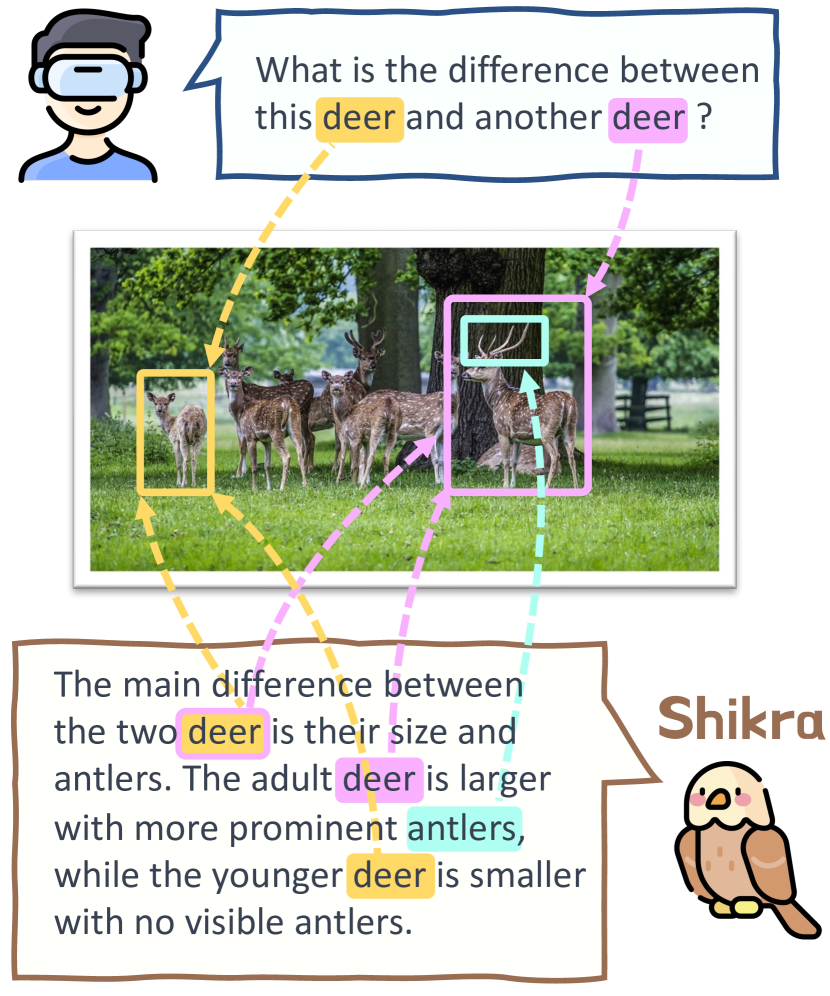
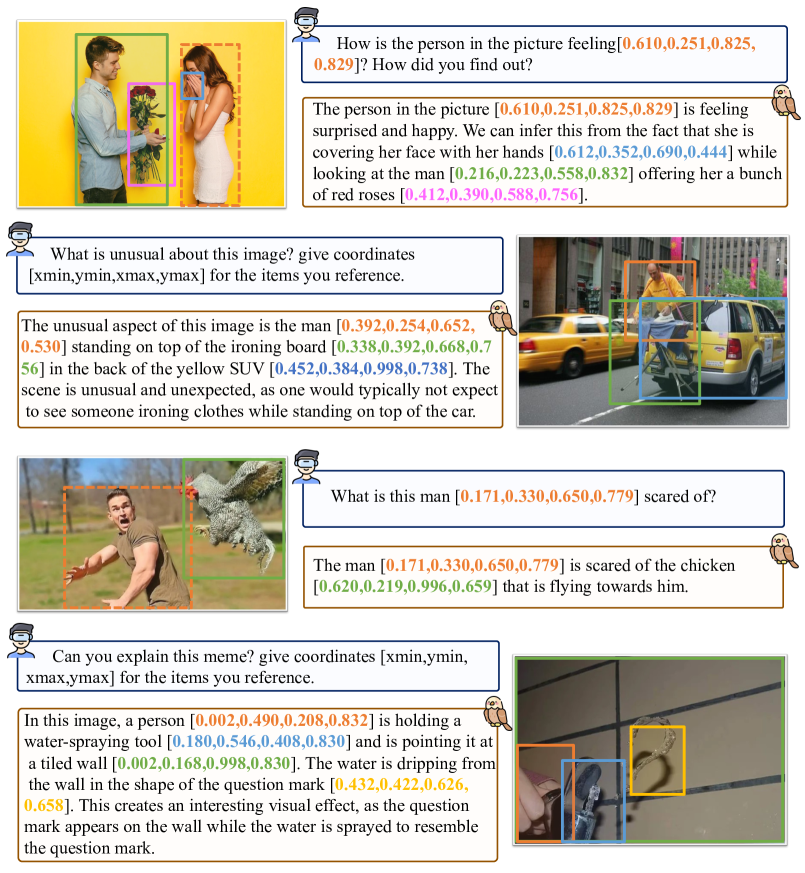
In human conversations, individuals can indicate relevant regions within a scene while addressing others. In turn, the other person can then respond by referring to specific regions if necessary. This natural referential ability in dialogue remains absent in current Multimodal Large Language Models (MLLMs). To fill this gap, this paper proposes an MLLM called Shikra, which can handle spatial coordinate inputs and outputs in natural language. Its architecture consists of a vision encoder, an alignment layer, and a LLM. It is designed to be straightforward and simple, without the need for extra vocabularies, position encoder, pre-/post-detection modules, or external plug-in models. All inputs and outputs are in natural language form. Referential dialogue is a superset of various vision-language (VL) tasks. Shikra can naturally handle location-related tasks like REC and PointQA, as well as conventional VL tasks such as Image Captioning and VQA. Experimental results showcase Shikra's promising performance. Furthermore, it enables numerous exciting applications, like providing mentioned objects' coordinates in chains of thoughts and comparing user-pointed regions similarities. Our code, model and dataset are accessed at https://github.com/shikras/shikra.
Motivation & Objective
- Motivate and formalize Referential Dialogue (RD) as a core capability for MLLMs to discuss specific image regions.
- Propose Shikra, a simple, unified MLLM that handles location inputs/outputs in natural language without extra vocabularies or plug-ins.
- Demonstrate RD enables tasks like REC, PointQA, VQA, and Image Captioning within a single model.
- Show that coordinate-based reasoning can improve accuracy and reduce hallucinations when using positional annotations.
Proposed method
- Use a vision encoder (ViT-L/14 of CLIP) and an LLM (Vicuna-7B or Vicuna-13B) with a single fully connected layer to map visual features to the LLM.
- Represent all coordinates as natural-language numbers inside sentence tokens; no extra position encoders or dedicated vocabularies are introduced.
- Train in two stages on reorganized VL data and on Shikra-RD generated data from Flickr30K Entities via GPT-4, with positional annotations.
- Fine-tune the LLM (while freezing the visual encoder) using AdamW and a cosine-annealing scheduler on 8 A100 GPUs, totaling about 120 hours across stages.
Experimental results
Research questions
- RQ1Can Referential Dialogue be effectively learned and generalized by a unified MLLM without external detectors or vocabularies?
- RQ2Is natural-language numeric position representation sufficient and advantageous over coordinate vocabularies for localization tasks?
- RQ3Can Shikra perform RD across traditional VL tasks (REC, PointQA, VQA, Captioning) without task-specific tuning?
- RQ4Does training with positional annotations reduce visual hallucinations and improve grounding?
- RQ5What is the performance of Shikra on standard RD-related benchmarks compared to specialist and generalist models?
Key findings
- Shikra demonstrates promising performance on RD and conventional VL tasks without finetuning.
- Coordinates are naturally integrated into input/output as NL numbers, enabling flexible spatial reasoning without extra vocabularies.
- Using positional annotations (Grounding CoT) improves performance over vanilla CoT and reduces hallucinations in controlled settings.
- Numerical position representation outperforms coordinate-vocabulary representations for REC-like tasks in controlled comparisons.
- Shikra achieves strong PointQA capabilities and competitive results on VQA and image captioning compared to several baselines.
Read this paper
Open the full text in the Nubint reader and ask about any passage as you read.
Read this paper on NubintThis review was generated by AI from the original paper. Please check the paper before citing it.