
[Paper Review] Shoal: Improving DAG-BFT Latency And Robustness
Shoal adds leader reputation and pipelining to Narwhal-based DAG-BFT, reducing latency (up to 40% in failure-free runs and up to 80% under failures) and improving robustness with prevalent responsiveness.
The Narwhal system is a state-of-the-art Byzantine fault-tolerant scalable architecture that involves constructing a directed acyclic graph (DAG) of messages among a set of validators in a Blockchain network. Bullshark is a zero-overhead consensus protocol on top of the Narwhal's DAG that can order over 100k transactions per second. Unfortunately, the high throughput of Bullshark comes with a latency price due to the DAG construction, increasing the latency compared to the state-of-the-art leader-based BFT consensus protocols. We introduce Shoal, a protocol-agnostic framework for enhancing Narwhal-based consensus. By incorporating leader reputation and pipelining support for the first time, Shoal significantly reduces latency. Moreover, the combination of properties of the DAG construction and the leader reputation mechanism enables the elimination of timeouts in all but extremely uncommon scenarios in practice, a property we name Prevalent Responsiveness" (it strictly subsumes the established and often desired Optimistic Responsiveness property for BFT protocols). We integrated Shoal instantiated with Bullshark, the fastest existing Narwhal-based consensus protocol, in an open-source Blockchain project and provide experimental evaluations demonstrating up to 40% latency reduction in the failure-free executions, and up-to 80% reduction in executions with failures against the vanilla Bullshark implementation.
Motivation & Objective
- Motivate reducing latency in Narwhal-based DAG-BFT without sacrificing safety in practice.
- Develop a protocol-agnostic framework to incorporate leader reputation and pipelining into Narwhal-based protocols.
- Enable near-continuous progress by eliminating timeouts in common failure scenarios.
- Demonstrate correctness of Shoal by leveraging existing properties of Narwhal-based protocols.
- Evaluate practical performance improvements in a live-like blockchain setting.
Proposed method
- Introduce Shoal as a protocol-agnostic framework operating on top of Narwhal-based consensus protocols (DAG-Rider, Tusk, Bullshark).
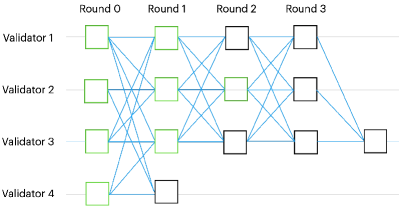
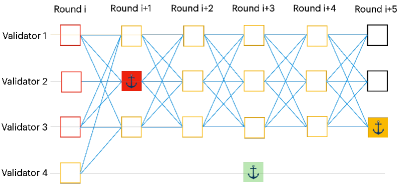
- Use a two-phase approach: (i) pipelining by re-interpreting the DAG to start new protocol instances from the first ordered anchor, (ii) leader reputation to bias round leadership based on historical activity.
- Guarantee correctness via Property 1: if honest validators agree on the anchor-leader mapping, they will agree on the first anchor ordered.
- Incorporate a deterministic function F to map rounds to anchors and update F after each ordered anchor.
- Implement practical enhancements such as eliminating timeouts (prevalent responsiveness).
- Provide open-source implementation integrated with Bullshark to evaluate latency improvements.
Experimental results
Research questions
- RQ1Can Shoal reduce ordering latency in Narwhal-based DAG-BFT without compromising safety?
- RQ2How do leader reputation and pipelining interact to improve liveness and throughput in practice?
- RQ3What quantifiable latency improvements can be achieved in failure-free vs. failure scenarios?
- RQ4Does eliminating timeouts under Shoal preserve safety while reducing latency?
- RQ5How does Shoal perform when instantiated with Bullshark in real or production-like settings?
Key findings
- Shoal achieves up to 40% latency reduction in failure-free executions compared to vanilla Bullshark.
- Shoal achieves up to 80% latency reduction in executions with failures compared to vanilla Bullshark.
- Leadership reputation helps filter slow/crashed validators, enabling DAG progress at network speed.
- Pipelining guarantees an anchor in every round, reducing spiky latency by interleaving protocol instances.
- Eliminating timeouts further reduces latency and simplifies implementation under common conditions.
- The framework is protocol-agnostic and can be applied to DAG-Rider, Tusk, and Bullshark.
Read this paper
Open the full text in the Nubint reader and ask about any passage as you read.
Read this paper on NubintThis review was generated by AI from the original paper. Please check the paper before citing it.