
[Paper Review] ShuttleSet: A Human-Annotated Stroke-Level Singles Dataset for Badminton Tactical Analysis
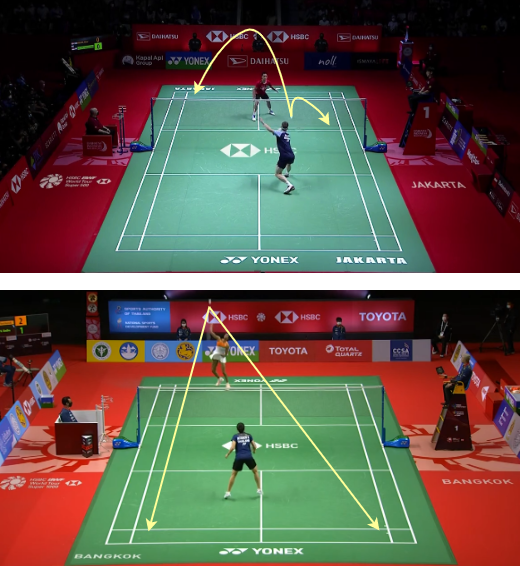
ShuttleSet is a large-scale, human-annotated stroke-level badminton singles dataset comprising 44 matches, 3,685 rallies, and 36,492 strokes from top-ranking players (2018–2021). Annotators used a computer-aided labeling tool to record 18 shot types, hitting locations, and player positions, enabling advanced tactical analysis and serving as a benchmark for stroke forecasting, influence, and movement prediction with state-of-the-art models.
With the recent progress in sports analytics, deep learning approaches have demonstrated the effectiveness of mining insights into players' tactics for improving performance quality and fan engagement. This is attributed to the availability of public ground-truth datasets. While there are a few available datasets for turn-based sports for action detection, these datasets severely lack structured source data and stroke-level records since these require high-cost labeling efforts from domain experts and are hard to detect using automatic techniques. Consequently, the development of artificial intelligence approaches is significantly hindered when existing models are applied to more challenging structured turn-based sequences. In this paper, we present ShuttleSet, the largest publicly-available badminton singles dataset with annotated stroke-level records. It contains 104 sets, 3,685 rallies, and 36,492 strokes in 44 matches between 2018 and 2021 with 27 top-ranking men's singles and women's singles players. ShuttleSet is manually annotated with a computer-aided labeling tool to increase the labeling efficiency and effectiveness of selecting the shot type with a choice of 18 distinct classes, the corresponding hitting locations, and the locations of both players at each stroke. In the experiments, we provide multiple benchmarks (i.e., stroke influence, stroke forecasting, and movement forecasting) with baselines to illustrate the practicability of using ShuttleSet for turn-based analytics, which is expected to stimulate both academic and sports communities. Over the past two years, a visualization platform has been deployed to illustrate the variability of analysis cases from ShuttleSet for coaches to delve into players' tactical preferences with human-interactive interfaces, which was also used by national badminton teams during multiple international high-ranking matches.
Motivation & Objective
- To address the lack of publicly available, high-quality, stroke-level annotated datasets for turn-based sports like badminton.
- To provide structured, microscopic metadata (shot type, location, player positions) for every stroke in elite-level singles matches.
- To support advanced machine learning and deep learning applications in sports analytics, particularly for tactical pattern recognition and forecasting.
- To bridge the gap between academic research and sports practice by enabling coaches and analysts to explore player strategies via an interactive visualization platform.
- To establish benchmarks for stroke influence, stroke forecasting, and movement forecasting using real-world elite-level badminton data.
Proposed method
- The dataset was constructed through manual annotation by domain experts using the S2-labeling tool, which supports efficient and consistent labeling of stroke-level events.
- Each stroke was labeled with 18 distinct shot types, hitting locations, and player positions at the time of impact, using the BLSR format for structured data representation.
- A computer-aided labeling interface reduced annotation time and improved consistency, minimizing human error in complex, high-speed sequences.
- The dataset covers 44 matches from 2018–2021, involving 27 top-ranked men’s and women’s singles players, with 104 sets and 3,685 rallies.
- Multiple benchmarks were established: stroke influence (classification), stroke forecasting (sequence modeling), and movement forecasting (spatiotemporal prediction).
- An interactive visualization platform was developed to enable coaches and analysts to explore tactical patterns without technical expertise, using real match data from the dataset.
Experimental results
Research questions
- RQ1How can stroke-level annotations in badminton improve the performance of machine learning models in tactical forecasting and action recognition?
- RQ2What are the key differences in player positioning and shot selection patterns between elite male and female singles players?
- RQ3To what extent can sequence-based models predict the next stroke or movement based on historical stroke and positioning data?
- RQ4How do tactical patterns, such as net shot usage and court coverage, vary across different match stages (e.g., semi-finals vs. finals)?
- RQ5Can an interactive visualization platform built on a stroke-level dataset effectively support coaches in analyzing player strategies and opponent tendencies?
Key findings
- ShuttleSet is the largest publicly available badminton singles dataset with stroke-level annotations, containing 36,492 strokes across 44 elite-level matches.
- The dataset includes 18 distinct shot types, precise hitting locations, and player positions at each stroke, enabling fine-grained tactical analysis.
- Benchmark results show that current models achieve decent but suboptimal performance on stroke influence, forecasting, and movement prediction tasks, indicating room for improvement.
- Analysis of Viktor Axelsen and Kento Momota’s matches revealed that consistent central positioning and effective net shot usage correlate with higher success rates in front-court exchanges.
- The visualization platform successfully enabled national badminton teams to analyze opponent strategies during international matches, demonstrating real-world utility.
- The dataset and benchmarks are expected to stimulate research in sequence modeling, graph-based methods, and player style comparison in turn-based sports analytics.
Better researchstarts right now
From reading papers to final review, dramatically reduce your research time.
No credit card · Free plan available
This review was created by AI and reviewed by human editors.