
[Paper Review] Siamese SIREN: Audio Compression with Implicit Neural Representations
This paper proposes Siamese SIREN, a novel implicit neural representation (INR) architecture based on SIREN for audio compression that reduces audible background noise through a siamese network design. By training twin SIREN branches to estimate and subtract reconstruction noise, it achieves superior audio fidelity with fewer parameters and better robustness to weight quantization than standard SIREN.
Implicit Neural Representations (INRs) have emerged as a promising method for representing diverse data modalities, including 3D shapes, images, and audio. While recent research has demonstrated successful applications of INRs in image and 3D shape compression, their potential for audio compression remains largely unexplored. Motivated by this, we present a preliminary investigation into the use of INRs for audio compression. Our study introduces Siamese SIREN, a novel approach based on the popular SIREN architecture. Our experimental results indicate that Siamese SIREN achieves superior audio reconstruction fidelity while utilizing fewer network parameters compared to previous INR architectures.
Motivation & Objective
- To explore the feasibility of using implicit neural representations (INRs) for audio compression, a domain where INRs have seen limited prior application.
- To address the challenge of audible background noise in INR-based audio reconstruction, especially after model quantization.
- To develop a method that enhances reconstruction quality without increasing model size, focusing on perceptual fidelity in audio signals.
- To evaluate the trade-off between compression ratio, model size, and audio quality using perceptual metrics.
Proposed method
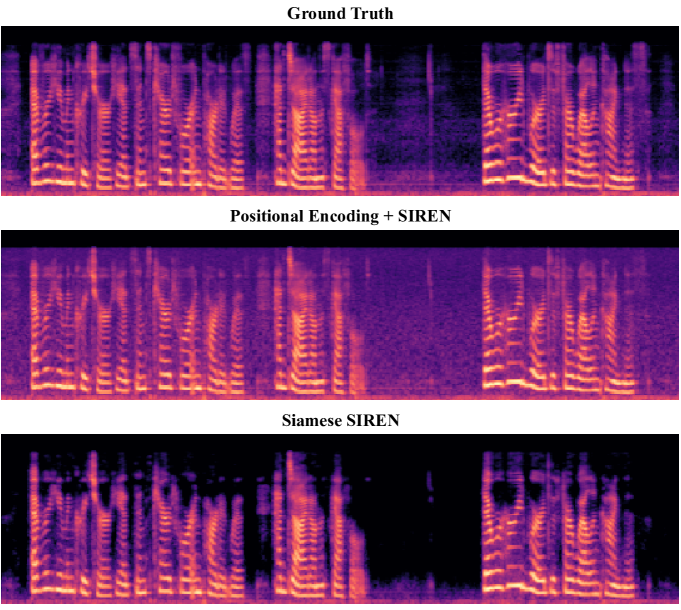
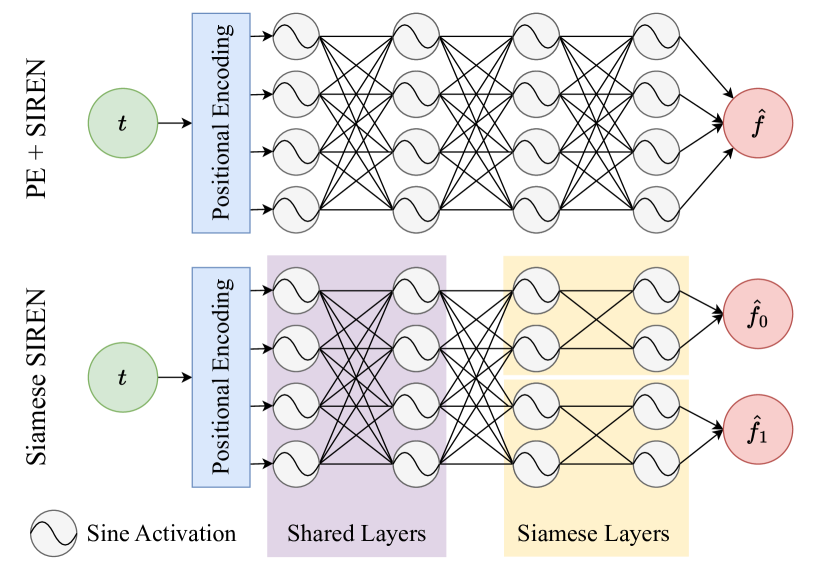
- The method extends the SIREN architecture with a siamese structure, where two identical SIREN networks share early layers but diverge in the final layers to produce two distinct reconstructions of the same audio signal.
- Each siamese branch learns a slightly different noise pattern, enabling the difference between the two outputs to estimate the residual noise in the signal.
- The noise estimate is used to compute a frequency-band-specific noise mask via the Noise Reduce algorithm, which suppresses background noise in the final reconstructed waveform.
- Positional encoding is applied to time-domain inputs to improve high-frequency representation learning, enhancing reconstruction accuracy.
- The model is trained via gradient descent to minimize MSE on the training signal, with overfitting used to achieve high-fidelity reconstruction.
- Model compression is achieved via post-training quantization (PTQ), reducing storage size by 4x while preserving perceptual quality.
Experimental results
Research questions
- RQ1Can implicit neural representations be effectively used for audio compression, particularly in terms of perceptual quality and model efficiency?
- RQ2How does the siamese architecture improve noise suppression in INR-based audio reconstruction compared to standard SIREN?
- RQ3To what extent does weight quantization degrade audio quality in INR models, and can the siamese design mitigate this effect?
- RQ4What is the optimal trade-off between network parameter count, compression ratio, and perceptual audio quality in INR-based audio compression?
Key findings
- Siamese SIREN achieves a ViSQOL score of 2.22 with only 513k parameters, significantly outperforming standard SIREN (1.92) under the same configuration.
- With 142k parameters, Siamese SIREN maintains a ViSQOL score of 1.28, demonstrating robustness even at low model sizes.
- The ablation study shows that using a noise estimate reduces background noise more effectively, especially in music signals, where the difference in signal fidelity is most pronounced.
- The method achieves a 4x reduction in model size via PTQ with minimal perceptual degradation, indicating strong quantization robustness.
- The best performance is achieved when the majority of the network is shared and only the final layer is split into siamese heads, balancing parameter efficiency and reconstruction quality.
Read this paper
Open the full text in the Nubint reader and ask about any passage as you read.
Read this paper on NubintThis review was generated by AI from the original paper. Please check the paper before citing it.