
[Paper Review] SiCL: Silhouette-Driven Contrastive Learning for Unsupervised Person Re-Identification with Clothes Change
This paper proposes MaskCL, a novel unsupervised contrastive learning framework for long-term person re-identification under clothes change, using person silhouette masks as semantic prompts to learn cross-clothes invariant features. By constructing a hierarchical semantic neighbor structure from RGB and mask features, MaskCL significantly outperforms unsupervised baselines and closes the gap to supervised SOTA on five benchmark datasets.
In this paper, we address a highly challenging yet critical task: unsupervised long-term person re-identification with clothes change. Existing unsupervised person re-id methods are mainly designed for short-term scenarios and usually rely on RGB cues so that fail to perceive feature patterns that are independent of the clothes. To crack this bottleneck, we propose a silhouette-driven contrastive learning (SiCL) method, which is designed to learn cross-clothes invariance by integrating both the RGB cues and the silhouette information within a contrastive learning framework. To our knowledge, this is the first tailor-made framework for unsupervised long-term clothes change eid{}, with superior performance on six benchmark datasets. We conduct extensive experiments to evaluate our proposed SiCL compared to the state-of-the-art unsupervised person reid methods across all the representative datasets. Experimental results demonstrate that our proposed SiCL significantly outperforms other unsupervised re-id methods.
Motivation & Objective
- To address the lack of unsupervised long-term person re-identification methods under clothes change, a realistic but underexplored setting.
- To overcome the failure of conventional unsupervised methods that rely solely on RGB features and cluster based on clothing color, leading to error propagation.
- To learn clothes-independent, cross-clothes invariant features by integrating silhouette masks as semantic prompts in contrastive learning.
- To establish a benchmark for unsupervised long-term person re-identification with clothes change through extensive evaluation on five datasets.
Proposed method
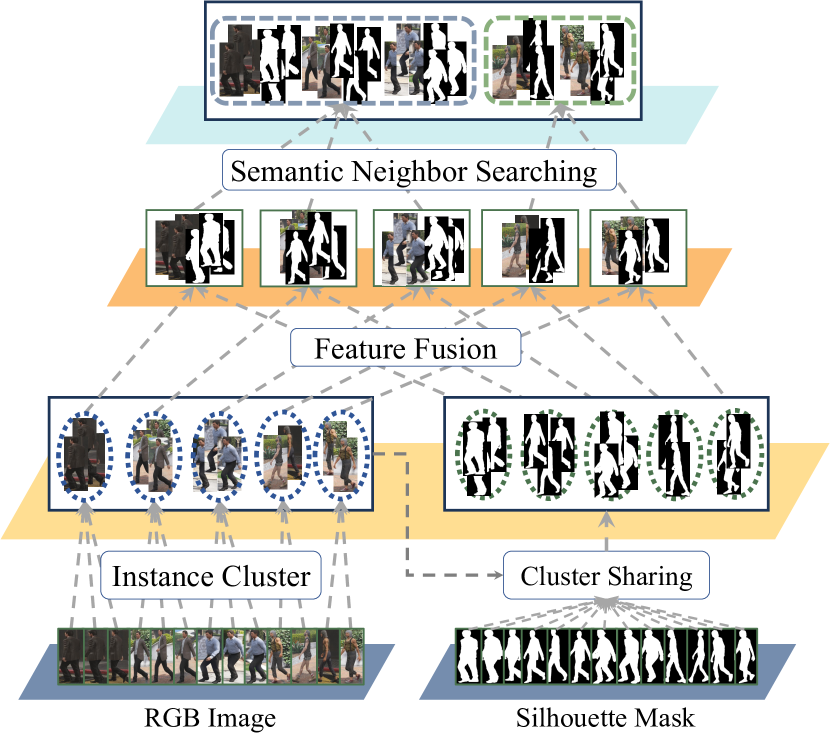
- MaskCL employs a two-branch network to extract RGB and silhouette mask features, enabling joint learning of appearance and semantic structure.
- Silhouette masks are used as semantic prompts to guide contrastive learning, promoting invariance to clothing changes.
- A hierarchical semantic neighbor structure is constructed: instance-level clustering via RGB features and cluster-level neighbor discovery using combined RGB and mask features.
- The model trains using contrastive loss that encourages positive pairs (same identity) to be close in the feature space, with semantic neighbors from mask features guiding the learning.
- The framework uses a neighbor sampling strategy based on a semantic neighbor set to improve feature alignment across different clothing appearances.
- The method is trained end-to-end with a contrastive objective that leverages both RGB and mask-based semantic cues to minimize feature disparity due to clothes change.
Experimental results
Research questions
- RQ1Can unsupervised person re-identification models generalize to long-term scenarios with significant clothing changes?
- RQ2Can silhouette masks serve as effective semantic prompts to guide contrastive learning and improve cross-clothes invariance?
- RQ3Does a hierarchical semantic neighbor structure, combining RGB and mask features, lead to better feature learning than RGB-only clustering?
- RQ4How does the quality of extracted silhouette masks affect model performance in low- and high-quality datasets?
- RQ5Can an unsupervised method achieve performance close to supervised SOTA on real-world, unconstrained clothes-change benchmarks?
Key findings
- MaskCL achieves 61.7% mAP and 71.7% R-1 on VC-Clothes, outperforming the next best unsupervised method by over 2% in mAP.
- On the challenging Deepchange benchmark, MaskCL achieves 11.8% mAP and 39.7% R-1 with ResNet-50, surpassing the unsupervised SOTA SpCL (8.90% mAP).
- The model closes the performance gap to supervised SOTA, achieving 14.9% mAP on Deepchange with ViT-B16, compared to 14.9% for supervised ViT-B16.
- On VC-Clothes, using only mask features (without RGB) achieved the best result (63.4% mAP), indicating high-quality masks contain rich invariant information.
- Visualization shows MaskCL produces more precise matches than CACL, with fewer incorrect matches due to color similarity.
- The proportion of correct identity samples in semantic neighbor sets increases during training, confirming improved feature alignment and cluster consistency.
![Figure 2: Visualizing the intrinsic challenges in long-term person re-id with clothes change. We randomly selected $28$ images of a single individual from the Deepchange [ 48 ] dataset. It is clear that the differences in appearance across different clothes (rows) are much more significant than that](https://ar5iv.labs.arxiv.org/html/2305.13600/assets/x2.png)
Better researchstarts right now
From reading papers to final review, dramatically reduce your research time.
No credit card · Free plan available
This review was created by AI and reviewed by human editors.