
[Paper Review] SIGMA: Semantic-complete Graph Matching for Domain Adaptive Object Detection
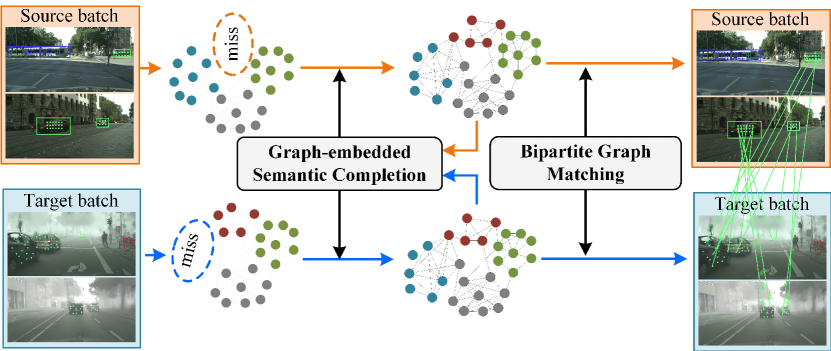
SIGMA proposes a semantic-complete graph matching framework for domain adaptive object detection that addresses within-class variance and domain-mismatched semantics by generating hallucinated graph nodes for missing categories and reformulating adaptation as a bipartite graph matching problem. It achieves state-of-the-art performance through graph-guided semantic completion and structure-aware node matching with a quadratic assignment loss.
Domain Adaptive Object Detection (DAOD) leverages a labeled domain to learn an object detector generalizing to a novel domain free of annotations. Recent advances align class-conditional distributions by narrowing down cross-domain prototypes (class centers). Though great success,they ignore the significant within-class variance and the domain-mismatched semantics within the training batch, leading to a sub-optimal adaptation. To overcome these challenges, we propose a novel SemantIc-complete Graph MAtching (SIGMA) framework for DAOD, which completes mismatched semantics and reformulates the adaptation with graph matching. Specifically, we design a Graph-embedded Semantic Completion module (GSC) that completes mismatched semantics through generating hallucination graph nodes in missing categories. Then, we establish cross-image graphs to model class-conditional distributions and learn a graph-guided memory bank for better semantic completion in turn. After representing the source and target data as graphs, we reformulate the adaptation as a graph matching problem, i.e., finding well-matched node pairs across graphs to reduce the domain gap, which is solved with a novel Bipartite Graph Matching adaptor (BGM). In a nutshell, we utilize graph nodes to establish semantic-aware node affinity and leverage graph edges as quadratic constraints in a structure-aware matching loss, achieving fine-grained adaptation with a node-to-node graph matching. Extensive experiments verify that SIGMA outperforms existing works significantly. Our code is available at https://github.com/CityU-AIM-Group/SIGMA.
Motivation & Objective
- Address the limitations of existing domain adaptive object detection methods that rely on handcrafted class centers and ignore within-class variance.
- Overcome domain-mismatched semantics in training batches where categories appear in only one domain.
- Reformulate domain adaptation as a graph matching problem to enable fine-grained, structure-aware alignment between source and target domains.
- Develop a semantic completion mechanism using hallucinated graph nodes to restore missing semantic knowledge in the target domain.
- Achieve better generalization by modeling class-conditional distributions through graphs rather than simplified prototypes.
Proposed method
- Introduce a Graph-embedded Semantic Completion (GSC) module that generates hallucinated graph nodes in missing categories using domain-level statistics.
- Perform vision-to-graph (V2G) transformation to convert features into graph nodes, followed by deep graph clustering (DNC) for semantic-complete node representation.
- Construct cross-image graphs for both source and target domains to model class-conditional distributions using graph convolutional networks (GCNs).
- Learn a graph-guided memory bank to enhance semantic completion capacity through iterative refinement.
- Propose a Bipartite Graph Matching (BGM) adaptor that solves a quadratic assignment problem using node affinity and edge structure as constraints.
- Formulate a structure-aware matching loss combining node affinity and edge consistency, optimized via Sinkhorn normalization and a differentiable assignment layer.
Experimental results
Research questions
- RQ1Can graph-based modeling of class-conditional distributions improve domain adaptation beyond prototype-based alignment?
- RQ2How can missing semantic categories in the target domain be effectively completed during training to reduce domain gap?
- RQ3Can fine-grained node-to-node matching across source and target graphs outperform global or category-level feature alignment?
- RQ4To what extent does incorporating structural constraints (edges) in graph matching improve adaptation robustness and accuracy?
- RQ5Does semantic completion via hallucinated nodes reduce bias from source-only supervision and improve generalization to unseen domains?
Key findings
- SIGMA achieves state-of-the-art performance on multiple domain adaptation benchmarks, including Cityscapes → Foggy Cityscapes and COCO → Cityscapes.
- The method significantly reduces false-negative and false-positive detection errors compared to class-agnostic baselines like EPM.
- The graph-guided memory bank improves semantic completion, especially in scenarios with high category imbalance.
- The structure-aware matching loss with edge constraints leads to more accurate node pairings, as visualized in the doubly stochastic affinity matrix.
- End-to-end training without warm-up achieves comparable performance to warm-up strategies, demonstrating training stability and efficiency.
- Ablation studies confirm that both semantic completion and graph matching components are essential, with the full SIGMA framework outperforming ablated variants.

Read this paper
Open the full text in the Nubint reader and ask about any passage as you read.
Read this paper on NubintThis review was generated by AI from the original paper. Please check the paper before citing it.