
[Paper Review] Significance-aware Information Bottleneck for Domain Adaptive Semantic Segmentation
This paper proposes SIBAN, a significance-aware information bottlenecked adversarial network that improves domain adaptive semantic segmentation by purifying features before adversarial adaptation. By filtering task-irrelevant factors and stabilizing training, SIBAN achieves state-of-the-art performance on GTA5→Cityscapes and SYNTHIA→Cityscapes, matching output-space methods while operating in the feature space.
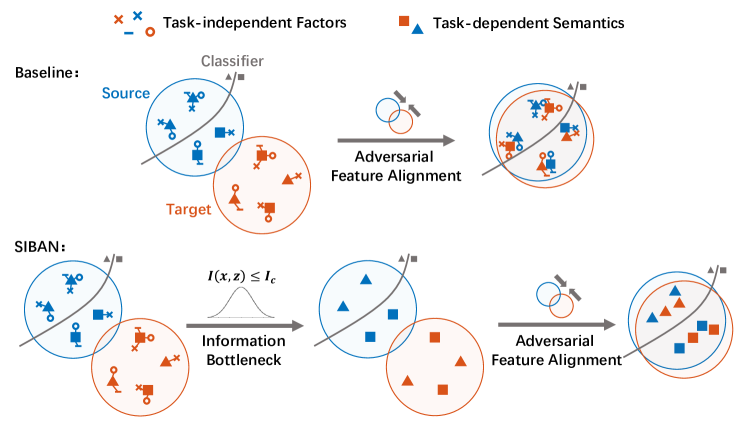
For unsupervised domain adaptation problems, the strategy of aligning the two domains in latent feature space through adversarial learning has achieved much progress in image classification, but usually fails in semantic segmentation tasks in which the latent representations are overcomplex. In this work, we equip the adversarial network with a "significance-aware information bottleneck (SIB)", to address the above problem. The new network structure, called SIBAN, enables a significance-aware feature purification before the adversarial adaptation, which eases the feature alignment and stabilizes the adversarial training course. In two domain adaptation tasks, i.e., GTA5 -> Cityscapes and SYNTHIA -> Cityscapes, we validate that the proposed method can yield leading results compared with other feature-space alternatives. Moreover, SIBAN can even match the state-of-the-art output-space methods in segmentation accuracy, while the latter are often considered to be better choices for domain adaptive segmentation task.
Motivation & Objective
- Address the instability and poor alignment in feature-space domain adaptation for semantic segmentation due to high-dimensional, complex features.
- Overcome the challenge of adversarial training instability caused by overly accurate discriminators misled by task-irrelevant visual factors.
- Reclaim the potential of feature-space adaptation by enabling effective, stable, and accurate domain alignment without relying on output-space supervision.
- Achieve performance on par with state-of-the-art output-space methods while remaining within the feature-space adaptation paradigm.
Proposed method
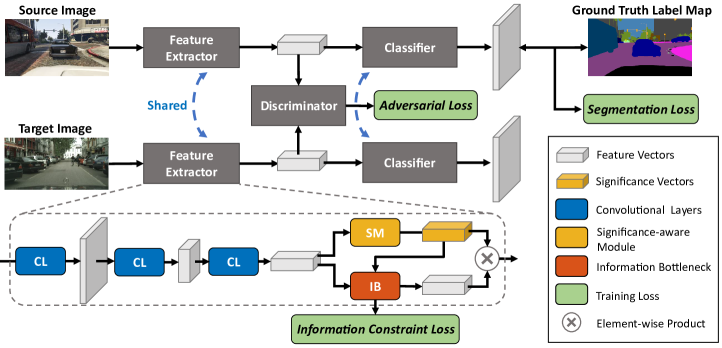
- Introduce a significance-aware information bottleneck (SIB) that selectively removes task-irrelevant, nuisance factors from latent features before adversarial adaptation.
- Apply information bottleneck theory to minimize mutual information I(X,Z) between input X and latent representation Z, preserving only domain-invariant semantic information.
- Design a learnable SIB module that dynamically adjusts feature purification based on significance, improving robustness and performance over standard IB.
- Integrate SIB into an adversarial network (SIBAN) to stabilize training by reducing excessive discriminator accuracy from irrelevant cues.
- Adopt an adaptive β strategy to balance the trade-off between information compression and semantic preservation during training.
- Combine SIBAN with other DA methods (e.g., significance or output map alignment) to further improve performance.
Experimental results
Research questions
- RQ1Can a significance-aware information bottleneck stabilize adversarial training in feature-space domain adaptation for semantic segmentation?
- RQ2Does filtering task-irrelevant factors improve feature alignment and segmentation accuracy in the presence of domain shift?
- RQ3Can feature-space adaptation match the performance of state-of-the-art output-space methods in domain adaptive semantic segmentation?
- RQ4How does the SIB module compare to standard information bottleneck in terms of training stability and segmentation accuracy?
- RQ5What is the contribution of adaptive β and additional discriminators in enhancing SIBAN's performance?
Key findings
- On the GTA5→Cityscapes benchmark with ResNet-101, SIBAN achieves 41.4% mean Intersection over Union (mIoU), matching the state-of-the-art output-space method.
- SIBAN outperforms other feature-space adaptation methods, achieving the highest mIoU among feature-space approaches on both GTA5→Cityscapes and SYNTHIA→Cityscapes.
- The introduction of SIB reduces the adversarial discriminator loss (Loss_D) toward 0.5, indicating stabilized training, whereas the baseline without IB shows rapid loss drop, signaling discriminator dominance.
- The A-distance metric confirms that SIBAN reduces domain discrepancy more effectively than standard IB, despite IB having a slightly smaller A-distance, due to better preservation of semantic information.
- Ablation studies show that adding the significance-aware (SA) layer improves standard IB by 1.5%, and adaptive β further boosts performance by 0.4%.
- Combining SIBAN with additional discriminators on significance tensors and segmentation maps yields further gains of 0.8% and 2.3% mIoU, respectively.
Read this paper
Open the full text in the Nubint reader and ask about any passage as you read.
Read this paper on NubintThis review was generated by AI from the original paper. Please check the paper before citing it.