
[Paper Review] SILO Language Models: Isolating Legal Risk In a Nonparametric Datastore
SILO combines a parametric LM trained on Open License Corpus with an inference-time nonparametric datastore containing high-risk data, enabling attribution and opt-out, and reducing performance gaps on out-of-domain data by leveraging the datastore.
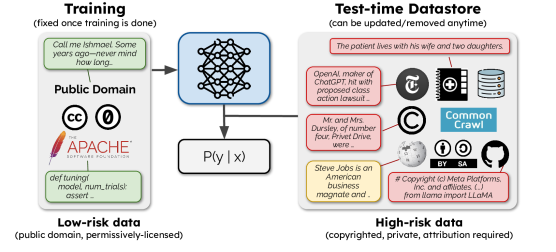
The legality of training language models (LMs) on copyrighted or otherwise restricted data is under intense debate. However, as we show, model performance significantly degrades if trained only on low-risk text (e.g., out-of-copyright books or government documents), due to its limited size and domain coverage. We present SILO, a new language model that manages this risk-performance tradeoff during inference. SILO is built by (1) training a parametric LM on Open License Corpus (OLC), a new corpus we curate with 228B tokens of public domain and permissively licensed text and (2) augmenting it with a more general and easily modifiable nonparametric datastore (e.g., containing copyrighted books or news) that is only queried during inference. The datastore allows use of high-risk data without training on it, supports sentence-level data attribution, and enables data producers to opt out from the model by removing content from the store. These capabilities can foster compliance with data-use regulations such as the fair use doctrine in the United States and the GDPR in the European Union. Our experiments show that the parametric LM struggles on domains not covered by OLC. However, access to the datastore greatly improves out of domain performance, closing 90% of the performance gap with an LM trained on the Pile, a more diverse corpus with mostly high-risk text. We also analyze which nonparametric approach works best, where the remaining errors lie, and how performance scales with datastore size. Our results suggest that it is possible to build high quality language models while mitigating their legal risk.
Motivation & Objective
- Address legal risk in LM training by separating low-risk training data from high-risk data
- Develop a two-component model: a parametric LM trained on permissively licensed text and a nonparametric datastore used at inference
- Enable sentence-level data attribution and data opt-out to align with data-use regulations
- Evaluate whether datastore retrieval can close performance gaps without training on high-risk data
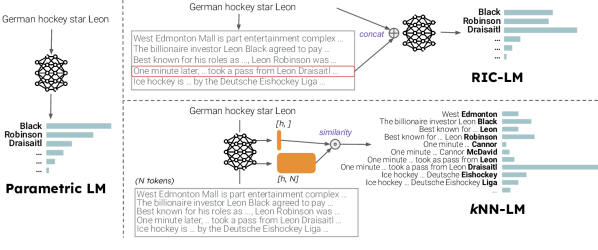
- Analyze which nonparametric method (kNN-LM vs RIC-LM) works best under domain shift
Proposed method
- Train 1.3B-parameter LLaMA-style LMs on the Open License Corpus (OLC) with varying license subsets (pd, sw, by)
- Construct a test-time nonparametric datastore containing high-risk data that is queried only during inference
- Evaluate two retrieval methods: k-nearest neighbors LM (kNN-LM) with interpolation and retrieval-in-context LM (RIC-LM)
- Compare parametric-only SILO against Pythia (Pile-trained baseline) on 14 domains for perplexity
- Allow datastore-based attribution and per-example opt-out for data producers
- Analyze datastore scaling effects and domain generalization implications
Experimental results
Research questions
- RQ1Can a nonparametric datastore containing high-risk data improve LM performance without training on that data?
- RQ2How do kNN-LM and RIC-LM compare in mitigating domain shift when used with a permissively trained parametric LM?
- RQ3To what extent can datastore size and retrieval method close the performance gap to a model trained on more diverse data like Pile?
- RQ4What are the attribution and opt-out capabilities provided by the datastore, and how do they support legal compliance?
- RQ5What challenges arise from extreme domain generalization when training on heavily skewed, permissive-license data?
Key findings
- Datastore-enhanced SILO dramatically improves out-of-domain performance compared to parametric-only models
- On average, SILO reduces the performance gap with Pythia by about 90% across domains
- Both kNN-LM and RIC-LM improve out-of-domain perplexity, with kNN-LM benefiting more from datastore scaling
- kNN-LM’s direct influence on output and robustness to domain shift drive its superior generalization
- The approach enables sentence-level attribution and per-example opt-out, aiding compliance with data-use regulations
- Performance approaches can be further improved by scaling datastore size and refining nonparametric methods
Read this paper
Open the full text in the Nubint reader and ask about any passage as you read.
Read this paper on NubintThis review was generated by AI from the original paper. Please check the paper before citing it.