
[Paper Review] SimCGNN: Simple Contrastive Graph Neural Network for Session-based Recommendation
This paper proposes SimCGNN, a simple contrastive graph neural network for session-based recommendation that addresses the 'same last-item confusion' problem and popularity bias. By introducing a contrastive learning module with a novel negative sampling strategy based on shared last items and normalizing session and item embeddings, SimCGNN achieves state-of-the-art performance on two real-world datasets, significantly outperforming prior methods in Recall@20 and MRR@20.
Session-based recommendation (SBR) problem, which focuses on next-item prediction for anonymous users, has received increasingly more attention from researchers. Existing graph-based SBR methods all lack the ability to differentiate between sessions with the same last item, and suffer from severe popularity bias. Inspired by nowadays emerging contrastive learning methods, this paper presents a Simple Contrastive Graph Neural Network for Session-based Recommendation (SimCGNN). In SimCGNN, we first obtain normalized session embeddings on constructed session graphs. We next construct positive and negative samples of the sessions by two forward propagation and a novel negative sample selection strategy, and then calculate the constructive loss. Finally, session embeddings are used to give prediction. Extensive experiments conducted on two real-word datasets show our SimCGNN achieves a significant improvement over state-of-the-art methods.
Motivation & Objective
- Address the 'same last-item confusion' problem in session-based recommendation, where models fail to distinguish sessions sharing the same last interacted item.
- Reduce popularity bias in recommendations by normalizing item and session embeddings to de-emphasize frequently interacted items.
- Improve representation learning of session embeddings through a contrastive learning framework that enhances discrimination between similar sessions.
- Design a novel negative sample selection strategy that leverages sessions with the same last item as negative pairs to increase embedding divergence.
- Demonstrate the effectiveness of positional embeddings and normalization in improving model generalization and fairness in recommendations.
Proposed method
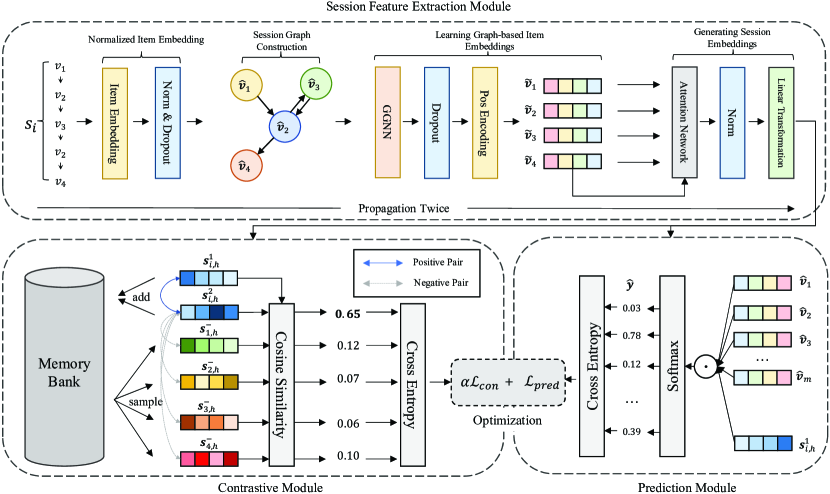
- Construct session graphs from user interaction sequences, where each node represents an item and edges represent sequential transitions.
- Apply graph neural networks (GNNs) to learn initial session embeddings through message passing on the session graph.
- Introduce a contrastive learning module that treats the original session embedding as a positive sample and sessions with the same last item as negative samples.
- Use dropout during forward passes to generate two views of the same session for contrastive learning, enhancing robustness and diversity in embeddings.
- Normalize both item and session embeddings using L2 normalization to suppress popularity bias and improve fairness in recommendations.
- Apply a final prediction head using the normalized session embedding to predict the next item in the sequence.
Experimental results
Research questions
- RQ1Can contrastive learning effectively reduce the 'same last-item confusion' problem in session-based recommendation?
- RQ2Does normalizing session and item embeddings significantly reduce popularity bias in recommendation results?
- RQ3How effective is the proposed negative sampling strategy—based on sessions sharing the same last item—compared to random negative sampling?
- RQ4To what extent does the inclusion of positional embeddings improve the performance of session graph models?
- RQ5Can the combination of contrastive learning and normalization lead to consistent improvements across different benchmark datasets?
Key findings
- SimCGNN outperforms state-of-the-art methods on both the Diginetica and Yoochoose 1/64 datasets, achieving a significant improvement in Recall@20 and MRR@20.
- The ablation study shows that removing the contrastive module (SimCGNN-Contrast) leads to a notable drop in performance, confirming its effectiveness in mitigating the same last-item confusion.
- Using random negative sampling (SimCGNN-WeakNeg) instead of same-last-item negative sampling results in worse ranking performance, validating the design of the proposed negative sampling strategy.
- Removing normalization (SimCGNN-Norm) severely degrades performance, indicating that normalization is crucial for reducing popularity bias and enabling effective contrastive learning.
- The removal of positional embeddings (SimCGNN-PE) significantly harms performance, especially on the Yoochoose 1/64 dataset, demonstrating the importance of modeling sequential order in sessions.
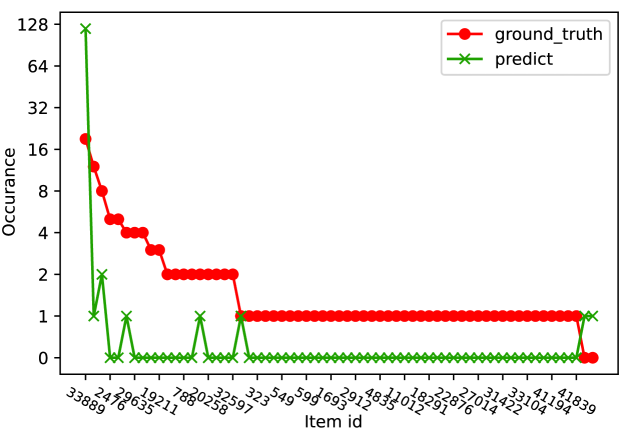
- The case study confirms that SimCGNN recommends 142 distinct items for sessions with the same last item (item 33889), compared to 122 by SR-GNN, proving its ability to generate diverse recommendations.
- The Average Recommendation Popularity (ARP) of SimCGNN is 2678.64 on Yoochoose 1/64 and 285.85 on Diginetica, significantly lower than SR-GNN’s 4128.54 and 495.25, respectively, confirming reduced popularity bias.
Read this paper
Open the full text in the Nubint reader and ask about any passage as you read.
Read this paper on NubintThis review was generated by AI from the original paper. Please check the paper before citing it.