
[Paper Review] Simfluence: Modeling the Influence of Individual Training Examples by Simulating Training Runs
Simfluence introduces a new paradigm for training data attribution (TDA) by modeling the influence of individual training examples not via scalar scores, but through a training run simulator that predicts loss trajectories on test examples under counterfactual training sequences. The proposed Simfluence-Linear method uses a Markov process to simulate these trajectories with high fidelity, outperforming existing TDA methods by doubling Spearman’s correlation and reducing mean-squared error by 75% in LLM fine-tuning tasks.
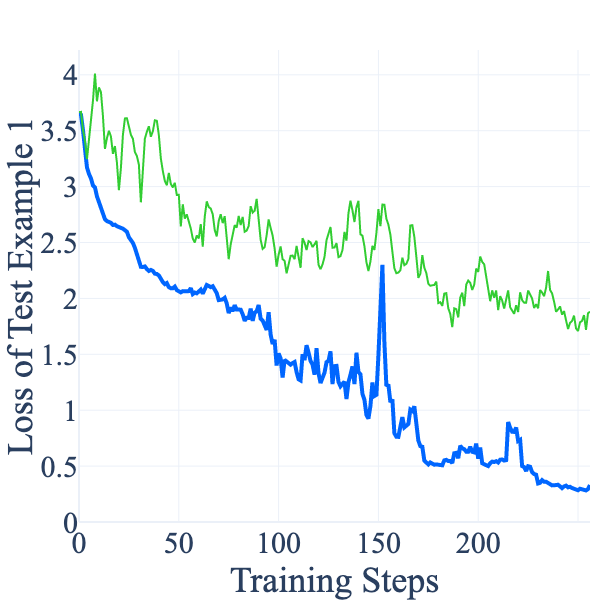
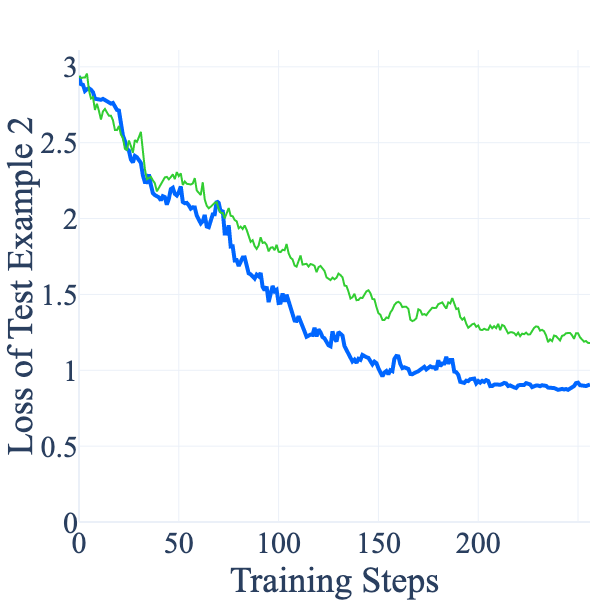
Training data attribution (TDA) methods offer to trace a model's prediction on any given example back to specific influential training examples. Existing approaches do so by assigning a scalar influence score to each training example, under a simplifying assumption that influence is additive. But in reality, we observe that training examples interact in highly non-additive ways due to factors such as inter-example redundancy, training order, and curriculum learning effects. To study such interactions, we propose Simfluence, a new paradigm for TDA where the goal is not to produce a single influence score per example, but instead a training run simulator: the user asks, ``If my model had trained on example $z_1$, then $z_2$, ..., then $z_n$, how would it behave on $z_{test}$?''; the simulator should then output a simulated training run, which is a time series predicting the loss on $z_{test}$ at every step of the simulated run. This enables users to answer counterfactual questions about what their model would have learned under different training curricula, and to directly see where in training that learning would occur. We present a simulator, Simfluence-Linear, that captures non-additive interactions and is often able to predict the spiky trajectory of individual example losses with surprising fidelity. Furthermore, we show that existing TDA methods such as TracIn and influence functions can be viewed as special cases of Simfluence-Linear. This enables us to directly compare methods in terms of their simulation accuracy, subsuming several prior TDA approaches to evaluation. In experiments on large language model (LLM) fine-tuning, we show that our method predicts loss trajectories with much higher accuracy than existing TDA methods (doubling Spearman's correlation and reducing mean-squared error by 75%) across several tasks, models, and training methods.
Motivation & Objective
- To address the limitations of existing TDA methods that assume additive influence, which fails to capture non-additive interactions like redundancy and curriculum effects.
- To enable users to simulate counterfactual training scenarios—such as changing training order or removing examples—by predicting how model loss on a test example would evolve.
- To develop a fast, interpretable simulator that captures complex training dynamics while remaining computationally efficient.
- To subsume existing TDA methods like TracIn and influence functions as special cases, enabling direct comparison via simulation accuracy.
- To improve interpretability of model behavior by modeling how influence accumulates over time in response to specific training sequences.
Proposed method
- Proposes a new TDA paradigm where the output is a training run simulator that predicts the time series of test loss across a simulated training sequence.
- Introduces Simfluence-Linear, a Markov-based simulator that models loss trajectory evolution using two learnable parameters per training example: $A_i$ and $B_i$, capturing influence and decay effects.
- Models the loss at each step as a function of cumulative influence from previously seen examples, using a linear combination of influence scores with exponential decay.
- Derives the simulator’s dynamics using a time-series formulation where the predicted loss at step $t$ depends on the sum of past influences weighted by decay factors.
- Demonstrates that TracIn and influence functions emerge as special cases of Simfluence-Linear under specific assumptions, enabling unified evaluation.
- Trains the simulator on observed training runs to learn parameters $A_i$ and $B_i$ for each example, enabling fast inference in milliseconds.
Experimental results
Research questions
- RQ1Can a training run simulator predict loss trajectories on test examples with higher accuracy than scalar influence scores?
- RQ2How well can a Markov-based simulator capture non-additive interactions such as redundancy and curriculum effects in model training?
- RQ3To what extent do existing TDA methods like TracIn and influence functions fail to model real training dynamics due to their additive influence assumption?
- RQ4Can the Simfluence paradigm enable accurate simulation of counterfactual training scenarios, such as reordering or removing training examples?
- RQ5How does the simulation accuracy of Simfluence-Linear compare to prior TDA methods across diverse LLM fine-tuning tasks?
Key findings
- Simfluence-Linear reduces mean-squared error in loss trajectory prediction by 75% compared to existing TDA methods across multiple LLM fine-tuning tasks.
- The method doubles Spearman’s correlation between predicted and actual loss trajectories, indicating significantly improved predictive accuracy.
- Simfluence-Linear successfully captures spiky, non-smooth loss trajectories that reflect real training dynamics, including sudden changes due to example exposure.
- Existing TDA methods such as TracIn and influence functions are formally subsumed as special cases of Simfluence-Linear, enabling direct benchmarking.
- The simulator runs in milliseconds per prediction, making it practical for interactive analysis of training dynamics.
- The approach reveals that many loss fluctuations in real training are predictable and not random, demonstrating the simulator’s understanding of example-level influence.
Read this paper
Open the full text in the Nubint reader and ask about any passage as you read.
Read this paper on NubintThis review was generated by AI from the original paper. Please check the paper before citing it.