
[Paper Review] SimMIM: A Simple Framework for Masked Image Modeling
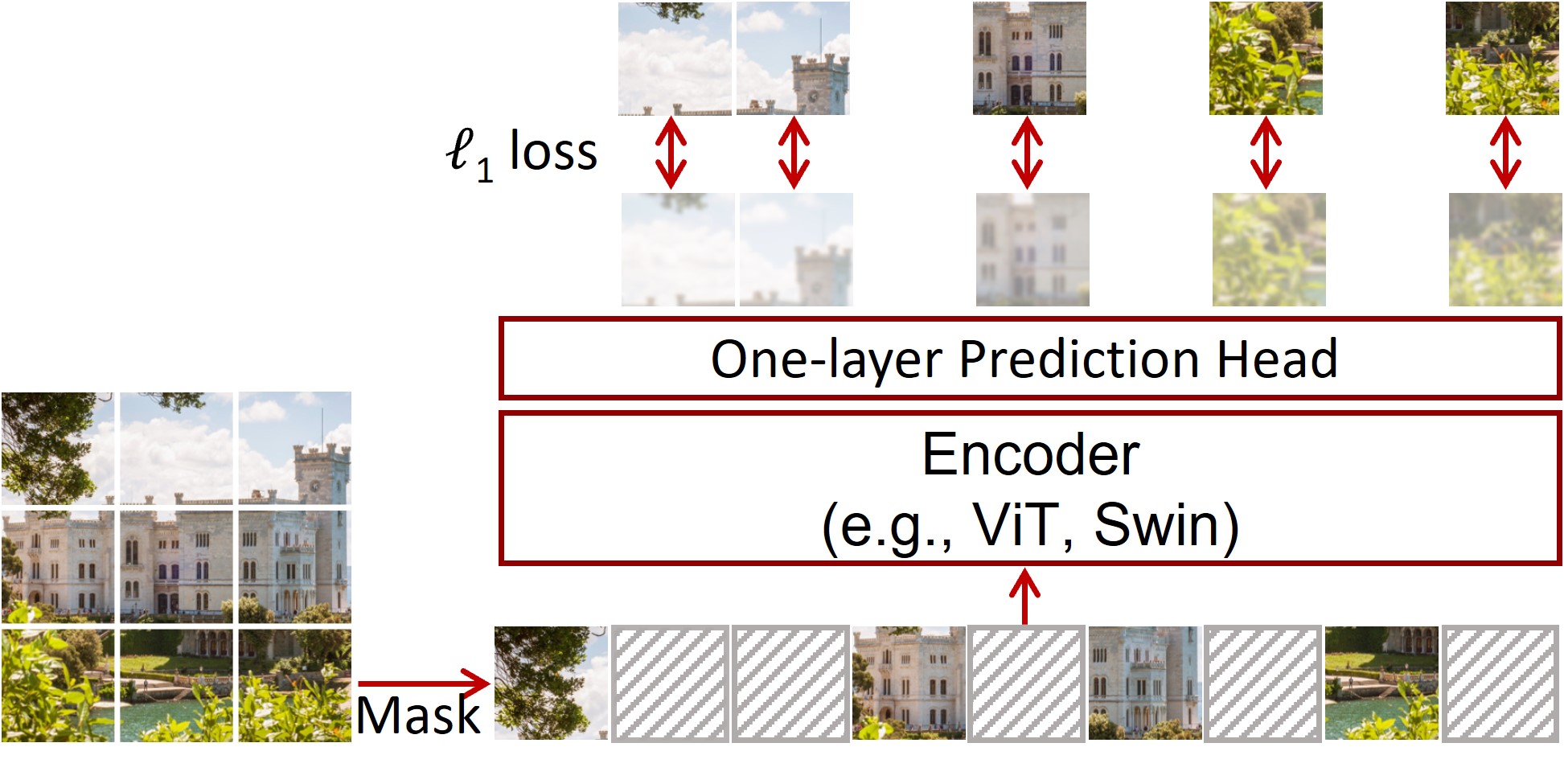
SimMIM proposes a simple masked image modeling framework that achieves state-of-the-art performance by randomly masking image patches and regressing raw pixel values using a lightweight linear head with ℓ₁ loss. On ImageNet-1K, it achieves 83.8% top-1 accuracy with ViT-B and 87.1% with SwinV2-H, outperforming prior methods while eliminating complex designs like discrete VAEs or block-wise masking.
This paper presents SimMIM, a simple framework for masked image modeling. We simplify recently proposed related approaches without special designs such as block-wise masking and tokenization via discrete VAE or clustering. To study what let the masked image modeling task learn good representations, we systematically study the major components in our framework, and find that simple designs of each component have revealed very strong representation learning performance: 1) random masking of the input image with a moderately large masked patch size (e.g., 32) makes a strong pre-text task; 2) predicting raw pixels of RGB values by direct regression performs no worse than the patch classification approaches with complex designs; 3) the prediction head can be as light as a linear layer, with no worse performance than heavier ones. Using ViT-B, our approach achieves 83.8% top-1 fine-tuning accuracy on ImageNet-1K by pre-training also on this dataset, surpassing previous best approach by +0.6%. When applied on a larger model of about 650 million parameters, SwinV2-H, it achieves 87.1% top-1 accuracy on ImageNet-1K using only ImageNet-1K data. We also leverage this approach to facilitate the training of a 3B model (SwinV2-G), that by $40 imes$ less data than that in previous practice, we achieve the state-of-the-art on four representative vision benchmarks. The code and models will be publicly available at https://github.com/microsoft/SimMIM.
Motivation & Objective
- To simplify masked image modeling by removing complex components like discrete VAEs, clustering, or block-wise masking.
- To investigate whether simple designs—random masking, raw pixel regression, and lightweight heads—can yield strong representation learning.
- To evaluate the effectiveness of SimMIM across diverse vision tasks and model scales, including data-efficient training.
- To demonstrate that minimal design choices can match or exceed performance of more complex self-supervised methods.
Proposed method
- Randomly mask image patches using a fixed patch size (e.g., 32×32) and a masking ratio between 10% and 70%.
- Predict the original RGB pixel values of masked patches via direct regression using a lightweight one-layer feedforward head.
- Train the model using a simple ℓ₁ loss between predicted and ground-truth pixel values.
- Use Vision Transformers (ViT, Swin) and ResNets as backbones to evaluate generalization across architectures.
- Apply multi-scale testing during inference and use standard data augmentation during pre-training.
- Evaluate on downstream tasks including ImageNet-1K classification, COCO detection, and ADE20K segmentation.
Experimental results
Research questions
- RQ1Does random masking with large patch sizes lead to effective representation learning in vision transformers?
- RQ2Can direct regression of raw pixel values outperform classification-based masked modeling with complex tokenization?
- RQ3Is a minimal prediction head (e.g., linear layer) sufficient for strong transfer performance?
- RQ4How does SimMIM scale across model sizes and data regimes, especially with limited labeled data?
- RQ5What is the impact of masking strategy (e.g., AvgDist to nearest visible pixels) on downstream performance?
Key findings
- SimMIM achieves 83.8% top-1 accuracy on ImageNet-1K using ViT-B, surpassing the previous SOTA by +0.6%.
- With SwinV2-H (658M parameters), SimMIM reaches 87.1% top-1 accuracy on ImageNet-1K using only ImageNet-1K data.
- A 3B-parameter SwinV2-G model trained with SimMIM achieves SOTA performance on four vision benchmarks using 40× less labeled data than prior methods.
- A linear prediction head outperforms deeper heads (e.g., inverse Swin-T) by +0.4% on ImageNet-1K and +0.6% on ADE20K, indicating simplicity enhances generalization.
- Raw pixel regression with ℓ₁ loss performs as well as or better than binarized or clustered classification targets, even with 8–256 color bins.
- An average distance (AvgDist) of ~15 pixels between masked and visible patches correlates strongly with optimal performance, suggesting a balance between local context and global structure.

Read this paper
Open the full text in the Nubint reader and ask about any passage as you read.
Read this paper on NubintThis review was generated by AI from the original paper. Please check the paper before citing it.