
[Paper Review] Simple Contrastive Representation Learning for Time Series Forecasting
SimTS learns to predict future latent representations from history without negative pairs, achieving strong multivariate forecasting performance across benchmarks. It challenges conventional contrastive learning assumptions for time series forecasting.
Contrastive learning methods have shown an impressive ability to learn meaningful representations for image or time series classification. However, these methods are less effective for time series forecasting, as optimization of instance discrimination is not directly applicable to predicting the future state from the historical context. To address these limitations, we propose SimTS, a simple representation learning approach for improving time series forecasting by learning to predict the future from the past in the latent space. SimTS exclusively uses positive pairs and does not depend on negative pairs or specific characteristics of a given time series. In addition, we show the shortcomings of the current contrastive learning framework used for time series forecasting through a detailed ablation study. Overall, our work suggests that SimTS is a promising alternative to other contrastive learning approaches for time series forecasting.
Motivation & Objective
- Question the necessity of negative pairs and heavy augmentation in contrastive learning for forecasting.
- Propose a simple siamese framework that predicts future latent representations from history.
- Show that maximizing history-to-future predictive information improves forecasting across diverse time-series datasets.
- Demonstrate robustness and generalizability of SimTS compared to existing contrastive methods.
Proposed method
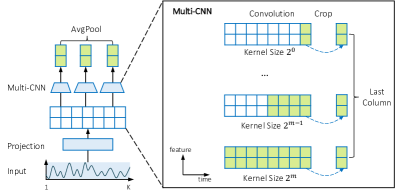
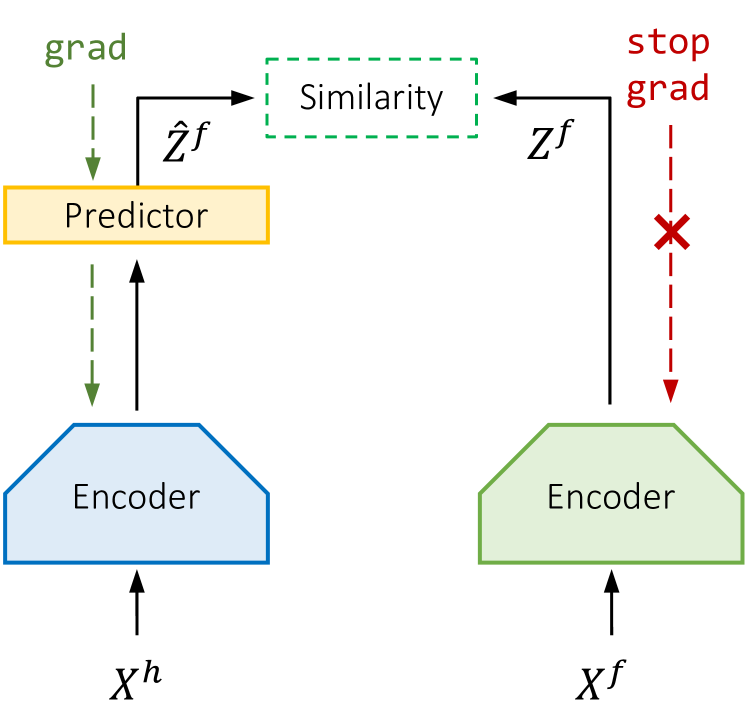
- Use a siamese encoder F_theta to map history X^h and future X^f to latent representations Z^h and Z^f.
- Predict the latent future rom the history latent: 1Z^f = G_phi(z^h_K) using the last history latent column as input to a predictor MLP.
- Train with a cosine similarity loss between the predicted future latent _hat and the encoded future Z^f, using stop-gradient on Z^f to avoid encoder collapse.
- Employ a multi-scale convolutional encoder with kernel sizes 2^i to capture local and global temporal patterns and average their outputs.
- Do not rely on negative examples; rather, treat the predicted future and encoded future as a positive pair to maximize shared information for forecasting.
Experimental results
Research questions
- RQ1Can predictive latent matching between history and future outperform traditional contrastive instance discrimination for time series forecasting?
- RQ2What architectural choices (backbone, multi-scale encoding) and training mechanisms (stop-gradient) best support forecasting in a self-supervised setting?
- RQ3How do negative samples and augmentation strategies affect forecasting performance in contrastive-based time series methods?
- RQ4Is SimTS robust and generalizable across diverse univariate and multivariate forecasting datasets?
Key findings
- SimTS achieves state-of-the-art or competitive forecasting performance on multiple real-world multivariate datasets compared to recent representation-learning baselines.
- Removing negative samples generally improves performance, highlighting issues with current negative-pair constructions in time series contrastive learning.
- Stop-gradient on the future encoding path is crucial for optimal performance; reversing it or removing it hurts results.
- A convolutional encoder with multi-scale kernels outperforms TCN and LSTM backbones in this setup.
- Ablation studies show that relaxing season-trend disentanglement assumptions can impact performance depending on dataset stationarity.
Read this paper
Open the full text in the Nubint reader and ask about any passage as you read.
Read this paper on NubintThis review was generated by AI from the original paper. Please check the paper before citing it.