
[Paper Review] Simplified and Generalized Masked Diffusion for Discrete Data
This paper proposes a simplified and generalized masked diffusion framework for discrete data, reformulating the variational objective as a weighted integral of cross-entropy losses, enabling efficient training and state-of-the-art performance. It achieves SOTA results on text and image modeling, surpassing prior discrete diffusion models in likelihood and zero-shot transfer, with 2.78 and 3.42 bits/dim on CIFAR-10 and ImageNet 64×64 respectively.
Masked (or absorbing) diffusion is actively explored as an alternative to autoregressive models for generative modeling of discrete data. However, existing work in this area has been hindered by unnecessarily complex model formulations and unclear relationships between different perspectives, leading to suboptimal parameterization, training objectives, and ad hoc adjustments to counteract these issues. In this work, we aim to provide a simple and general framework that unlocks the full potential of masked diffusion models. We show that the continuous-time variational objective of masked diffusion models is a simple weighted integral of cross-entropy losses. Our framework also enables training generalized masked diffusion models with state-dependent masking schedules. When evaluated by perplexity, our models trained on OpenWebText surpass prior diffusion language models at GPT-2 scale and demonstrate superior performance on 4 out of 5 zero-shot language modeling tasks. Furthermore, our models vastly outperform previous discrete diffusion models on pixel-level image modeling, achieving 2.75 (CIFAR-10) and 3.40 (ImageNet 64x64) bits per dimension that are better than autoregressive models of similar sizes. Our code is available at https://github.com/google-deepmind/md4.
Motivation & Objective
- To address the complexity and suboptimal design of existing masked diffusion models for discrete data.
- To unify and clarify the relationship between different continuous-time formulations of masked diffusion.
- To simplify the training objective and improve model performance through a principled variational formulation.
- To enable state-dependent masking schedules for generalized masked diffusion models.
- To achieve state-of-the-art performance on discrete sequence and image modeling benchmarks.
Proposed method
- Reformulates the Evidence Lower Bound (ELBO) for masked diffusion as a weighted integral of cross-entropy losses over time.
- Derives a continuous-time limit of the discrete masking process using a time-reversal framework.
- Introduces a signal-to-noise ratio parameterization that preserves invariance properties similar to continuous-space diffusion.
- Proposes a generalized masked diffusion model with state-dependent masking schedules to improve modeling flexibility.
- Uses a continuous-time forward process with transition matrices that probabilistically mask states to the absorbing state.
- Employs a time-reversed generative process to model data distribution via denoising from the mask state.
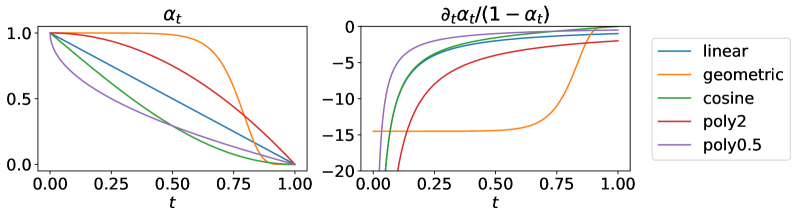
Experimental results
Research questions
- RQ1How can the variational objective of masked diffusion models be simplified and made more interpretable?
- RQ2What is the relationship between different continuous-time formulations of masked diffusion in the literature?
- RQ3Can a unified and simpler training objective improve performance on discrete data generation tasks?
- RQ4How does state-dependent masking improve modeling capacity and likelihood in discrete diffusion?
- RQ5Can masked diffusion achieve SOTA performance comparable to autoregressive models on text and image tasks?
Key findings
- The ELBO for masked diffusion is equivalent to a time-weighted integral of cross-entropy losses, simplifying training and interpretation.
- The proposed framework unifies prior approaches and identifies issues such as high variance and inconsistent forward-reverse processes.
- On GPT-2 scale text modeling, the model achieves superior perplexity and zero-shot performance compared to prior discrete diffusion models.
- On CIFAR-10 and ImageNet 64×64, the model achieves 2.78 and 3.42 bits/dim respectively, matching or exceeding autoregressive models of similar size.
- The generalized masked diffusion model with state-dependent masking further improves test likelihood, demonstrating the benefit of adaptive scheduling.
- The method enables efficient training with reduced complexity and improved sample quality across diverse discrete data types.

Read this paper
Open the full text in the Nubint reader and ask about any passage as you read.
Read this paper on NubintThis review was generated by AI from the original paper. Please check the paper before citing it.