
[Paper Review] Simplifying Low-Light Image Enhancement Networks with Relative Loss Functions
This paper proposes FLW-Net, a lightweight low-light image enhancement network that simplifies model architecture by leveraging two relative loss functions—L_brightness and L_structure—based on comparative feature learning. By replacing absolute reference supervision with relative comparisons, the method reduces the one-to-many problem, enabling high-quality enhancement with significantly fewer parameters and faster inference, achieving SOTA performance on benchmark datasets with up to 95% fewer parameters.
Image enhancement is a common technique used to mitigate issues such as severe noise, low brightness, low contrast, and color deviation in low-light images. However, providing an optimal high-light image as a reference for low-light image enhancement tasks is impossible, which makes the learning process more difficult than other image processing tasks. As a result, although several low-light image enhancement methods have been proposed, most of them are either too complex or insufficient in addressing all the issues in low-light images. In this paper, to make the learning easier in low-light image enhancement, we introduce FLW-Net (Fast and LightWeight Network) and two relative loss functions. Specifically, we first recognize the challenges of the need for a large receptive field to obtain global contrast and the lack of an absolute reference, which limits the simplification of network structures in this task. Then, we propose an efficient global feature information extraction component and two loss functions based on relative information to overcome these challenges. Finally, we conducted comparative experiments to demonstrate the effectiveness of the proposed method, and the results confirm that the proposed method can significantly reduce the complexity of supervised low-light image enhancement networks while improving processing effect. The code is available at \url{https://github.com/hitzhangyu/FLW-Net}.
Motivation & Objective
- To address the challenge of designing a lightweight, high-performance low-light image enhancement network.
- To overcome the one-to-many problem in supervised low-light enhancement, where no absolute reference exists for pixel-wise supervision.
- To simplify network architecture by replacing complex components with an efficient global feature extraction module.
- To improve enhancement quality in contrast, color fidelity, and noise reduction without increasing model complexity.
- To enable real-time application by drastically reducing parameter count while maintaining or improving performance.
Proposed method
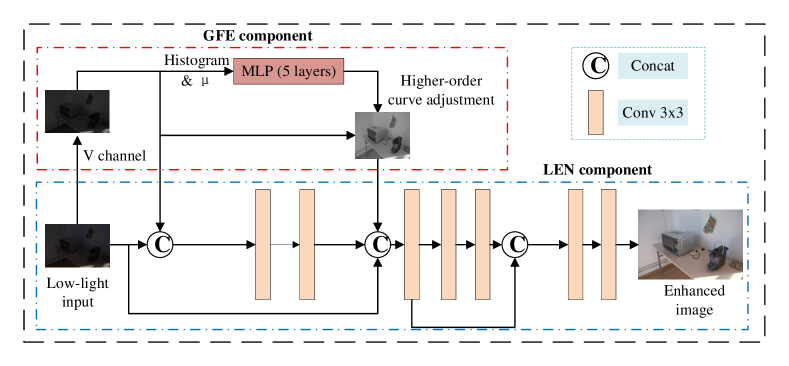
- Proposes FLW-Net, a lightweight network with a Global Feature Extraction (GFE) component that uses histogram-based global information and higher-order curve adjustment for brightness correction.
- Introduces two relative loss functions: L_brightness, which compares brightness levels between image patches to guide global contrast adjustment; and L_structure, which enforces structural similarity between patches to preserve details.
- L_brightness and L_structure are designed to achieve optimal performance when the enhanced image and reference are similar in relative features, not exact pixel values.
- The relative losses reduce dependency on absolute ground-truth values, mitigating the one-to-many problem in low-light enhancement.
- The GFE module efficiently captures global context with minimal computational cost, enabling a compact network structure.
- The method is compatible with existing architectures, such as RetinexNet and KIND, where it improves performance when added to their training loss.
Experimental results
Research questions
- RQ1Can a lightweight network achieve SOTA performance in low-light image enhancement by simplifying the architecture and loss design?
- RQ2Can relative loss functions effectively replace absolute supervision in low-light enhancement, reducing the one-to-many problem?
- RQ3Does global feature extraction via histogram-based curve adjustment outperform standard global modeling in lightweight networks?
- RQ4Can the proposed losses improve color fidelity, contrast, and noise reduction without increasing model complexity?
- RQ5To what extent can parameter count be reduced while maintaining or improving enhancement quality?
Key findings
- FLW-Net achieves SOTA performance on the LOL-V1 dataset with only 0.43M parameters, a 95% reduction compared to the original KIND method.
- When combined with DecomNet in KIND, the proposed relative losses improve PSNR from 15.68 to 18.94 and SSIM from 0.50 to 0.80, with a 95% reduction in parameters.
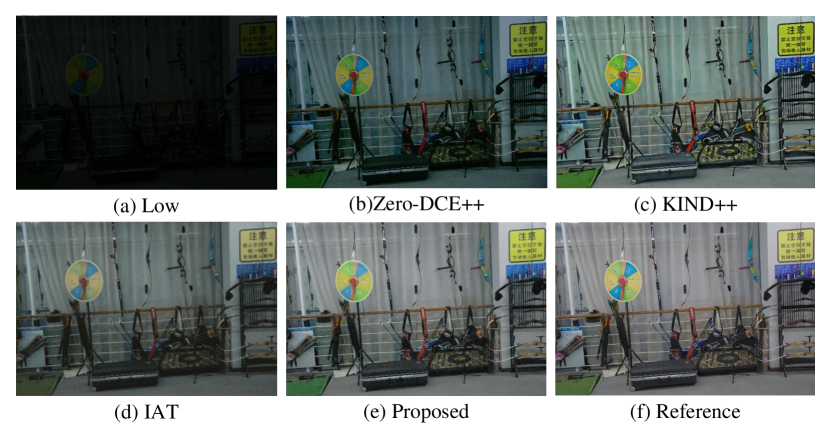
- The visual results show that the enhanced images are closest to the reference in color accuracy, outperforming Zero-DCE++ and KIND++.
- The combination of L_brightness and L_structure with RetinexNet improves detail preservation and noise suppression, as shown in zoomed-in comparisons.
- The method maintains high performance across diverse low-light conditions, including severe noise and color deviation.
- The relative losses enable effective training without requiring exact pixel-level ground truth, making the method more robust to ambiguous supervision.
Read this paper
Open the full text in the Nubint reader and ask about any passage as you read.
Read this paper on NubintThis review was generated by AI from the original paper. Please check the paper before citing it.