
[Paper Review] Simplifying Transformer Blocks
The paper presents simplified transformer blocks (SAS and SAS-P) that remove skip connections, value/projection matrices, sequential sub-blocks, and even normalisation layers, achieving training-speed and throughput on par with or better than standard Pre-LN transformers while reducing parameters by up to ~16% and increasing throughput by around ~15-16%.
A simple design recipe for deep Transformers is to compose identical building blocks. But standard transformer blocks are far from simple, interweaving attention and MLP sub-blocks with skip connections & normalisation layers in precise arrangements. This complexity leads to brittle architectures, where seemingly minor changes can significantly reduce training speed, or render models untrainable. In this work, we ask to what extent the standard transformer block can be simplified? Combining signal propagation theory and empirical observations, we motivate modifications that allow many block components to be removed with no loss of training speed, including skip connections, projection or value parameters, sequential sub-blocks and normalisation layers. In experiments on both autoregressive decoder-only and BERT encoder-only models, our simplified transformers emulate the per-update training speed and performance of standard transformers, while enjoying 15% faster training throughput, and using 15% fewer parameters.
Motivation & Objective
- Motivate the need to simplify standard Transformer blocks due to training instability and architectural brittleness.
- Investigate which components (skip connections, value/projection matrices, sequential sub-blocks, normalisation) are essential for training speed and performance.
- Develop progressively simplified block variants guided by signal propagation theory and empirical evidence.
- Demonstrate that simplified blocks can match or exceed standard Transformer training speed and performance across autoregressive and encoder-only models.
- Quantify efficiency and scalability gains at various depths and on downstream tasks (e.g., GLUE).
Proposed method
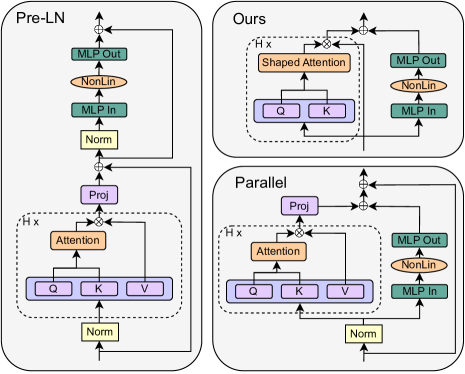
- Start from the Pre-LN transformer block and remove components one by one guided by signal propagation and experiments.
- Fix or remove value and projection matrices in self-attention to identity to recover per-update speed.
- Reparameterise or downweight residual components to mimic skip connections’ benefits without actual skips.
- Adopt parallel MHA and MLP sub-blocks to enable parallelization and reduce sequential dependency (SAS-P).
- Optionally remove normalisation layers and evaluate impact, while keeping SAS and SAS-P with normalisation as main baselines.
- Evaluate on decoder-only GPT-like models and encoder-only BERT setups, including GLUE fine-tuning, and compare against Pre-LN baselines.
Experimental results
Research questions
- RQ1Can key components of the standard Transformer block (skip connections, value/projection matrices, sequential sub-blocks, normalisation) be removed without hurting per-update training speed?
- RQ2Do identity initialisation and constrained updates to certain matrices mitigate speed losses in skipless attention blocks?
- RQ3Can parallelizing MHA and MLP blocks (parallel blocks) sustain or improve training throughput while preserving performance?
- RQ4Do simplified blocks scale to deeper architectures and transfer to encoder-only models and downstream tasks like GLUE?
Key findings
- Skip connections in the attention sub-block can be removed with proper initialisation (Shaped Attention) and downweighting of the MLP path to preserve training speed.
- Fixing or removing value and projection matrices to identity maintains or improves per-update training speed, allowing substantial parameter and FLOP reductions.
- Removing the MLP skip connection is feasible when combined with parallel sub-blocks, enabling SAS-P which matches Pre-LN training speed with fewer parameters.
- The SAS and SAS-P blocks can match or exceed Pre-LN training speed in terms of runtime, with about 13% fewer parameters and up to ~16% throughput gains.
- Depth scaling shows the simplified blocks benefit from deeper architectures and extend to encoder-only setups (BERT) and GLUE fine-tuning, maintaining performance.
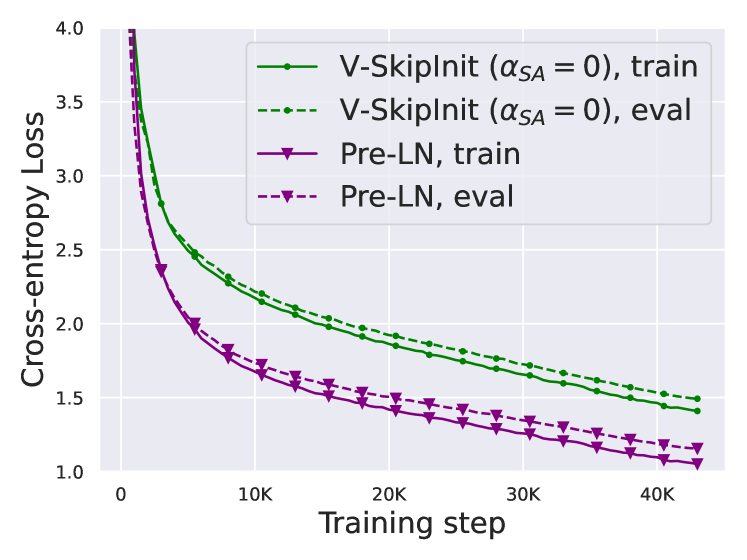
- GLUE results indicate SAS and SAS-P match baseline performance with reduced parameter counts and higher throughput; V-SkipInit lags in per-update speed and scalability.
Read this paper
Open the full text in the Nubint reader and ask about any passage as you read.
Read this paper on NubintThis review was generated by AI from the original paper. Please check the paper before citing it.