
[Paper Review] SimRIS Channel Simulator for Reconfigurable Intelligent Surface-Empowered Communication Systems
This paper proposes SimRIS, an open-source, physically accurate mmWave channel simulator for reconfigurable intelligent surface (RIS)-empowered communication systems. It models RIS-assisted links with free-space path loss, specular reflection, and practical propagation effects, demonstrating that RIS significantly boosts achievable rates in LOS-dominated indoor and outdoor scenarios when both Tx-RIS and RIS-Rx links are line-of-sight.
Reconfigurable intelligent surface (RIS)-assisted communication appears as one of the potential enablers for sixth generation (6G) wireless networks by providing a new way to optimize the communication system performance. This paper aims to fill an important gap in the open literature by providing an accurate, source, and widely applicable RIS channel model for mmWave frequencies. Our model is not only applicable in various indoor and outdoor environments but also includes the physical aspects of wireless propagation in the presence of an RIS as well as various practical 5G channel modeling issues. The open-source and comprehensive SimRIS Channel Simulator is also introduced in this paper to be used in computer simulations of RIS-assisted communication systems.
Motivation & Objective
- Address the lack of open, accurate, and widely applicable RIS channel models for mmWave frequencies in 6G research.
- Integrate RIS into state-of-the-art 5G channel models to reflect real-world propagation conditions.
- Provide a comprehensive, open-source simulation tool to support RIS-empowered system design and performance evaluation.
- Enable accurate modeling of RIS in both indoor and outdoor environments with realistic path loss and reflection effects.
- Facilitate future research by offering a testable, extensible platform for RIS channel modeling and experimental validation.
Proposed method
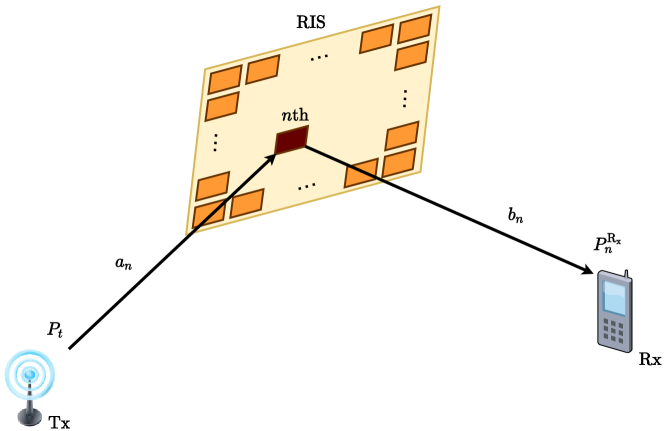
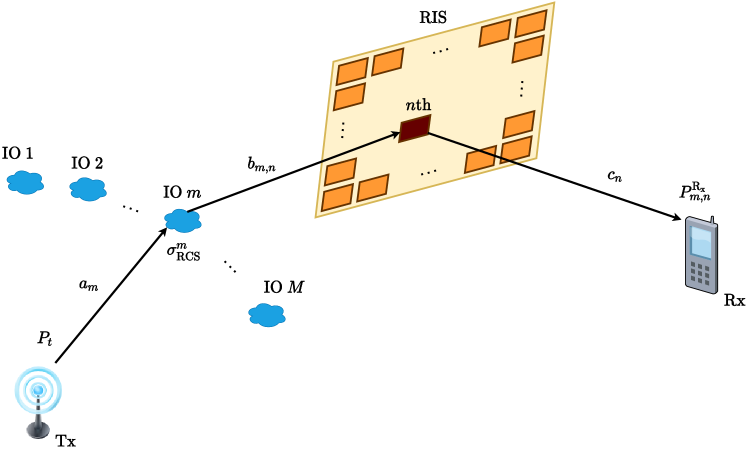
- Develop a baseline cascaded channel model incorporating free-space path loss and specular reflection for RIS-empowered links.
- Formulate power scaling laws for RIS-assisted systems with multiple scatterers and practical RIS element gains.
- Implement a MATLAB-based SimRIS Channel Simulator supporting tunable operating frequency, terminal and RIS positions, number of RIS elements, and environment types.
- Incorporate physical layer models including effective aperture, re-radiation efficiency, and distance-dependent path loss for both Tx-RIS and RIS-Rx links.
- Integrate error-checking mechanisms to validate input parameters and ensure simulation reliability.
- Use the simulator to generate numerical results under various indoor and outdoor scenarios, including LOS and non-LOS conditions.
Experimental results
Research questions
- RQ1How does RIS performance vary in indoor environments when both Tx-RIS and RIS-Rx links are line-of-sight versus non-line-of-sight?
- RQ2What is the impact of RIS height and placement on achievable rate in indoor scenarios with varying LOS probabilities?
- RQ3How does the presence or absence of a direct Tx-Rx link affect RIS performance in outdoor urban canyon environments?
- RQ4To what extent does the RIS improve spectral efficiency in mmWave bands under realistic propagation conditions?
- RQ5How does the distance between the RIS and receiver influence system performance when the direct link is blocked?
Key findings
- When both Tx-RIS and RIS-Rx links are line-of-sight (e.g., RIS at 2 m height), the achievable rate improves significantly, with gains observed in both indoor and outdoor scenarios.
- At a moderate RIS height of 1.5 m (lower LOS probability), the RIS provides only minor SNR improvement due to higher path loss in the RIS-assisted link.
- In outdoor urban canyon environments with blocked direct Tx-Rx links, the achievable rate drops sharply when the receiver moves far from the RIS, indicating that RIS-Rx distance is a critical performance factor.
- In scenarios with both direct and RIS-assisted links, the highest achievable rates are achieved when the receiver is near the transmitter, as the direct link dominates.
- The SimRIS simulator successfully models realistic mmWave propagation effects, including path loss and reflection, enabling accurate system-level simulations.
- The open-source SimRIS MATLAB package enables reproducible, flexible, and scalable simulations for RIS-empowered systems across diverse environments and configurations.
Read this paper
Open the full text in the Nubint reader and ask about any passage as you read.
Read this paper on NubintThis review was generated by AI from the original paper. Please check the paper before citing it.