
[Paper Review] Simulating Human Strategic Behavior: Comparing Single and Multi-agent LLMs
The paper compares single- and multi-agent LLM architectures (GPT-3.5/4) in simulating five-round ultimatum game strategies with greedy and fair personalities; multi-agent LLMs align with human behavior more often (up to 87.5%) than single LLMs (as low as 42.5%).
When creating policies, plans, or designs for people, it is challenging for designers to foresee all of the ways in which people may reason and behave. Recently, Large Language Models (LLMs) have been shown to be able to simulate human reasoning. We extend this work by measuring LLMs ability to simulate strategic reasoning in the ultimatum game, a classic economics bargaining experiment. Experimental evidence shows human strategic reasoning is complex; people will often choose to punish other players to enforce social norms even at personal expense. We test if LLMs can replicate this behavior in simulation, comparing two structures: single LLMs and multi-agent systems. We compare their abilities to (1) simulate human-like reasoning in the ultimatum game, (2) simulate two player personalities, greedy and fair, and (3) create robust strategies that are logically complete and consistent with personality. Our evaluation shows that multi-agent systems are more accurate than single LLMs (88 percent vs. 50 percent) in simulating human reasoning and actions for personality pairs. Thus, there is potential to use LLMs to simulate human strategic reasoning to help decision and policy-makers perform preliminary explorations of how people behave in systems.
Motivation & Objective
- Motivate design researchers to anticipate strategic human behavior when creating plans, policies, or applications for people.
- Evaluate whether LLM-based simulations can capture social norms and strategic reasoning in economic games.
- Compare single- vs multi-agent LLM architectures in generating complete, personality-consistent strategies and in gameplay.
- Assess robustness of strategies and identify common sources of simulation error.
Proposed method
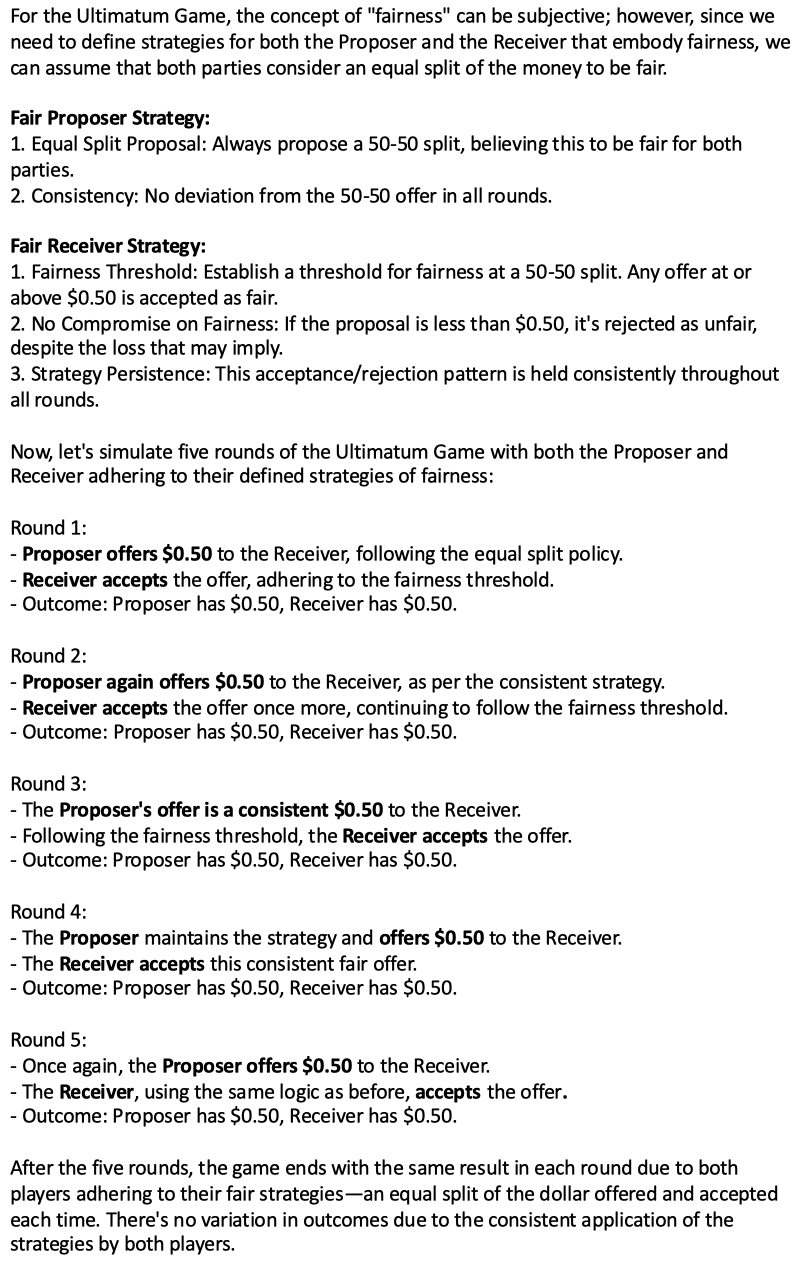
- Use five-round ultimatum game simulations with two personality types: greedy and fair.
- Implement two LLM architectures: a single GPT-4 prompting for both players, and a multi-agent setup with separate GPT-4 agents for proposer and receiver.
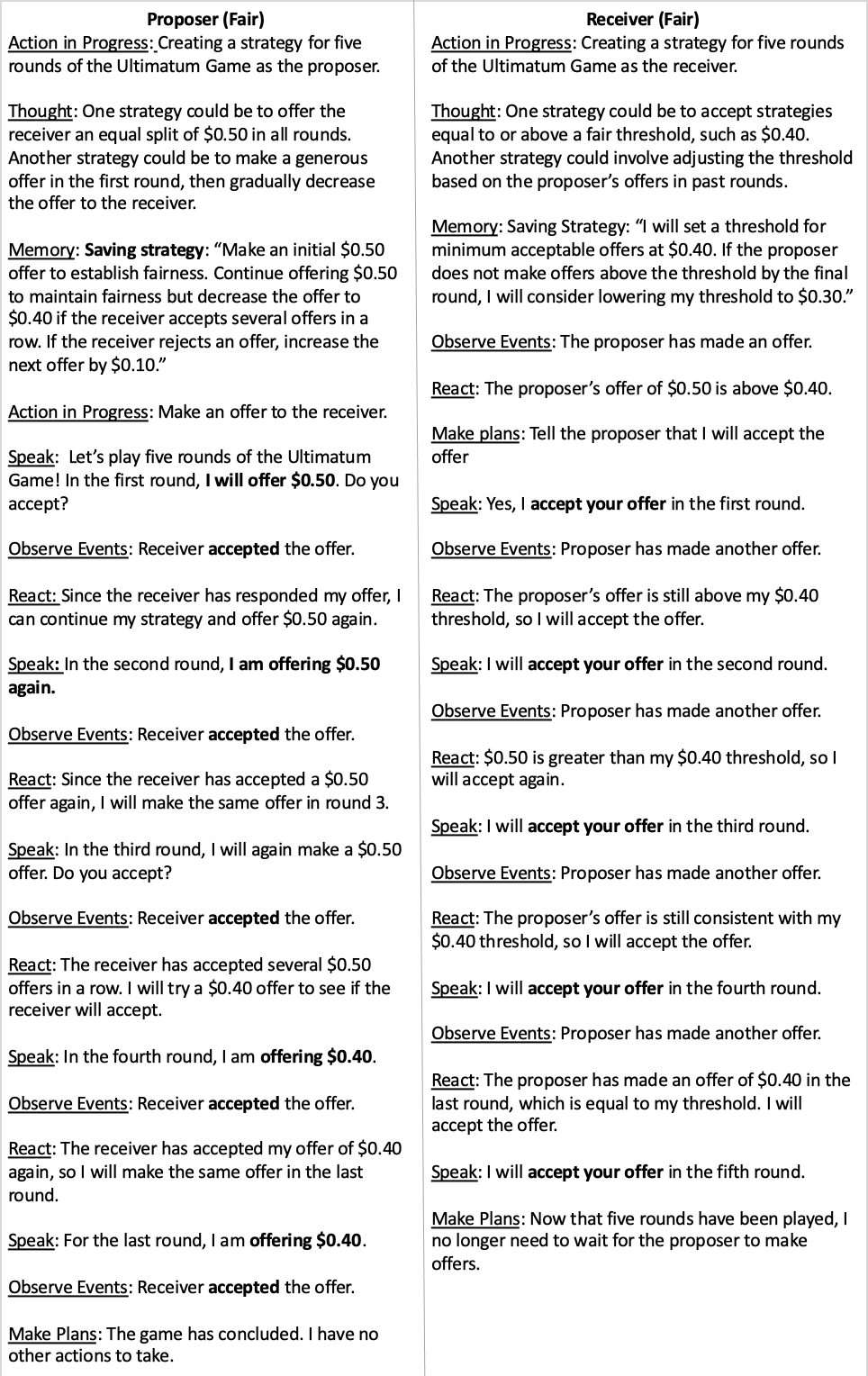
- Prompt designs task agents to create strategies and then play the game according to those strategies for five rounds.
- Evaluate outputs against human-baseline data extracted from economics literature on offers and accept/reject decisions.
- Analyze errors to distinguish strategy-generation issues from gameplay deviations.
- Test GPT-3.5 and GPT-4 across four architecture/personality combinations, totaling 40 simulations.
Experimental results
Research questions
- RQ1RQ1: Which architecture (single vs multi-agent) more accurately simulates human-like actions in the five-round ultimatum game?
- RQ2RQ2: Which architecture more accurately simulates actions corresponding to the two personality types (greedy and fair)?
- RQ3RQ3: Which architecture more often yields robust strategies that are complete and consistent with personality?
Key findings
- Multi-agent LLMs achieved higher consistency with human behavior (87.5% for the best setting) than single LLMs (as low as 42.5%).
- Across architectures, multi-agent setups produced human-like actions more reliably (MultiAgent-3.5: 82.5%; MultiAgent-4: 87.5%; SingleLLM-3.5: 42.5%; SingleLLM-4: 50%).
- Most errors in single-LLM simulations stemmed from strategy creation rather than gameplay (e.g., incomplete or personality-inconsistent strategies).
- In multi-agent simulations, errors were predominantly due to strategies inconsistent with personality, with higher alignment to intended personalities.
- Robustness analysis showed multi-agent configurations, especially MultiAgent-4, produced complete and personality-consistent strategies in a larger share of simulations (up to 87.5%).
- The study provides evidence that multi-agent LLM architectures can better mirror complex human strategic behavior and may aid designers in exploring policy or interface effects.
Read this paper
Open the full text in the Nubint reader and ask about any passage as you read.
Read this paper on NubintThis review was generated by AI from the original paper. Please check the paper before citing it.