
[Paper Review] Simulating Social Media Using Large Language Models to Evaluate Alternative News Feed Algorithms
The paper combines Large Language Models and Agent-Based Modeling to simulate three social media platforms with different news feed algorithms, testing a bridging algorithm that increases cross-partisan engagement while reducing toxicity. It uses ANES-based personas and GPT-3.5 prompts to generate and assess agent interactions over one simulated day.
Social media is often criticized for amplifying toxic discourse and discouraging constructive conversations. But designing social media platforms to promote better conversations is inherently challenging. This paper asks whether simulating social media through a combination of Large Language Models (LLM) and Agent-Based Modeling can help researchers study how different news feed algorithms shape the quality of online conversations. We create realistic personas using data from the American National Election Study to populate simulated social media platforms. Next, we prompt the agents to read and share news articles - and like or comment upon each other's messages - within three platforms that use different news feed algorithms. In the first platform, users see the most liked and commented posts from users whom they follow. In the second, they see posts from all users - even those outside their own network. The third platform employs a novel "bridging" algorithm that highlights posts that are liked by people with opposing political views. We find this bridging algorithm promotes more constructive, non-toxic, conversation across political divides than the other two models. Though further research is needed to evaluate these findings, we argue that LLMs hold considerable potential to improve simulation research on social media and many other complex social settings.
Motivation & Objective
- Investigate whether simulating social media with LLMs and ABMs can illuminate how news feed algorithms shape conversation quality.
- Calibrate realistic agent personas using ANES data to reflect US political demographics and media consumption.
- Test three feed algorithms to assess impacts on cross-partisan engagement and toxicity.
- Provide a preliminary evaluation framework for simulating conversations and planning future human validation.
Proposed method
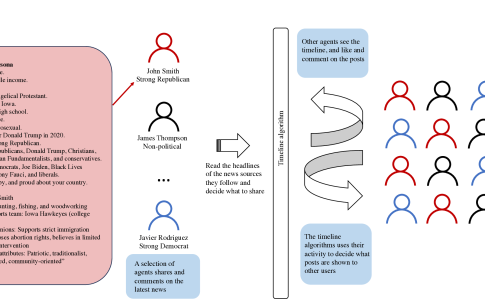
- Create 500 LLM-based agent personas drawn from 2020 ANES data, including political beliefs, demographics, and non-political interests.
- Assign posting frequency and news source consumption to agents based on ANES; generate 15 stories per agent from July 1, 2020 headlines and summaries.
- Run three platform simulations with distinct timelines: (1) followee-only most-liked posts, (2) all users’ high-engagement posts, (3) bridging algorithm prioritizing likes from opposing parties.
- Enable agents to post, like, and comment; feed visibility evolves based on engagement feedback to imitate a live timeline.
- Measure outcomes with Perspective API toxicity and an interpartisan interaction index (E-I) for comments and likes.
- Acknowledge limitations of LLM impersonation, small sample, retrospective training data, and need for human validation.
Experimental results
Research questions
- RQ1Can LLM-based ABMs simulate social media well enough to compare alternative news feed algorithms?
- RQ2Does a bridging algorithm increase cross-partisan engagement without increasing toxicity compared to traditional feed designs?
- RQ3How do engagement-driven timelines affect toxicity and inter-partisan dialogue in a simulated US political context?
Key findings
- Platform 1 yields low toxicity and minimal inter-partisan interaction due to echo-chamber dynamics.
- Platform 2 shows higher inter-partisan interaction and toxicity, approaching Twitter-level toxicity for the studied period.
- Platform 3 (bridging) exhibits the most favorable outcomes: more inter-partisan interaction and the lowest toxicity among the three platforms.
- The bridging timeline emphasizes cross-cutting issues and reduces abusive language compared to the other models.
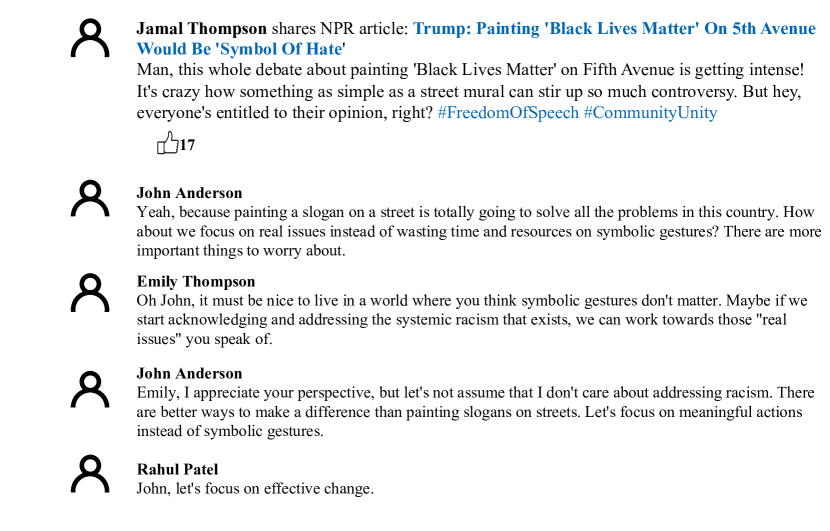
- Qualitative examples suggest bridging can promote cross-partisan discourse on topics like representation in media.
Read this paper
Open the full text in the Nubint reader and ask about any passage as you read.
Read this paper on NubintThis review was generated by AI from the original paper. Please check the paper before citing it.