
[Paper Review] Simulation study on the optical processes at deep-sea neutrino telescope sites
This paper presents a Geant4-based Monte Carlo simulation to model photon propagation in deep-seawater at the TRIDENT neutrino telescope site, validating its accuracy against in-situ T-REX experiment data. The simulation enables precise extraction of optical parameters—especially absorption and scattering lengths—by comparing PMT time-of-flight data and camera image intensity profiles, revealing that effective attenuation length measured by PMTs can be up to 40% higher than canonical values due to directional integration.
The performance of a large-scale water Cherenkov neutrino telescope relies heavily on the transparency of the surrounding water, quantified by its level of light absorption and scattering. A pathfinder experiment was carried out to measure the optical properties of deep seawater in South China Sea with light-emitting diodes (LEDs) as light sources, photon multiplier tubes (PMTs) and cameras as photon sensors. Here, we present an optical simulation program employing the Geant4 toolkit to understand the absorption and scattering processes in the deep seawater, which helps to extract the underlying optical properties from the experimental data. The simulation results are compared with the experimental data and show good agreements. We also verify the analysis methods that utilize various observables of the PMTs and the cameras with this simulation program, which can be easily adapted by other neutrino telescope pathfinder experiments and future large-scale detectors.
Motivation & Objective
- To develop a high-fidelity simulation of photon propagation in deep seawater to interpret in-situ optical measurements from the T-REX pathfinder experiment.
- To validate the simulation against experimental data from both PMTs (timing) and cameras (spatial intensity) to ensure accuracy in optical parameter extraction.
- To resolve discrepancies between canonical attenuation length (from camera central intensity) and effective attenuation length (from PMT photon counts) in neutrino telescope design.
- To provide a transferable simulation framework for future neutrino telescope pathfinders in deep-sea, lake, or glacial ice environments.
- To enable systematic calibration of optical properties using dual-sensor (PMT and camera) observables, reducing systematic errors through relative measurements.
Proposed method
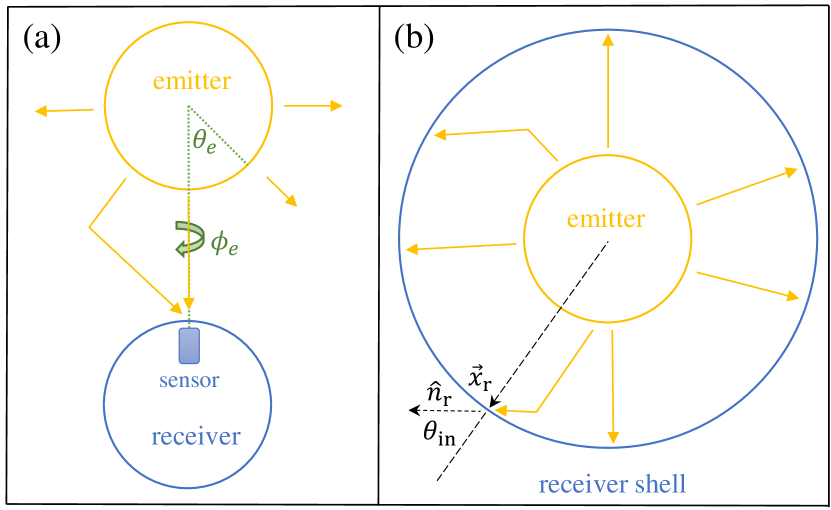
- Utilizes the Geant4 toolkit to simulate photon emission from LEDs in steady and pulsing modes, modeling isotropic emission via a double-layer diffuser.
- Implements wavelength-dependent absorption and scattering processes using a Mie scattering phase function parameterized by the Henyey-Greenstein model.
- Simulates photon propagation through deep seawater with variable absorption length (λ_a) and scattering length (λ_s), tracking position, direction, and time of flight.
- Reconstructs experimental observables: PMT time-of-flight distributions (ATD) and camera gray-value images from simulated photon trajectories.
- Applies geometric and angular reconstruction to map image pixel intensity to incident photon radiance, enabling comparison with camera data.
- Compares simulated PMT counts and ATD with experimental data to validate the simulation and extract optical parameters via fitting.
Experimental results
Research questions
- RQ1How accurately can a Geant4-based simulation reproduce the photon propagation behavior observed in the T-REX deep-sea pathfinder experiment?
- RQ2To what extent do PMT-measured effective attenuation lengths differ from camera-measured canonical attenuation lengths in the presence of scattering?
- RQ3Can the simulation reliably reconstruct both time-of-flight distributions (from PMTs) and spatial intensity profiles (from cameras) for validation against real data?
- RQ4How do geometric simplifications (e.g., ignoring glass interfaces) affect the simulation’s fidelity in predicting observable quantities?
- RQ5What is the impact of scattering on the relative sensitivity of PMTs and cameras to absorption and scattering lengths in deep seawater?
Key findings
- The simulation shows good agreement with experimental data for both PMT time-of-flight distributions and camera image intensity profiles across multiple distances.
- The effective attenuation length measured by PMTs—based on integrated photon counts over all directions—can be up to 40% larger than the canonical attenuation length derived from central pixel intensity in camera images.
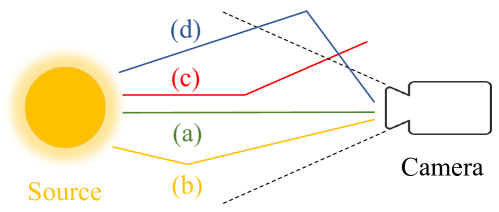
- The camera system is most sensitive to directly arriving photons and thus provides a robust measurement of canonical attenuation length via central image intensity.
- The PMT system, due to its angular-integrated response, is better suited for measuring scattering-dominated effective attenuation length, especially when combined with timing resolution.
- The simulation framework successfully reproduces the relative measurement strategy of T-REX, where differences in baseline distances cancel out systematic errors from optical interfaces.
- The simulation accounts for refractive interface effects (air-glass-water) and shows they do not alter the final image size observed by cameras, justifying their omission in the model.
Read this paper
Open the full text in the Nubint reader and ask about any passage as you read.
Read this paper on NubintThis review was generated by AI from the original paper. Please check the paper before citing it.