
[Paper Review] Singling out SO(10) GUT models using recent PTA results
This paper constructs realistic supersymmetric SO(10) Grand Unified Theories (GUTs) using only adjoint and fundamental Higgs representations to solve the doublet-triplet splitting problem without fine-tuning. It identifies a specific model with two adjoint Higgs fields that generates a metastable cosmic string network, producing a stochastic gravitational wave background consistent with recent pulsar timing array (PTA) results at nanohertz frequencies.
In this work, we construct promising model building routes towards SO(10) GUT inflation and examine their ability to explain the recent PTA results hinting at a stochastic gravitational wave (GW) background at nanohertz frequencies. We consider a supersymmetric framework within which the so-called doublet-triplet splitting problem is solved without introducing fine-tuning. Additionally, realistic fermion masses and mixings, gauge coupling unification, and cosmic inflation are incorporated by utilizing superfields with representations no higher than the adjoint representation. Among the three possible scenarios, two of these cases require a single adjoint Higgs field, and do not lead to cosmic strings. In contrast, the third scenario featuring two adjoints, can lead to a network of metastable cosmic strings that generates a GW background contribution compatible with the recent PTA findings and testable by various ongoing and upcoming GW observatories.
Motivation & Objective
- To construct realistic supersymmetric SO(10) GUT models that solve the doublet-triplet splitting problem without fine-tuning.
- To incorporate realistic fermion masses, gauge coupling unification, and cosmic inflation using only Higgs fields up to the adjoint representation.
- To identify model-building scenarios where cosmic strings can form and produce a stochastic gravitational wave background (SGWB) matching recent PTA observations.
- To determine which SO(10) GUT scenarios can produce a detectable SGWB via metastable cosmic strings, testable by upcoming gravitational wave observatories.
Proposed method
- Constructing SO(10) GUT models using Higgs fields in the 45H (adjoint) and 10H (fundamental) representations to break symmetry down to the SM.
- Employing a single adjoint Higgs field in two scenarios (proportional to B-L or I3R generators) and a two-adjoint scenario to explore symmetry breaking patterns.
- Analyzing the formation of topological defects—specifically cosmic strings—via the spontaneous breaking of U(1) symmetries in the intermediate scale.
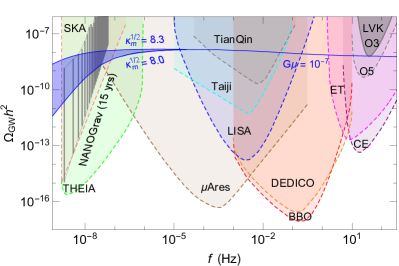
- Estimating the stochastic gravitational wave background (SGWB) from metastable cosmic strings using the formalism of Buchmüller et al. (2021), calibrated to PTA data.
- Assessing gauge coupling unification under the assumption of degenerate symmetry-breaking scales and 3 TeV SUSY breaking, with 1% uncertainty on gauge couplings.
- Evaluating proton decay constraints by suppressing d=6 operators via Yukawa sector tuning in the two-adjoint model.
Experimental results
Research questions
- RQ1Can realistic SO(10) GUT models with only adjoint and fundamental Higgs representations solve the doublet-triplet splitting problem without fine-tuning?
- RQ2Which SO(10) GUT model-building scenarios can produce a metastable cosmic string network capable of generating a stochastic gravitational wave background?
- RQ3Is the gravitational wave signal from such a cosmic string network consistent with the recent PTA results showing a common-spectrum noise at nanohertz frequencies?
- RQ4Can the proposed model achieve gauge coupling unification while maintaining realistic fermion masses and suppressing proton decay?
- RQ5Which upcoming gravitational wave observatories will be able to test the predicted SGWB signal from metastable cosmic strings?
Key findings
- The two-adjoint Higgs scenario leads to a network of metastable cosmic strings that generate a stochastic gravitational wave background consistent with recent PTA results.
- The model with two adjoint Higgs fields, breaking to a U(1) × U(1) intermediate group, allows for the formation of metastable cosmic strings with monopole and string formation scales nearly degenerate at ~10^9–10^17 GeV.
- The predicted gravitational wave signal from cosmic strings overlaps with the PTA data and lies at the edge of sensitivity for current and future observatories like LISA, Taiji, TianQin, and the SKA.
- The model achieves gauge coupling unification within a wide range of monopole/string formation scales (10^9–10^17 GeV), provided the GUT scale is above 10^16 GeV and the SUSY breaking scale is fixed at 3 TeV.
- The two-adjoint model requires suppression of d=6 proton decay via the Yukawa sector, making it less natural than the single-adjoint cases, but still viable.
- The single-adjoint models (B-L and I3R cases) lead to embedded strings that are generally unstable and thus do not produce a detectable SGWB, ruling them out as explanations for the PTA signal.
Read this paper
Open the full text in the Nubint reader and ask about any passage as you read.
Read this paper on NubintThis review was generated by AI from the original paper. Please check the paper before citing it.