
[Paper Review] Skeleton-based Human Action Recognition via Convolutional Neural Networks (CNN)
The paper shows CNNs can match state-of-the-art GCNs for skeleton-based action recognition when using proper training tricks, augmentations, and a margin-based cosine loss, achieving 95% on NTU-60.
Recently, there has been a remarkable increase in the interest towards skeleton-based action recognition within the research community, owing to its various advantageous features, including computational efficiency, representative features, and illumination invariance. Despite this, researchers continue to explore and investigate the most optimal way to represent human actions through skeleton representation and the extracted features. As a result, the growth and availability of human action recognition datasets have risen substantially. In addition, deep learning-based algorithms have gained widespread popularity due to the remarkable advancements in various computer vision tasks. Most state-of-the-art contributions in skeleton-based action recognition incorporate a Graph Neural Network (GCN) architecture for representing the human body and extracting features. Our research demonstrates that Convolutional Neural Networks (CNNs) can attain comparable results to GCN, provided that the proper training techniques, augmentations, and optimizers are applied. Our approach has been rigorously validated, and we have achieved a score of 95% on the NTU-60 dataset
Motivation & Objective
- Motivate skeleton-based action recognition as a computationally efficient modality with discriminative features.
- Explore whether CNNs can achieve competitive performance against GCN-based approaches in this domain.
- Evaluate the impact of diverse data augmentation and optimization strategies on generalization and robustness.
- Demonstrate that a margin-based cosine loss can enhance discriminative feature learning over traditional cross-entropy.
Proposed method
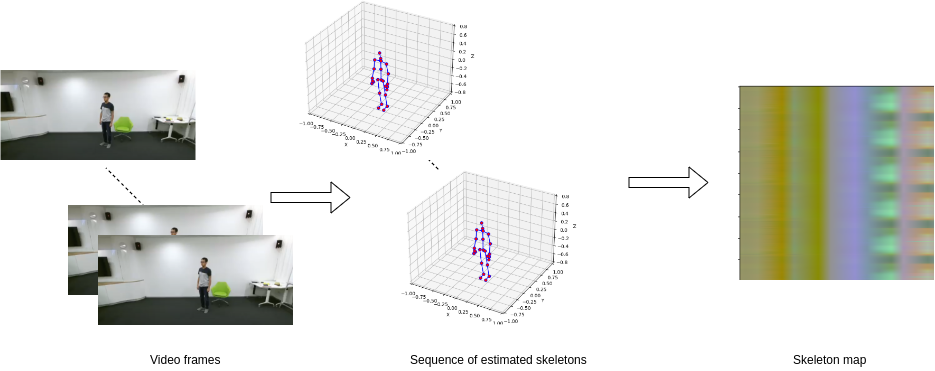
- Encode skeleton sequences into skeleton map images to enable CNN processing of spatiotemporal information.
- Apply diverse image-based and skeleton-based data augmentations inspired by RandAugment and pose-specific techniques.
- Use a margin-based cosine loss (AAML-inspired) instead of standard cross-entropy to increase inter-class separation.
- Experiment with optimizers (MadGrad) and learning-rate schedulers (Cosine Annealing + ReducedLR) to improve convergence and generalization.
- Regularization techniques (label smoothing, dropout, batch normalization, early stopping) to mitigate overfitting.
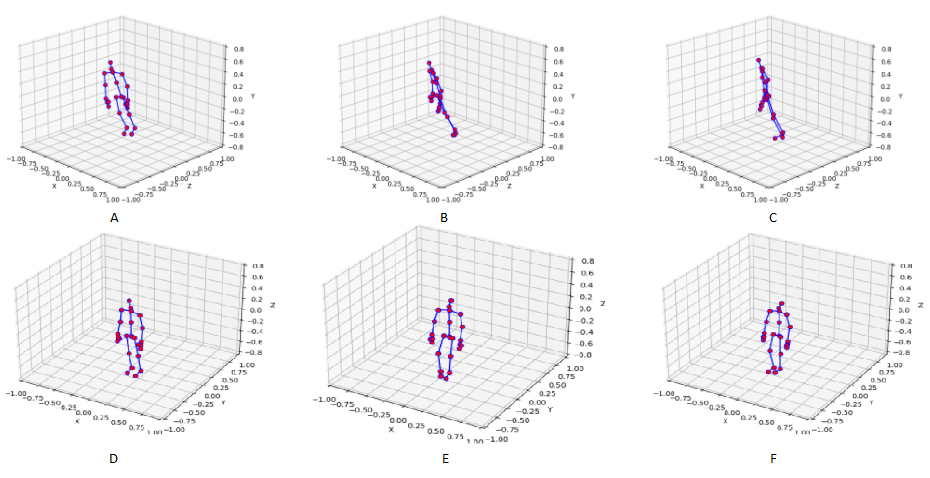
Experimental results
Research questions
- RQ1Can CNNs achieve competitive accuracy for skeleton-based action recognition compared to GCN-based methods when equipped with strong training and augmentation strategies?
- RQ2What impact do various augmentation techniques have on the generalization and robustness of CNN-based skeleton action recognizers?
- RQ3Does a margin-based cosine loss improve discriminative performance over cross-entropy in skeleton-based action recognition?
- RQ4What optimizer and learning-rate scheduling combinations yield the best performance for CNN-based skeleton action models?
Key findings
- CNN-based models with appropriate training tricks achieve state-of-the-art-like results comparable to GCN approaches on skeleton-based action recognition.
- Data augmentation (image-based and skeleton-based) significantly improves generalization and robustness across variations.
- Using a margin-based cosine loss (ArcFace-like) yields notable performance gains over cross-entropy loss.
- MadGrad optimizer with cosine annealing and ReducedLR schedulers enhance training stability and accuracy.
- Regularization techniques contribute to better generalization on unseen data.
Read this paper
Open the full text in the Nubint reader and ask about any passage as you read.
Read this paper on NubintThis review was generated by AI from the original paper. Please check the paper before citing it.