
[Paper Review] Sketch2Model: View-Aware 3D Modeling from Single Free-Hand Sketches
This paper proposes Sketch2Model, a view-aware 3D reconstruction method that generates high-quality 3D meshes from single free-hand sketches by explicitly conditioning generation on predicted or user-specified viewpoints. By disentangling view and shape features and using random view reinforced training, the model reduces ambiguity in sketch interpretation and achieves superior reconstruction quality and user intent alignment, especially on poorly-drawn sketches.
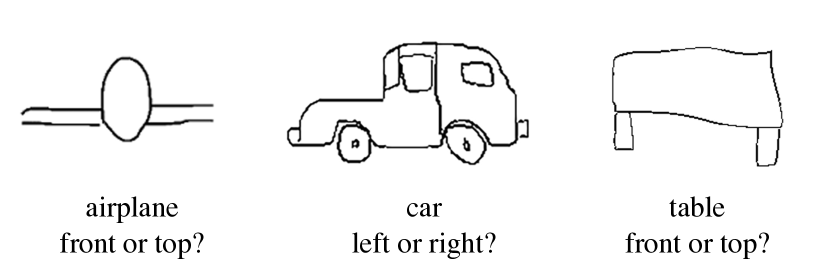
We investigate the problem of generating 3D meshes from single free-hand sketches, aiming at fast 3D modeling for novice users. It can be regarded as a single-view reconstruction problem, but with unique challenges, brought by the variation and conciseness of sketches. Ambiguities in poorly-drawn sketches could make it hard to determine how the sketched object is posed. In this paper, we address the importance of viewpoint specification for overcoming such ambiguities, and propose a novel view-aware generation approach. By explicitly conditioning the generation process on a given viewpoint, our method can generate plausible shapes automatically with predicted viewpoints, or with specified viewpoints to help users better express their intentions. Extensive evaluations on various datasets demonstrate the effectiveness of our view-aware design in solving sketch ambiguities and improving reconstruction quality.
Motivation & Objective
- To enable fast, intuitive 3D modeling for novice users using only a single free-hand sketch.
- To address the ambiguity in sketch-based 3D reconstruction caused by poor drawing quality, geometric distortions, and lack of visual cues.
- To improve reconstruction quality and user intent fidelity by explicitly conditioning the generation process on viewpoint information.
- To develop a method that generalizes well to out-of-distribution sketches, including real-world hand-drawn inputs.
- To bridge the domain gap between synthetic training sketches and real-world free-hand sketches using domain adaptation.
Proposed method
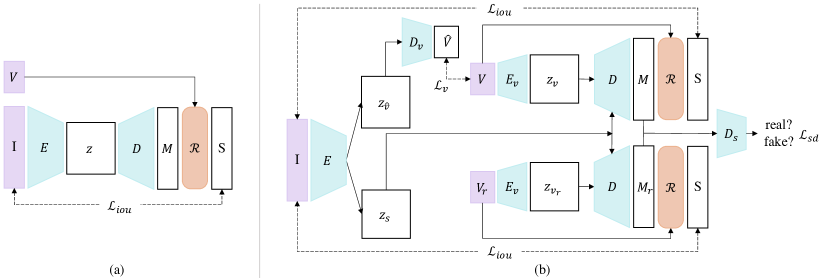
- The method uses a disentangled encoder-decoder architecture that separates latent features into a view code and a shape code.
- A view auto-encoder is trained to map viewpoints to and from the latent view space, ensuring that only viewpoint information is encoded in the view code.
- Random view reinforced training is introduced, where the decoder is fed both ground-truth and randomly sampled views during training to enforce view-conditioned generation.
- A shape discriminator is used to improve the realism and structural fidelity of generated 3D meshes.
- Multi-scale progressive training is applied to stabilize training and improve generation quality.
- Domain adaptation is applied using a domain discriminator to align synthetic training sketches with real free-hand sketches from datasets like Sketchy and Tu-Berlin.
Experimental results
Research questions
- RQ1Can viewpoint specification significantly reduce ambiguity in 3D reconstruction from single free-hand sketches?
- RQ2How does conditioning the generation process on viewpoint improve reconstruction quality and user intent alignment?
- RQ3To what extent can a view-aware architecture generalize to real-world, poorly-drawn sketches not seen during training?
- RQ4What training strategies are most effective for learning view-conditioned 3D generation from synthetic sketches?
- RQ5How effective is domain adaptation in bridging the gap between synthetic sketches and real free-hand sketches?
Key findings
- On the ShapeNet-Synthetic dataset, Sketch2Model achieves higher voxel IoU scores than baselines, especially when using ground-truth viewpoints, demonstrating the importance of view conditioning.
- Ablation studies show that random view reinforced training and shape discriminator significantly improve performance on both predicted and ground-truth views.
- With domain adaptation, performance on the real-world ShapeNet-Sketch dataset improves notably, particularly for airplane, car, and sofa categories.
- Qualitative results on Sketchy and Tu-Berlin datasets show that Sketch2Model generates meshes with better boundary alignment to input sketches and improved realism.
- The method balances sketch alignment and shape realism effectively, even for out-of-distribution shapes like distorted airplanes and tables.
- Projected silhouette comparisons confirm that view-aware generation leads to more accurate sketch-to-mesh correspondence than view-agnostic methods.
Read this paper
Open the full text in the Nubint reader and ask about any passage as you read.
Read this paper on NubintThis review was generated by AI from the original paper. Please check the paper before citing it.