
[Paper Review] Skywork: A More Open Bilingual Foundation Model
Skywork-13B is a bilingual 13B LLM trained on 3.2T tokens, released openly, with a two-stage training regime and strong Chinese language modeling, plus open benchmarks and data.
In this technical report, we present Skywork-13B, a family of large language models (LLMs) trained on a corpus of over 3.2 trillion tokens drawn from both English and Chinese texts. This bilingual foundation model is the most extensively trained and openly published LLMs of comparable size to date. We introduce a two-stage training methodology using a segmented corpus, targeting general purpose training and then domain-specific enhancement training, respectively. We show that our model not only excels on popular benchmarks, but also achieves \emph{state of the art} performance in Chinese language modeling on diverse domains. Furthermore, we propose a novel leakage detection method, demonstrating that test data contamination is a pressing issue warranting further investigation by the LLM community. To spur future research, we release Skywork-13B along with checkpoints obtained during intermediate stages of the training process. We are also releasing part of our SkyPile corpus, a collection of over 150 billion tokens of web text, which is the largest high quality open Chinese pre-training corpus to date. We hope Skywork-13B and our open corpus will serve as a valuable open-source resource to democratize access to high-quality LLMs.
Motivation & Objective
- Promote open-source transparency in LLM development by releasing Skywork-13B and intermediate checkpoints.
- Present a two-stage pre-training pipeline (general-purpose followed by domain-specific enhancement).
- Demonstrate strong Chinese language modeling and benchmarking performance across diverse domains.
- Provide data filtering and corpus construction details to enable reproducibility.
- Highlight data contamination concerns and propose leakage detection methods.
Proposed method
- Build SkyPile, a massive publicly accessible bialigned corpus emphasizing text quality and distribution.
- Two-stage pre-training: Stage-1 on SkyPile-Main for general knowledge, Stage-2 on SkyPile-STEM mixed with SkyPile-Main to inject in-domain STEM capability.
- Modify a Transformer-decoder architecture inspired by LLaMA (RoPE, RMSNorm, pre-normalization, SwiGLU, reduced FFN size).
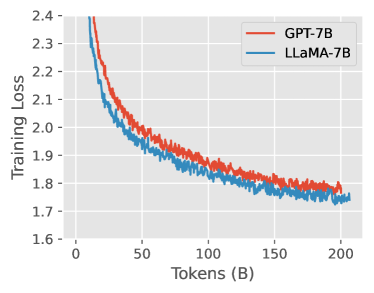
- Train with DP, PP, and ZeRO-1 on a 64-node A800 cluster using Megatron-LM, with Flash Attention V2 for efficiency.
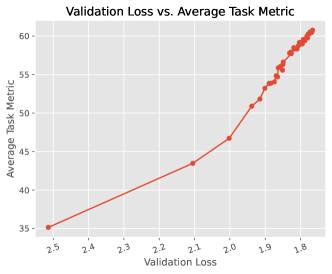
- Monitor training progress via cross-domain validation losses (multiple held-out sets) rather than sole training loss or single benchmarks.
- Release 150B+ token open Chinese corpus segment (SkyPile-150B) and intermediate checkpoints to aid reproducibility.
Experimental results
Research questions
- RQ1How does a two-stage, openly trained bilingual LLM perform on general language modeling and domain-specific tasks compared to peers of similar size?
- RQ2What is the impact of in-domain (STEM) continual pre-training on Chinese and overall STEM task performance?
- RQ3Can active monitoring using multi-domain validation losses serve as a reliable proxy for downstream performance during pre-training?
- RQ4What are the effects of architectural choices and hyperparameters (RoPE, RMSNorm, SwiGLU, FFN size) on model performance?
- RQ5What data contamination and leakage risks exist in large open corpora, and how can they be detected?
Key findings
- Skywork-13B achieves leading results on CEVAL (60.6) and MMLU (62.1) benchmarks among open 13B models.
- Skywork-13B attains 55.8 on GSM8K, outperforming several open models of similar size.
- On CMMLU, Baichuan2-13B leads (62.0), while Skywork-13B still delivers strong performance (61.8).
- In language-modeling-domain evaluation, Skywork-13B attains the lowest average perplexity (9.42) across diverse domains, including tech (11.58), movie (21.84), government (4.76), and finance (4.92).
- Stage-2 STEM-focused pre-training substantially boosts STEM-related capabilities and benchmarks (e.g., CEVAL, GSM8K) without destabilizing language modeling.
- Skywork-13B demonstrates exceptional Chinese language modeling strength, surpassing many open models and even larger closed models in Chinese-centric benchmarks.
Read this paper
Open the full text in the Nubint reader and ask about any passage as you read.
Read this paper on NubintThis review was generated by AI from the original paper. Please check the paper before citing it.