
[Paper Review] Slovo: Russian Sign Language Dataset
This paper introduces Slovo, a large-scale Russian Sign Language (RSL) video dataset comprising 20,000 FullHD videos from 194 signers, organized into 1,000 isolated gesture classes. The authors propose a crowdsourcing-based pipeline for data collection, validation, and temporal annotation, and demonstrate state-of-the-art performance using MViTv2-small on the dataset, achieving high accuracy in sign language recognition with 32 frames and a frame interval of 2.
One of the main challenges of the sign language recognition task is the difficulty of collecting a suitable dataset due to the gap between hard-of-hearing and hearing societies. In addition, the sign language in each country differs significantly, which obliges the creation of new data for each of them. This paper presents the Russian Sign Language (RSL) video dataset Slovo, produced using crowdsourcing platforms. The dataset contains 20,000 FullHD recordings, divided into 1,000 classes of isolated RSL gestures received by 194 signers. We also provide the entire dataset creation pipeline, from data collection to video annotation, with the following demo application. Several neural networks are trained and evaluated on the Slovo to demonstrate its teaching ability. Proposed data and pre-trained models are publicly available.
Motivation & Objective
- To address the scarcity of diverse, high-quality RSL datasets by creating a large-scale, publicly available video dataset.
- To bridge the gap between hearing and hard-of-hearing communities through scalable data collection using crowdsourcing platforms.
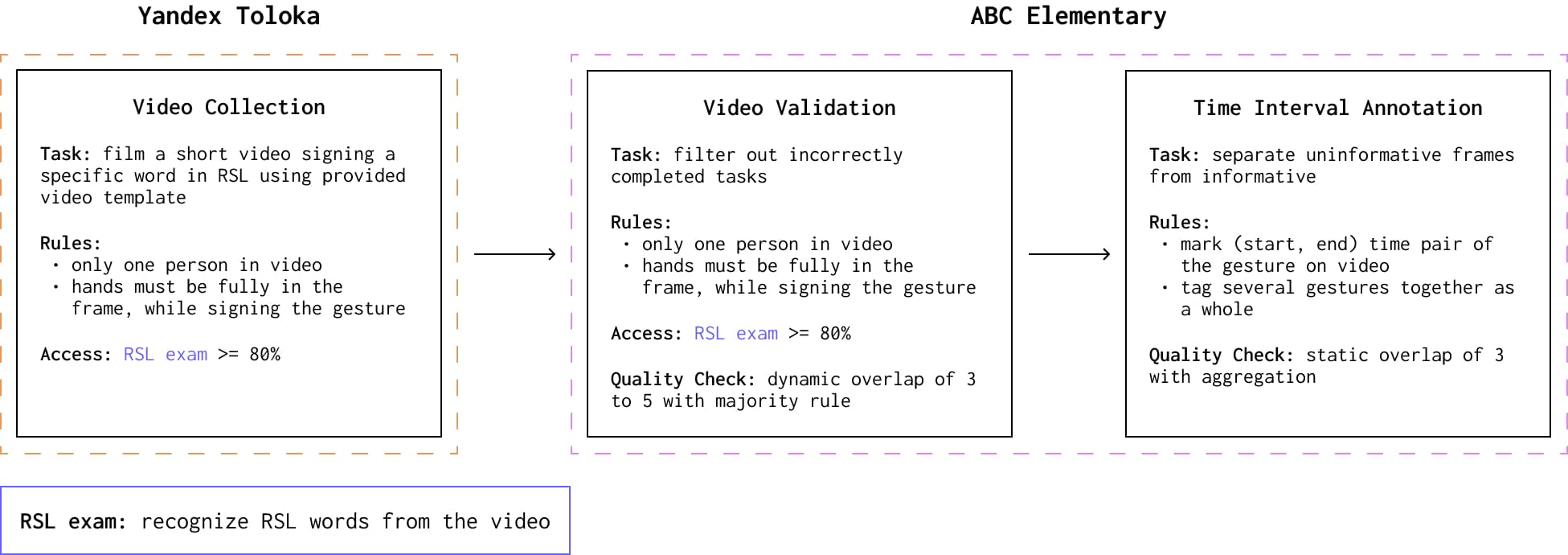
- To develop a reproducible pipeline for collecting, validating, and annotating sign language videos to ensure data quality and diversity.
- To enable robust training and evaluation of sign language recognition models on a native Russian sign language benchmark.
Proposed method
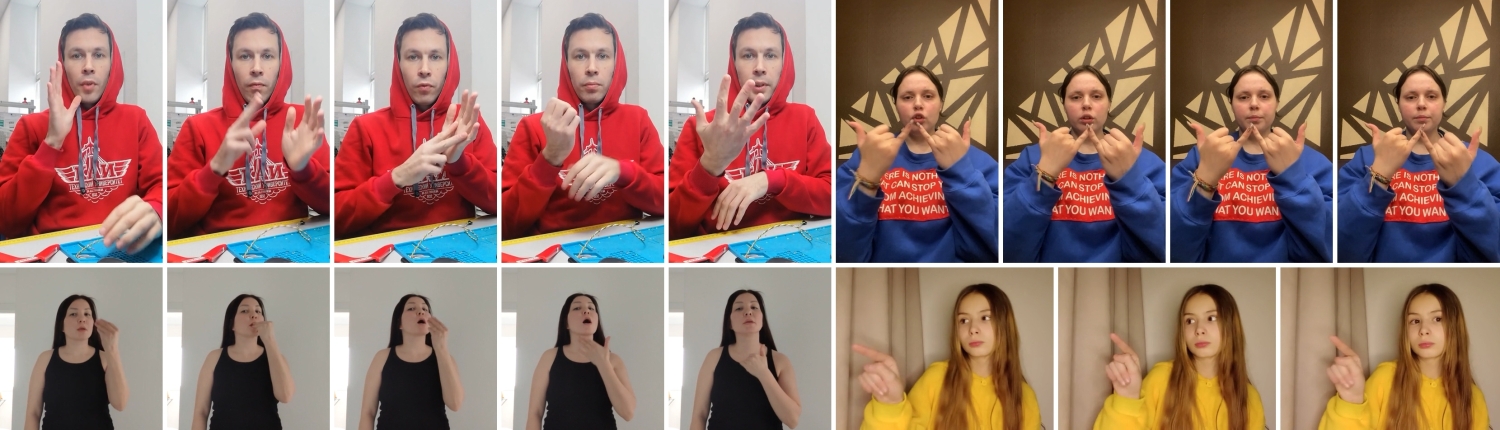
- Leveraged crowdsourcing platforms to collect 20,000 FullHD RSL video recordings from 194 signers across various environments.
- Implemented a three-stage pipeline: video collection, quality validation using exam tasks, and precise start/end time annotation of gestures.
- Applied data augmentation techniques including horizontal flipping, sharpness adjustment, and color jittering to improve model generalization.
- Used a balanced data split with 75% training and 25% test, minimizing signer overlap to reduce overfitting.
- Trained and evaluated three video recognition models—MViTv2-small, Swin-large, and ResNet3D-50—on the dataset with varying frame sampling strategies.
- Employed frame sampling strategies with 16, 32, and 48 frames and intervals from 1 to 4, excluding 64-frame sequences due to performance degradation.
Experimental results
Research questions
- RQ1Can a scalable, crowdsourced pipeline produce high-quality, diverse, and accurately annotated RSL video data at scale?
- RQ2How does the performance of video recognition models vary with different frame sampling strategies on a newly created RSL dataset?
- RQ3To what extent does model architecture (e.g., vision transformer vs. 3D CNN) affect sign language recognition accuracy on the Slovo dataset?
- RQ4Can a lightweight, video-optimized transformer like MViTv2-small outperform larger or more conventional architectures on isolated RSL gesture recognition?
Key findings
- The MViTv2-small model achieved the highest mean accuracy on the Slovo dataset when using 32 frames with a frame interval of 2, demonstrating superior performance over ResNet3D-50 and Swin-large.
- The use of a crowdsourced data collection pipeline enabled the acquisition of 20,000 diverse RSL videos from 194 signers, significantly expanding the available RSL training data.
- The data split strategy, which minimized signer overlap between training and test sets, effectively reduced model overfitting and improved generalization.
- ResNet3D-50 underperformed compared to vision transformer-based models, indicating that transformers are better suited for capturing spatiotemporal dynamics in sign language videos.
- Frame sampling with intervals greater than 4 degraded performance, suggesting that preserving temporal continuity is critical for accurate gesture recognition.
- The dataset and pre-trained models are publicly available, enabling future research in Russian sign language recognition and multimodal sign language modeling.
Read this paper
Open the full text in the Nubint reader and ask about any passage as you read.
Read this paper on NubintThis review was generated by AI from the original paper. Please check the paper before citing it.