
[Paper Review] Small-Coupling Dynamic Cavity: a Bayesian mean-field framework for epidemic inference
This paper introduces the Small-Coupling Dynamic Cavity (SCDC) method, a Bayesian mean-field framework for epidemic inference on contact networks. It uses dynamic cavity equations with a small-coupling expansion to compute time-dependent marginal probabilities of infection, enabling accurate individual risk assessment with linear computational complexity. SCDC achieves performance comparable to Belief Propagation while being generalizable to Markovian epidemic models like SIR and SIRS.
We present the Small-Coupling Dynamic Cavity (SCDC) method, a novel generalized mean-field approximation for epidemic inference and risk assessment within a fully Bayesian framework. SCDC accounts for non-causal effects of observations and uses a graphical model representation of epidemic processes to derive self-consistent equations for edge probability marginals. A small-coupling expansion yields time-dependent cavity messages capturing individual infection probabilities and observational conditioning. With linear computational cost per iteration in the epidemic duration, SCDC is particularly efficient and valid even for recurrent epidemic processes, where standard methods are exponentially complex. Tested on synthetic networks, it matches Belief Propagation in accuracy and outperforms individual-based mean-field methods. Notably, despite being derived as a small-infectiousness expansion, SCDC maintains good accuracy even for relatively large infection probabilities. While convergence issues may arise on graphs with long-range correlations, SCDC reliably estimates risk. Future extensions include non-Markovian models and higher-order terms in the dynamic cavity framework.
Motivation & Objective
- To develop a scalable, accurate method for individual-level epidemic risk assessment in complex contact networks.
- To address the challenge of non-causal information flow in epidemic inference due to sparse observations, which violates standard time-forward dynamics.
- To generalize mean-field approximations to handle observation-dependent dynamics while maintaining computational efficiency.
- To extend the applicability of dynamic cavity methods beyond time-forward, non-recurrent processes to Markovian recurrent models such as SIS and SIRS.
- To provide a framework that balances accuracy and efficiency, outperforming heuristic mean-field methods and approaching BP performance without its convergence issues.
Proposed method
- Formulates epidemic dynamics as a graphical model over a contact network, representing infection trajectories as stochastic processes on edges.
- Derives dynamic cavity equations for edge-based probability marginals, capturing the state of an individual conditioned on the absence of a specific neighbor.
- Applies a small-coupling expansion to the observation-reweighted cavity equations, yielding time-dependent cavity messages that encode infection risk and observation influence.
- Introduces a small self-infection probability to resolve inconsistencies from observation-induced non-causal effects, particularly in dense observation regimes.
- Employs a temporal transfer matrix formalism to compute cavity messages efficiently, ensuring linear scaling with epidemic duration and number of contacts.
- Adapts the framework to multi-state models (e.g., SIR, SIRS) by modifying matrix dimensions and elements, preserving linear complexity.
Experimental results
Research questions
- RQ1How can a Bayesian mean-field approximation be designed to handle non-causal information flow from sparse observations in epidemic inference?
- RQ2Can a small-coupling expansion of dynamic cavity equations yield accurate and efficient inference for Markovian epidemic processes on networks?
- RQ3To what extent does the SCDC method maintain accuracy in the presence of long-range correlations and loops in contact graphs?
- RQ4How does the performance of SCDC compare to Belief Propagation and heuristic mean-field methods in individual risk estimation?
- RQ5What is the role of second-order terms in the small-coupling expansion, and can they be leveraged to improve accuracy beyond the current first-order approximation?
Key findings
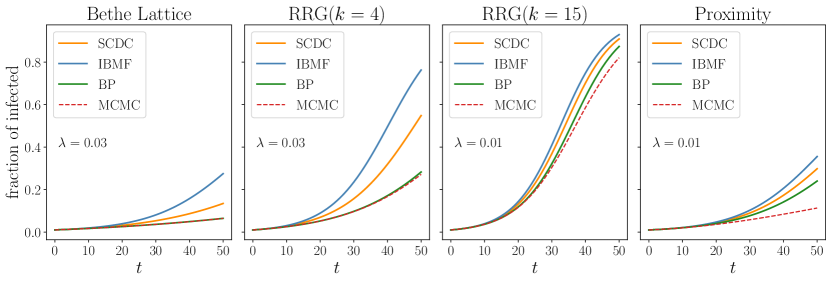
- The SCDC method achieves epidemic risk estimation accuracy comparable to Belief Propagation, particularly in time-forward dynamics, while maintaining linear computational complexity.
- In the absence of observations, SCDC reduces to a generalized mean-field approximation that outperforms standard individual-based mean-field (IBMF) methods, especially in low-infectiousness and high-connectivity regimes.
- The introduction of a small self-infection probability effectively resolves convergence and consistency issues arising from repeated or dense observations.
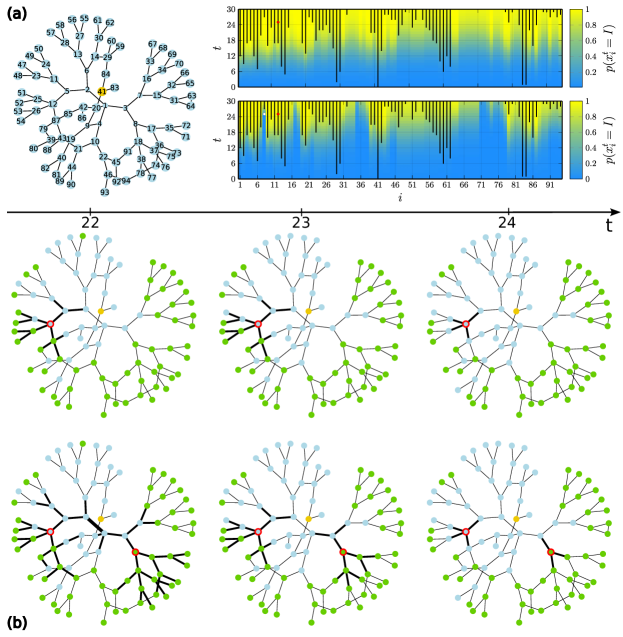
- Even when convergence issues occur due to long-range correlations in loopy networks, the estimated marginal probabilities remain sufficiently accurate for reliable risk assessment.
- The method generalizes straightforwardly to recurrent Markovian models such as SIRS, with preliminary results showing strong predictive power without assuming small infectiousness.
- The SCDC framework maintains linear scaling with epidemic duration and network size, making it suitable for large-scale, real-time epidemic inference applications.
Read this paper
Open the full text in the Nubint reader and ask about any passage as you read.
Read this paper on NubintThis review was generated by AI from the original paper. Please check the paper before citing it.