
[Paper Review] Small Language Models: Survey, Measurements, and Insights
The paper surveys 59 open-source decoder-only small language models (100M–5B) and benchmarks their architectures, training data, algorithms, capabilities, and on-device runtime costs to glean insights for edge deployments.
Small language models (SLMs), despite their widespread adoption in modern smart devices, have received significantly less academic attention compared to their large language model (LLM) counterparts, which are predominantly deployed in data centers and cloud environments. While researchers continue to improve the capabilities of LLMs in the pursuit of artificial general intelligence, SLM research aims to make machine intelligence more accessible, affordable, and efficient for everyday tasks. Focusing on transformer-based, decoder-only language models with 100M-5B parameters, we survey 70 state-of-the-art open-source SLMs, analyzing their technical innovations across three axes: architectures, training datasets, and training algorithms. In addition, we evaluate their capabilities in various domains, including commonsense reasoning, mathematics, in-context learning, and long context. To gain further insight into their on-device runtime costs, we benchmark their inference latency and memory footprints. Through in-depth analysis of our benchmarking data, we offer valuable insights to advance research in this field.
Motivation & Objective
- Systematically review decoder-only small language models (100M–5B) and their release configurations.
- Analyze architecture, training datasets, and training algorithms across surveyed SLMs.
- Benchmark capabilities across commonsense reasoning, in-context learning, mathematics, and coding.
- Evaluate on-device runtime costs (latency, memory, energy) to inform edge deployments.
- Provide insights and guidance for future SLM research and hardware-aware design.
Proposed method
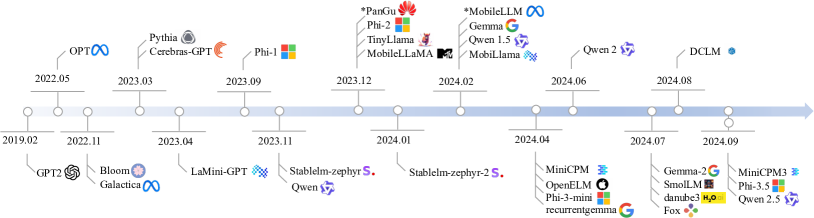
- Collect and categorize 59 open-source decoder-only SLMs with 100M–5B parameters.
- Benchmark capabilities on commonsense reasoning, problem solving, mathematics, and in-context learning.
- Measure on-device runtime costs (prefill latency, decode latency, memory, energy) on edge devices using a common inference engine (llama.cpp).
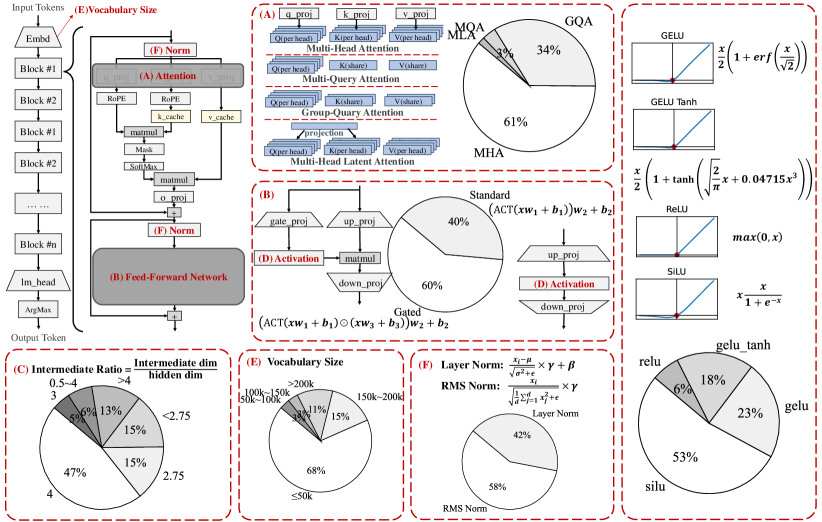
- Analyze architectures (attention type, FFN, activation, normalization, vocabulary) and training data usage.
- Compare training datasets and data quality, including model-based data filtering.
- Extract insights on data quality, dataset choice, and architecture choices for SLM development.
Experimental results
Research questions
- RQ1What architectural choices are prevalent in SLMs and how do they impact on-device performance?
- RQ2How do open-source training datasets and data quality affect SLM capabilities compared to closed-source data?
- RQ3How do SLMs perform on commonsense reasoning, problem-solving, and mathematics tasks, and how do model size and data influence this performance?
- RQ4What are the on-device latency, memory, and energy characteristics across hardware and quantization settings for SLMs?
Key findings
- SLMs show substantial performance gains from 2022 to 2024 across commonsense reasoning, problem solving, and mathematics (approximately 10.4%, 13.5%, and 13.5% respectively).
- The Phi family delivers state-of-the-art results across most tasks, with Phi-3-mini rivaling Llama 3.1 8B in some cases and Phi-3-mini leading in mathematics among the evaluated models.
- Open-source datasets like FineWeb-Edu and DCLM-baseline, which employ model-based filtering, achieve competitive performance relative to closed datasets.
- Larger parameter counts generally correlate with better performance, but anomalies exist (e.g., Qwen 2); data quality and training data choices often outweigh sheer model size.
- In-context learning generally benefits larger models and, on average, 5-shot prompts yield about a 2.1% accuracy boost, with Gemma-2 showing the largest gains.
- Gaps remain between open-source and closed-source models on tasks requiring complex reasoning or mathematics, underscoring the need for higher-quality reasoning datasets.
Read this paper
Open the full text in the Nubint reader and ask about any passage as you read.
Read this paper on NubintThis review was generated by AI from the original paper. Please check the paper before citing it.