
[Paper Review] Smart Contract and DeFi Security Tools: Do They Meet the Needs of Practitioners?
This study evaluates the real-world effectiveness of five state-of-the-art smart contract and DeFi security tools against 127 high-impact attacks, revealing that only 8% of these attacks—amounting to $149 million in losses—could have been prevented by automated tools, primarily due to their failure to detect logic bugs and protocol-layer vulnerabilities. The findings highlight a critical gap between academic tool development and practitioner needs, urging the creation of specialized, user-informed tools for developers and auditors.
The growth of the decentralized finance (DeFi) ecosystem built on blockchain technology and smart contracts has led to an increased demand for secure and reliable smart contract development. However, attacks targeting smart contracts are increasing, causing an estimated \$6.45 billion in financial losses. Researchers have proposed various automated security tools to detect vulnerabilities, but their real-world impact remains uncertain. In this paper, we aim to shed light on the effectiveness of automated security tools in identifying vulnerabilities that can lead to high-profile attacks, and their overall usage within the industry. Our comprehensive study encompasses an evaluation of five SoTA automated security tools, an analysis of 127 high-impact real-world attacks resulting in \$2.3 billion in losses, and a survey of 49 developers and auditors working in leading DeFi protocols. Our findings reveal a stark reality: the tools could have prevented a mere 8% of the attacks in our dataset, amounting to \$149 million out of the \$2.3 billion in losses. Notably, all preventable attacks were related to reentrancy vulnerabilities. Furthermore, practitioners distinguish logic-related bugs and protocol layer vulnerabilities as significant threats that are not adequately addressed by existing security tools. Our results emphasize the need to develop specialized tools catering to the distinct demands and expectations of developers and auditors. Further, our study highlights the necessity for continuous advancements in security tools to effectively tackle the ever-evolving challenges confronting the DeFi ecosystem.
Motivation & Objective
- To assess the real-world effectiveness of automated security tools in detecting vulnerabilities that lead to high-impact DeFi attacks.
- To identify which vulnerability types are detectable by current tools and which remain undetected, especially those causing major financial losses.
- To understand the actual usage patterns, preferences, and challenges faced by developers and auditors when selecting and using security tools in practice.
- To investigate the trade-offs practitioners make between false positives, false negatives, usability, and tool reliability in real-world DeFi development and auditing workflows.
Proposed method
- The study evaluated five state-of-the-art automated security tools using a dataset of 127 high-impact real-world DeFi attacks resulting in $2.3 billion in losses.
- The researchers classified vulnerabilities in the attack dataset by type and assessed which could have been detected by each tool, focusing on reentrancy, logic bugs, and protocol-layer flaws.
- A survey of 49 DeFi developers and auditors was conducted to understand tool usage patterns, preferences, and perceived limitations in real-world audit and development workflows.
- The study analyzed the trade-offs practitioners make between false positives and false negatives, and evaluated the importance of usability, documentation, and report quality in tool selection.
- The researchers compared tool outputs against known attack patterns and validated findings through manual analysis and expert feedback from auditors.
- The study integrates empirical evaluation with practitioner surveys to provide a holistic view of tool effectiveness and adoption in the DeFi ecosystem.
Experimental results
Research questions
- RQ1RQ1: Which vulnerability types can be detected by automated security tools? How frequently do these vulnerabilities occur in real-world attacks, and what is the severity of those that could have been detected?
- RQ2RQ2: To what extent can automated security tools prevent real-world high-profile attacks? What is their effectiveness per vulnerability category, and which attacks could semi-automated tools have prevented with user input?
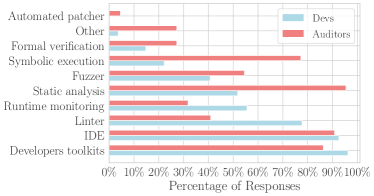
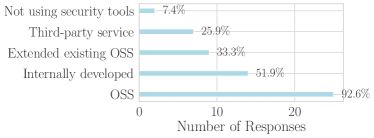
- RQ3RQ3: What is the actual landscape of security tool usage among developers and auditors? How prevalent are open-source tools, academic tools, and semi-automated tools in practice?
- RQ4RQ4: What characteristics do developers and auditors prioritize in security tools? How do they weigh false positives versus false negatives, and how important are usability, documentation, and report quality?
- RQ5RQ5: How effectively do current tools address different error classes? Which types of errors are inadequately covered, and what is the auditors' perception of tool usefulness?
Key findings
- Only 8% of the 127 high-impact DeFi attacks in the dataset—amounting to $149 million in losses—could have been prevented by existing automated security tools.
- All preventable attacks in the dataset were due to reentrancy vulnerabilities, indicating that current tools are effective only for a narrow class of well-known smart contract flaws.
- Practitioners identified logic-related bugs and protocol-layer vulnerabilities as major threats that are not adequately addressed by existing automated tools.
- Despite widespread use of security tools in audits, only 4 out of 246 vulnerabilities identified in a prior audit study were detected by automated tools, underscoring their limited real-world impact.
- Auditors and developers prioritize usability, report quality, and low false positive rates over raw detection capability, indicating a mismatch between tool design and practitioner needs.
- A significant gap exists between academic tool development and industry practice, with practitioners expressing a need for tools tailored to logic and protocol-level flaws, especially those requiring human-in-the-loop validation.
Read this paper
Open the full text in the Nubint reader and ask about any passage as you read.
Read this paper on NubintThis review was generated by AI from the original paper. Please check the paper before citing it.