
[Paper Review] SMART-LLM: Smart Multi-Agent Robot Task Planning using Large Language Models
SMART-LLM uses large language models to decompose high-level instructions, form robot coalitions, and allocate tasks for heterogeneous multi-robot teams, demonstrated in AI2-THOR simulations and real robots.
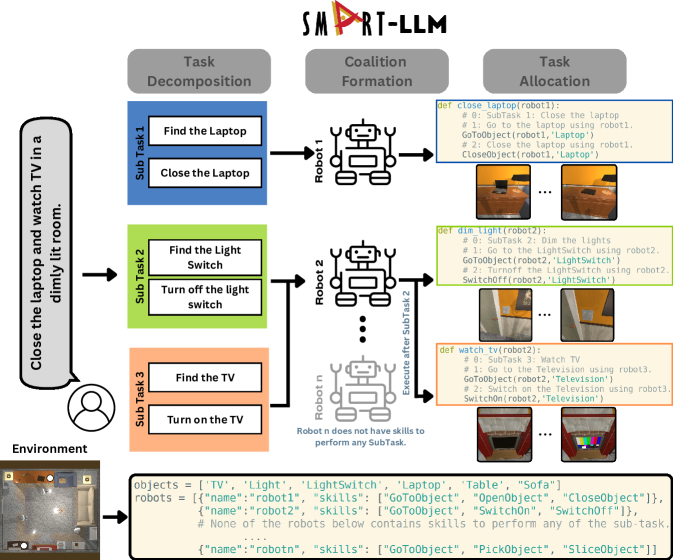
In this work, we introduce SMART-LLM, an innovative framework designed for embodied multi-robot task planning. SMART-LLM: Smart Multi-Agent Robot Task Planning using Large Language Models (LLMs), harnesses the power of LLMs to convert high-level task instructions provided as input into a multi-robot task plan. It accomplishes this by executing a series of stages, including task decomposition, coalition formation, and task allocation, all guided by programmatic LLM prompts within the few-shot prompting paradigm. We create a benchmark dataset designed for validating the multi-robot task planning problem, encompassing four distinct categories of high-level instructions that vary in task complexity. Our evaluation experiments span both simulation and real-world scenarios, demonstrating that the proposed model can achieve promising results for generating multi-robot task plans. The experimental videos, code, and datasets from the work can be found at https://sites.google.com/view/smart-llm/.
Motivation & Objective
- Motivate the need for flexible, language-driven multi-robot task planning in heterogeneous teams.
- Develop a four-stage framework that uses LLMs to decompose tasks, form coalitions, allocate tasks, and execute plans.
- Create and utilize a benchmark dataset in AI2-THOR to evaluate multi-robot planning with varying task complexities.
- Demonstrate applicability in simulation and real-robot experiments, and analyze performance under different prompts and baselines.
Proposed method
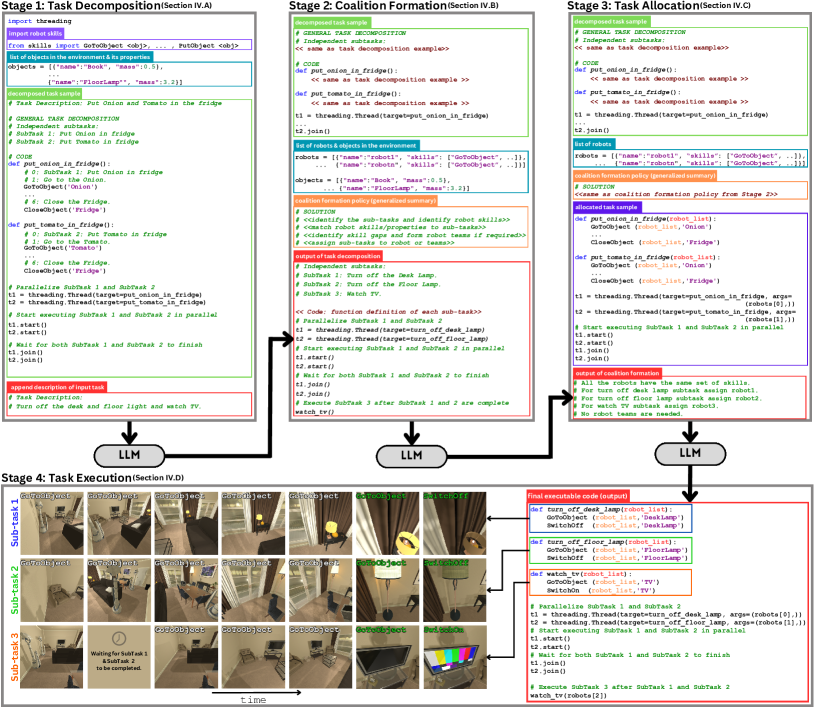
- Stage 1 (Task Decomposition): provide environment and skill information to an LLM with few-shot Python-based prompts to generate sub-tasks and action sequences.
- Stage 2 (Coalition Formation): prompt the LLM with robot skills, environment objects, and sample coalitions to produce a coalition policy for sub-tasks.
- Stage 3 (Task Allocation): prompt with decomposed tasks, coalition policy, and allocated plans to generate executable task allocations.
- Stage 4 (Task Execution): execute the allocated plans via API calls to robot low-level skills or an interpreter, enabling parallel or sequential execution as appropriate.
- Prompts leverage Pythonic structure with line-by-line comments and task-level summaries to guide LLM reasoning and code generation.
- Evaluation uses a benchmark dataset derived from AI2-THOR to assess planning quality across elemental, simple, compound, and complex tasks.
Experimental results
Research questions
- RQ1Can GPT-4-based prompting enable robust task decomposition, coalition formation, and allocation for heterogeneous robot teams?
- RQ2To what extent can an LLM-driven pipeline achieve high success rates and efficient robot utilization across tasks of increasing complexity?
- RQ3How does GPT-4 compare to GPT-3.5 in complex multi-robot planning scenarios?
- RQ4What is the impact of including natural language comments and coalition prompts on planning performance?
- RQ5Can the framework generalize from simulated prompts to real-robot task planning?
Key findings
- SMART-LLM achieves perfect success in elemental tasks in simulations.
- For simple tasks, SMART-LLM achieves TCR = 1.0 but exhibit lower SR due to sequential vs parallel execution, affecting RU.
- In compound and complex tasks, success rates are 70% with some sequencing and team-assignment challenges.
- GPT-4 generally outperforms GPT-3.5, especially on complex tasks requiring reasoning and diverse sub-skills.
- Removing comments, summaries, or coalition formation generally reduces performance, highlighting the value of reasoning-enhanced prompts and structured prompts.
- Real-robot experiments showed the method can allocate appropriate robot teams for coverage/patrol tasks unseen in simulation.
Read this paper
Open the full text in the Nubint reader and ask about any passage as you read.
Read this paper on NubintThis review was generated by AI from the original paper. Please check the paper before citing it.