
[Paper Review] Smoothed Moreau-Yosida Tensor Train Approximation of State-constrained Optimization Problems under Uncertainty
This paper proposes a tensor-train (TT)-based algorithm for solving state-constrained optimization problems governed by PDEs with random coefficients under uncertainty. By combining Moreau-Yosida regularization with ε-smoothed ReLU (softplus) functions, it enables efficient high-dimensional stochastic optimization with provable constraint violation bounds and strong convergence under strong convexity, demonstrated on elliptic PDEs and an epidemiological model with 20 random variables.
We propose an algorithm to solve optimization problems constrained by partial (ordinary) differential equations under uncertainty, with almost sure constraints on the state variable. To alleviate the computational burden of high-dimensional random variables, we approximate all random fields by the tensor-train decomposition. To enable efficient tensor-train approximation of the state constraints, the latter are handled using the Moreau-Yosida penalty, with an additional smoothing of the positive part (plus/ReLU) function by a softplus function. In a special case of a quadratic cost minimization constrained by linear elliptic partial differential equations, and some additional constraint qualification, we prove strong convergence of the regularized solution to the optimal control. This result also proposes a practical recipe for selecting the smoothing parameter as a function of the penalty parameter. We develop a second order Newton type method with a fast matrix-free action of the approximate Hessian to solve the smoothed Moreau-Yosida problem. This algorithm is tested on benchmark elliptic problems with random coefficients, optimization problems constrained by random elliptic variational inequalities, and a real-world epidemiological model with 20 random variables. These examples demonstrate mild (at most polynomial) scaling with respect to the dimension and regularization parameters.
Motivation & Objective
- To address the computational challenge of high-dimensional stochastic optimization with almost sure state constraints in PDE-constrained problems.
- To overcome the lack of regularity in state constraints by introducing a smoothed Moreau-Yosida penalty using softplus approximation.
- To enable efficient tensor-train (TT) approximation of random fields and constraints in high-dimensional probability spaces.
- To develop a scalable, matrix-free second-order optimization method that avoids the curse of dimensionality.
- To provide theoretical convergence guarantees and practical parameter selection rules for the regularization and smoothing parameters.
Proposed method
- The state constraints are relaxed using the Moreau-Yosida penalty, with the non-smooth positive part function replaced by a softplus-smoothed version to enable TT approximation.
- The softplus smoothing introduces a parameter ε, and the paper derives probabilistic bounds on constraint violation in terms of γ (Moreau-Yosida parameter) and ε.
- All random fields, including the state and control, are approximated via tensor-train (TT) decomposition to mitigate the curse of dimensionality.
- A second-order Newton-type method is developed with fast matrix-free Hessian actions, exploiting the low-rank structure of the TT format.
- The method is applied to elliptic PDEs with random coefficients and a 20D epidemiological ODE model with almost sure reproduction number constraints.
- The algorithm uses TT-cross approximation with relative error tolerance 1e-2 and finite differencing for gradient computation in the epidemiological case.
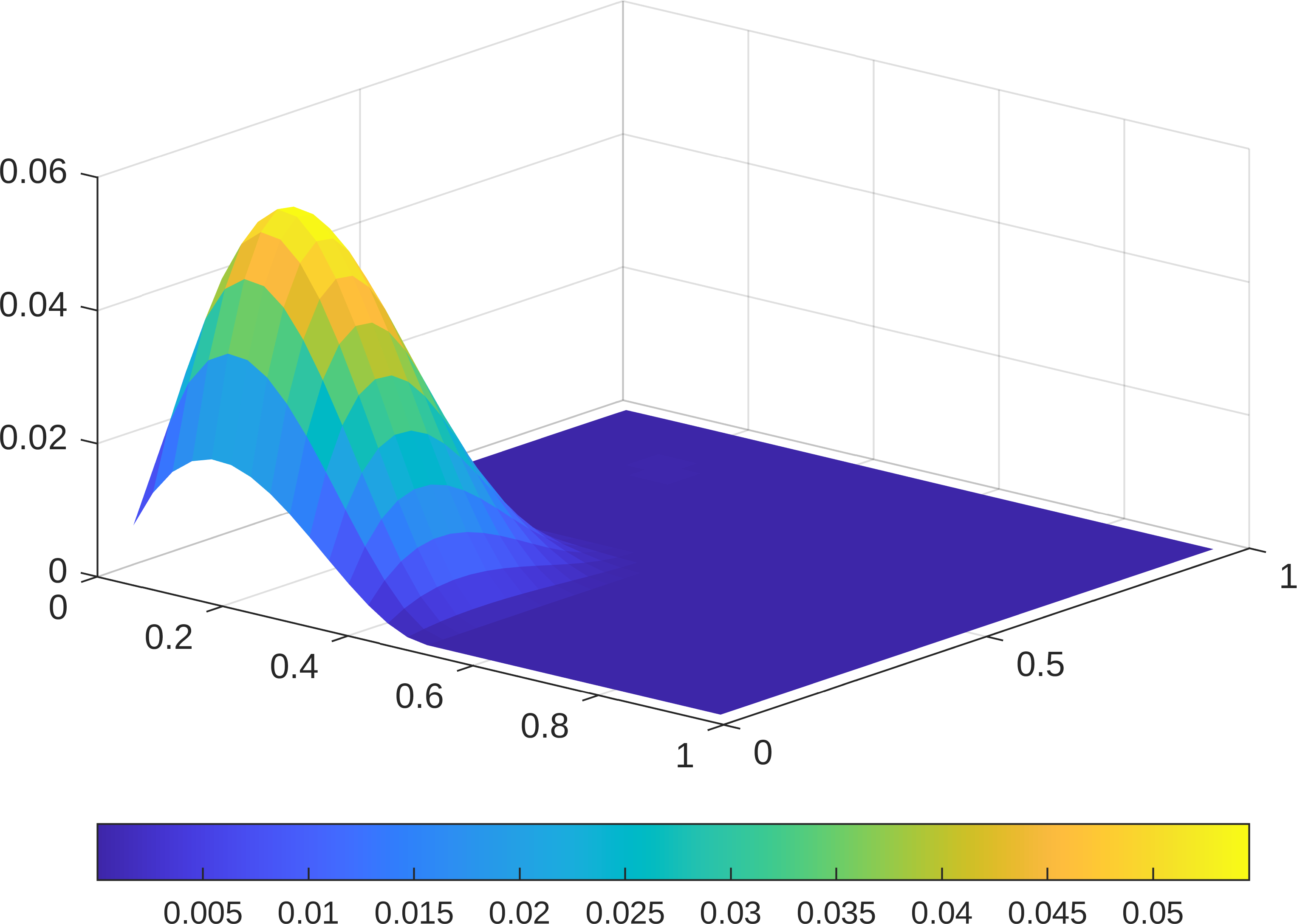
Experimental results
Research questions
- RQ1How can almost sure state constraints in PDE-constrained optimization under uncertainty be efficiently approximated using low-rank tensor formats?
- RQ2What is the theoretical relationship between the Moreau-Yosida regularization parameter γ and the softplus smoothing width ε in controlling constraint violation?
- RQ3Can the proposed smoothing and regularization strategy preserve convergence and enable scalable solution of high-dimensional stochastic optimization problems?
- RQ4How does the tensor-train approximation strategy mitigate the curse of dimensionality in problems with many random variables?
- RQ5What is the performance of the matrix-free Newton method in solving the smoothed problem, especially in terms of convergence and scalability?
Key findings
- The constraint violation is bounded by O(γ⁻¹/²) when ε ∝ γ⁻¹/², providing a practical recipe for parameter selection.
- For strongly convex problems, the regularized solution converges strongly to the optimal control as γ → 0.
- The algorithm exhibits mild (at most polynomial) scaling with respect to the number of random variables and regularization parameters, demonstrating robustness in high dimensions.
- In the epidemiological model with 20 random variables, the constrained optimization maintains R ≤ 1 almost surely beyond the time horizon, leading to more resilient control strategies.
- The unconstrained solution leads to epidemic resurgence after t=90 due to zero control, while the a.s. constraint preserves decay, showing the practical value of the approach.
- The TT-based method achieves efficient solution with relative error tolerance 1e-2 and avoids the slow convergence of Monte Carlo methods.
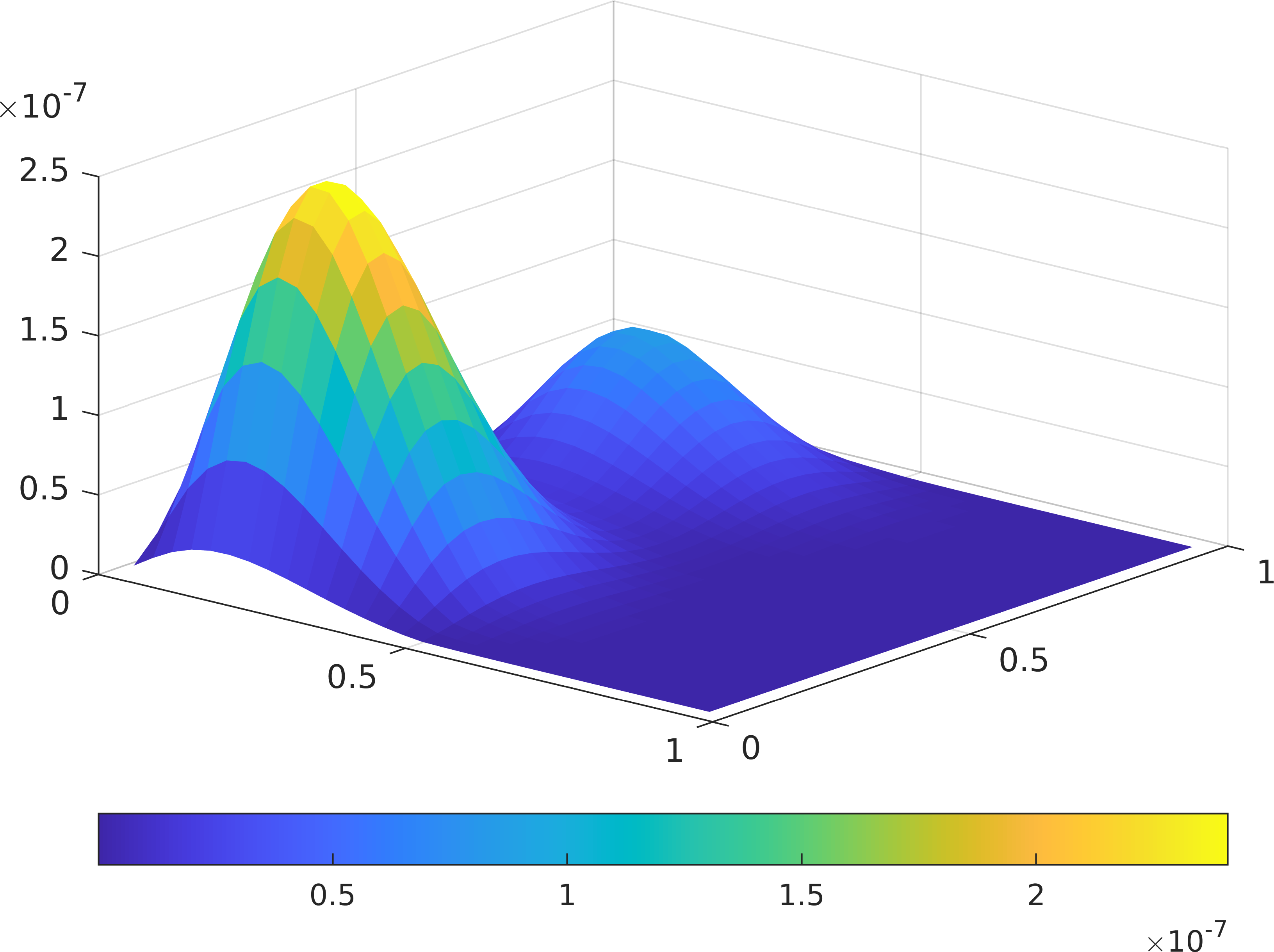
Read this paper
Open the full text in the Nubint reader and ask about any passage as you read.
Read this paper on NubintThis review was generated by AI from the original paper. Please check the paper before citing it.