
[Paper Review] SNeSCOPE - a python package for shock cooling fitting using the model of Morag et al 2024
This paper introduces SNeSCOPE, a Python package for fitting shock-cooling models to early ultraviolet and optical light curves of Type II supernovae using the Morag et al. 2024 framework. It demonstrates that early UV-optical colors and blackbody evolution are consistent with spherical shock cooling, and finds that 66% of red supergiant progenitors explode with breakout radii matching observed field RSG distributions, though luminosity bias skews the distribution toward larger radii due to CSM confinement or inflated envelopes.
SNeSCOPE - SuperNovae Shock Cooling Observations Parameter Estimator Documentation SNeSCOPE is a python package for modeling supernova light curves using the analytic models of Morag et al 2023 and Morag et al 2024. Installation to install, git clone the repository. Then run from within the SNeSCOPE directory (where the script setup.py is) python setup.py install Alternatively, use pip pip install SNeSCOPE add simulation data files Use the following link to download the MG simulatiosn used for constructing the covariance matrix for the likelihood function: https://www.dropbox.com/scl/fi/kawt98t2lri5j90o61u60/RSG_batch_R03_20_removed_lines_Z1.mat?rlkey=1hnpbgiayol7jtu4cn4895slg&dl=0 and for the keys: https://www.dropbox.com/scl/fi/o22vj00kjskp9gk6ae2h1/RSG_batch_R03_20_removed_lines_Z1_key.mat?rlkey=kop5iq609h10pgkgsnycuvjyx&dl=0 If these links do not work for any reason, the files can be found in the zenodo repository linked in the bottom of this readme In addition to these, the filter transmission data I use is collected in the Filters folder avilable in this repository and in the zenodo repository. running the script To run pre exsiting script, modify the parameter files (e.g., see in tests). You will modify paths, SN parameters (e.g., distance, redshift, extinction), package options, and the photometric filters used while observing (an extensive folder is added, but you can always add more. Make sure to update the plotting parameters accordingly). If you encounter errors at this point, make sure you have the correct paths and consider moving from relative to absolute paths. Then run the script fit_SC.py, e.g., from the SNeSCOPE directory (for a unix based system): python ./scripts/fit_SC.py --path_params ./tests/params_2020jfo.py or (if using windows) python .\scripts\fit_SC.py --path_params . ests\params_2020jfo.py As the script is currently written, it requires a data file containing magnituds, fluxes, instruments and filters as is shown in the example test files. The script uses a non-rectangular prior on the recombination time of Hydrogen at a photospheric temperature of roughly t_rec 0.7 eV~ 8000K. Given the typical deviations from blackbody and given a mild amount of host extinction (up to E(B-V) = 0.2), a blackboyd fit assuming E(B-V) = 0 mag at 8000K can give anywhere between 5000 and 10000 K. I recommend to first fix the extinction to lower than 0.2, using the color curves of Irani 2024. Then add a dates files. This is a list of times (JD) where E(B-V) = 0 blackbody fits are made, and then used as priors. The script will run the fitter in the following steps: blackbody fits prepare covariance matrix for likelihood function using the light curve sampling provided fit the data get the results. re-fit a blackbody using the fit host-extinciton save the results as a pickle object plot calculate physical parameters and save to a table (for a full description of these parameters, see Irani 2024, and Morag 2024, and references therein). There are 4 plots which are provided. Light curve fits. These include a vertical line indicating the early validity time of the model (the time the breakout pulse is over and homologous expansion is reached). I also provide these plots with a logarithmic axis, which are more convenient for high cadence sampling of the early light curves. Blackbody fits compared to the model predictions. These are compared to the new blackbody fits, using the fit E(B-V) (and Rv, if fitted). A good fit should also fit the blackbody temperature and radius reasonable well, although some deviations are expected as the SED is not a perfect blackbody. corner plots SED plot - These can be used to evaluate the observed and model SED at various epochs. The different lines are both the blackbody and the frequency dependent formulas smapled from the posterior. Keep in mind sometimes, due to a low mass envelope or fast V*, the model can be no longer valid at the lowest temperature plotted in these plots. Python version python 3 Required python packages numpy dynesty matplotlib scipy astropy numba astropy os pandas Support I'm happy to provide support in setting up the package and interpreting its results. You can contact me at idoirani@gmail.com. For the most up to date version of the package, please visit the github repository at https://github.com/idoirani/shock_cooling. Credit If you are using SNeSCOPE, please cite the following papers: light curve fitter: Irani et al 2024, "the early UV light curves of Type II SNe" @ARTICLE{2023arXiv231016885I, author = {{Irani}, Ido and {Morag}, Jonathan and {Gal-Yam}, Avishay and {Waxman}, Eli and {Schulze}, Steve and {Sollerman}, Jesper and {Hinds}, K-Ryan and {Perley}, Daniel A. and {Chen}, Ping and {Strotjohann}, Nora L. and {Yaron}, Ofer and {Zimmerman}, Erez A. and {Bruch}, Rachel and {Ofek}, Eran O. and {Soumagnac}, Maayane T. and {Yang}, Yi and {Groom}, Steven L. and {Masci}, Frank J. and {Riddle}, Reed and {Bellm}, Eric C. and {Hale}, David}, title = "{The Early Ultraviolet Light-Curves of Type II Supernovae and the Radii of Their Progenitor Stars}", journal = {arXiv e-prints}, keywords = {Astrophysics - High Energy Astrophysical Phenomena}, year = 2023, month = oct, eid = {arXiv:2310.16885}, pages = {arXiv:2310.16885}, doi = {10.48550/arXiv.2310.16885}, archivePrefix = {arXiv}, eprint = {2310.16885}, primaryClass = {astro-ph.HE}, adsurl = {https://ui.adsabs.harvard.edu/abs/2023arXiv231016885I}, adsnote = {Provided by the SAO/NASA Astrophysics Data System} } analytic model for T,L evolution: Morag et al 2023 "Shock cooling emission from explosions of red super-giants: I. A numerically calibrated analytic model" @ARTICLE{2023MNRAS.522.2764M, author = {{Morag}, Jonathan and {Sapir}, Nir and {Waxman}, Eli}, title = "{Shock cooling emission from explosions of red supergiants - I. A numerically calibrated analytic model}", journal = {\mnras}, keywords = {shock waves, supernovae: general, Astrophysics - High Energy Astrophysical Phenomena}, year = 2023, month = jun, volume = {522}, number = {2}, pages = {2764-2776}, doi = {10.1093/mnras/stad899}, archivePrefix = {arXiv}, eprint = {2207.06179}, primaryClass = {astro-ph.HE}, adsurl = {https://ui.adsabs.harvard.edu/abs/2023MNRAS.522.2764M}, adsnote = {Provided by the SAO/NASA Astrophysics Data System} } deviations from blackbody: Morag et al 2024, "Shock cooling emission from explosions of red super-giants: II. An analytic model of deviations from blackbody emission" @ARTICLE{2024MNRAS.528.7137M, author = {{Morag}, Jonathan and {Irani}, Ido and {Sapir}, Nir and {Waxman}, Eli}, title = "{Shock cooling emission from explosions of red supergiants: II. An analytic model of deviations from blackbody emission}", journal = {\mnras}, keywords = {radiation: dynamics, radiative transfer, shock waves, transients: supernovae, Astrophysics - High Energy Astrophysical Phenomena, Astrophysics - Solar and Stellar Astrophysics}, year = 2024, month = mar, volume = {528}, number = {4}, pages = {7137-7155}, doi = {10.1093/mnras/stae374}, archivePrefix = {arXiv}, eprint = {2307.05598}, primaryClass = {astro-ph.HE}, adsurl = {https://ui.adsabs.harvard.edu/abs/2024MNRAS.528.7137M}, adsnote = {Provided by the SAO/NASA Astrophysics Data System} } Variable validity domain: Soumagnac et al 2020 "SN 2018fif: The Explosion of a Large Red Supergiant Discovered in Its Infancy by the Zwicky Transient Facility" @ARTICLE{2020ApJ...902....6S, author = {{Soumagnac}, Maayane T. and {Ganot}, Noam and {Irani}, Ido and {Gal-yam}, Avishay and {Ofek}, Eran O. and {Waxman}, Eli and {Morag}, Jonathan and {Yaron}, Ofer and {Schulze}, Steve and {Yang}, Yi and {Rubin}, Adam and {Cenko}, S. Bradley and {Sollerman}, Jesper and {Perley}, Daniel A. and {Fremling}, Christoffer and {Nugent}, Peter and {Neill}, James D. and {Karamehmetoglu}, Emir and {Bellm}, Eric C. and {Bruch}, Rachel J. and {Burruss}, Rick and {Cunningham}, Virginia and {Dekany}, Richard and {Golkhou}, V. Zach and {Graham}, Matthew J. and {Kasliwal}, Mansi M. and {Konidaris}, Nicholas P. and {Kulkarni}, Shrinivas R. and {Kupfer}, Thomas and {Laher}, Russ R. and {Masci}, Frank J. and {Riddle}, Reed and {Rigault}, Mickael and {Rusholme}, Ben and {van Roestel}, Jan and {Zackay}, Barak}, title = "{SN 2018fif: The Explosion of a Large Red Supergiant Discovered in Its Infancy by the Zwicky Transient Facility}", journal = {\apj}, keywords = {Supernovae, Type II supernovae, Astronomy data modeling, Observational astronomy, Ultraviolet transient sources, Transient sources, 1668, 1731, 1859, 1145, 1854, 1851, Astrophysics - High Energy Astrophysical Phenomena}, year = 2020, month = oct, volume = {902}, number = {1}, eid = {6}, pages = {6}, doi = {10.3847/1538-4357/abb247}, archivePrefix = {arXiv}, eprint = {1907.11252}, primaryClass = {astro-ph.HE}, adsurl = {https://ui.adsabs.harvard.edu/abs/2020ApJ...902....6S}, adsnote = {Provided by the SAO/NASA Astrophysics Data System} } If using Piro 2021 "Shock Cooling Emission from Extended Material Revisited" @ARTICLE{2021ApJ...909..209P, author = {{Piro}, Anthony L. and {Haynie}, Annastasia and {Yao}, Yuhan}, title = "{Shock Cooling Emission from Extended Material Revisited}", journal = {\apj}, keywords = {Radiative transfer, Supernovae, 1335, 1668, Astrophysics - High Energy Astrophysical Phenomena}, year = 2021, month = mar, volume = {909}, number = {2}, ei
Motivation & Objective
- To develop a robust framework for fitting shock-cooling models to early supernova light curves using multi-band UV and optical data.
- To constrain progenitor radii and explosion energies by analyzing the shock breakout phase in Type II supernovae.
- To distinguish between shock-cooling and circumstellar material (CSM) interaction as the dominant mechanism powering early light curves.
- To derive constraints on extended CSM density and mass-loss rates from X-ray detections and upper limits.
- To correct for host extinction empirically using observed UV-optical colors and validate the fitting framework against multi-group simulations.
Proposed method
- The SNeSCOPE package implements the shock-cooling model of Morag et al. 2024 to fit multi-band light curves from the Zwicky Transient Facility (ZTF), including UV, optical, and X-ray data.
- The model uses the shock breakout timescale and luminosity evolution based on the progenitor radius, density profile, and explosion energy, with key parameters: $ R_{bo} $, $ v_{bo} $, $ E_{ ext{exp}} $, and $ M_{ ext{ej}} $.
- Fits are performed using nested sampling via the dynesty library, enabling posterior inference on model parameters with uncertainty quantification.
- Empirical host extinction corrections are derived from observed UV-optical color evolution, avoiding reliance on spectral modeling.
- X-ray data are used to constrain CSM density at $ ilde{10^{15}} $ cm independently of spectral fitting, assuming energy budget and radiative efficiency.
- The framework is validated using multi-group radiation hydrodynamics simulations, showing unbiased recovery of input parameters within 20% for radius and velocity.
Experimental results
Research questions
- RQ1Can early UV-optical light curves be consistently explained by spherical shock-cooling models, independent of flash ionization features?
- RQ2What is the distribution of progenitor breakout radii in Type II supernovae, and how does it relate to the observed population of red supergiants?
- RQ3To what extent do circumstellar material (CSM) interactions or inflated envelopes affect the early light curve rise and breakout characteristics?
- RQ4What constraints can be placed on the mass-loss rate and CSM density of progenitors using X-ray detections and upper limits?
- RQ5How does observational luminosity bias affect the inferred breakout radius distribution in the sample?
Key findings
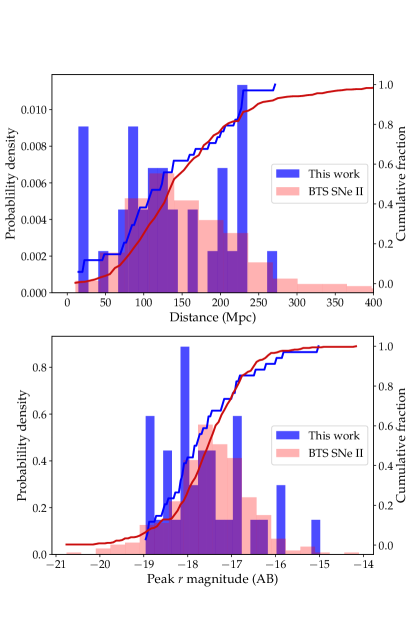
- The early UV-optical colors and blackbody evolution of 34 SNe II are consistent with spherical shock-cooling models, regardless of flash ionization features.
- SNeSCOPE recovers input parameters from multi-group simulations with less than 20% bias in radius and velocity, validating the fitting framework.
- About half of the sample (17/34) are best fit by models with breakout radii $ <10^{14} $ cm, while the other half require $ >10^{14} $ cm, suggesting a bimodal progenitor structure.
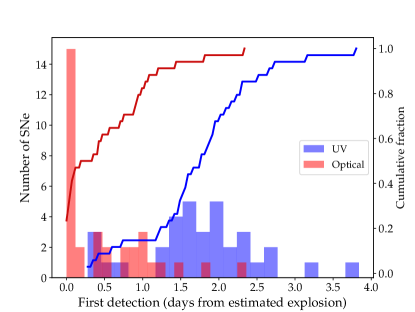
- The high-radius fits predict an unrealistically slow rise in the first day, indicating that large-breakout events likely result from inflated envelopes or steep CSM density profiles.
- X-ray detections and upper limits constrain CSM mass-loss rates to $ \dot{M} < 10^{-4} M_{\odot} \, \text{yr}^{-1} $, indicating that most SNe II progenitors have confined CSM.
- The observed breakout radius distribution is skewed toward larger radii due to luminosity bias, and after correction, 66% of RSGs explode with radii consistent with the field RSG distribution, with a tail extending to larger radii likely due to CSM.
Better researchstarts right now
From reading papers to final review, dramatically reduce your research time.
No credit card · Free plan available
This review was created by AI and reviewed by human editors.