
[Paper Review] SNIP: Bridging Mathematical Symbolic and Numeric Realms with Unified Pre-training
SNIP introduces a unified pre-training framework that jointly learns symbolic mathematical expressions and their numeric counterparts via contrastive learning, enabling cross-domain representation alignment. It achieves state-of-the-art performance in symbolic regression and mathematical property prediction, especially in few-shot settings, by leveraging shared, low-dimensional latent space representations that enhance both accuracy and model simplicity.
In an era where symbolic mathematical equations are indispensable for modeling complex natural phenomena, scientific inquiry often involves collecting observations and translating them into mathematical expressions. Recently, deep learning has emerged as a powerful tool for extracting insights from data. However, existing models typically specialize in either numeric or symbolic domains, and are usually trained in a supervised manner tailored to specific tasks. This approach neglects the substantial benefits that could arise from a task-agnostic multi-modal understanding between symbolic equations and their numeric counterparts. To bridge the gap, we introduce SNIP, a Symbolic-Numeric Integrated Pre-training model, which employs contrastive learning between symbolic and numeric domains, enhancing their mutual similarities in the embeddings. By performing latent space analysis, we observe that SNIP provides cross-domain insights into the representations, revealing that symbolic supervision enhances the embeddings of numeric data and vice versa. We evaluate SNIP across diverse tasks, including symbolic-to-numeric mathematical property prediction and numeric-to-symbolic equation discovery, commonly known as symbolic regression. Results show that SNIP effectively transfers to various tasks, consistently outperforming fully supervised baselines and competing strongly with established task-specific methods, especially in the low data regime scenarios where available data is limited. Code and model are available at: https://github.com/deep-symbolic-mathematics/Multimodal-Math-Pretraining
Motivation & Objective
- To bridge the gap between symbolic mathematics and numeric data by enabling mutual understanding through unified pre-training.
- To develop a task-agnostic model that enhances representations in both symbolic and numeric domains via joint contrastive learning.
- To improve few-shot and low-data scenarios in symbolic regression and mathematical reasoning tasks.
- To enable high-quality equation discovery by leveraging the interpolatable latent space of the pre-trained model.
Proposed method
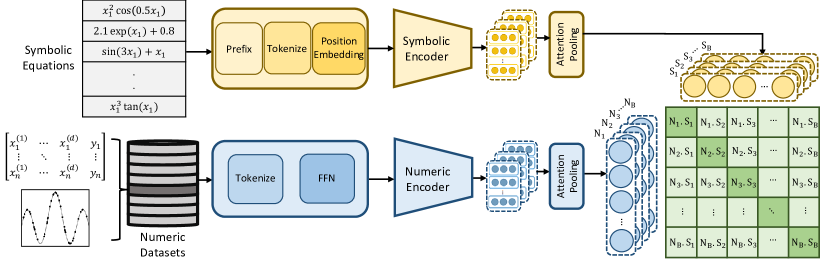
- SNIP employs dual transformer-based encoders to process symbolic expressions and numeric data separately.
- A joint contrastive learning objective aligns the embeddings of (symbolic, numeric) pairs, enhancing cross-domain similarity in the latent space.
- The model is pre-trained on paired symbolic and numeric data without task-specific fine-tuning, enabling zero-shot or few-shot transfer.
- After pre-training, an equation generation decoder is fine-tuned on top of the numeric encoder to perform symbolic regression.
- Latent space optimization is used to search for equations that balance accuracy and complexity by navigating the continuous, low-dimensional representations.
- The framework is evaluated on both synthetic (Feynman) and real-world (Black-box) datasets to assess generalization and robustness.
Experimental results
Research questions
- RQ1Can a unified pre-training approach effectively align symbolic and numeric representations in a shared latent space?
- RQ2Does joint contrastive learning between symbolic and numeric data improve downstream performance in mathematical reasoning tasks?
- RQ3How does SNIP perform in few-shot or low-data scenarios compared to fully supervised baselines?
- RQ4To what extent does the pre-trained latent space support effective symbolic regression through latent space optimization?
- RQ5Can SNIP achieve a better balance between accuracy and model complexity than existing state-of-the-art symbolic regression methods?
Key findings
- SNIP achieves state-of-the-art performance on the SRBench benchmark, ranking in the top three for accuracy on the Feynman dataset, especially for high-accuracy solutions (R² > 0.99).
- On the Black-box dataset, SNIP ranks fourth in median R² score (0.872) and achieves the lowest average complexity score (47.52), outperforming Operon (64.95), SBP-GP (639.19), and E2E (82.78).
- SNIP consistently maintains strong performance across varying noise levels on the Feynman dataset, demonstrating robustness to data perturbations.
- In Pareto-optimality analysis, SNIP lies on the first Pareto-front for both accuracy and complexity on both the Feynman and Black-box datasets, indicating superior trade-off performance.
- SNIP outperforms fully supervised baselines and competes strongly with task-specific methods, particularly in few-shot learning scenarios.
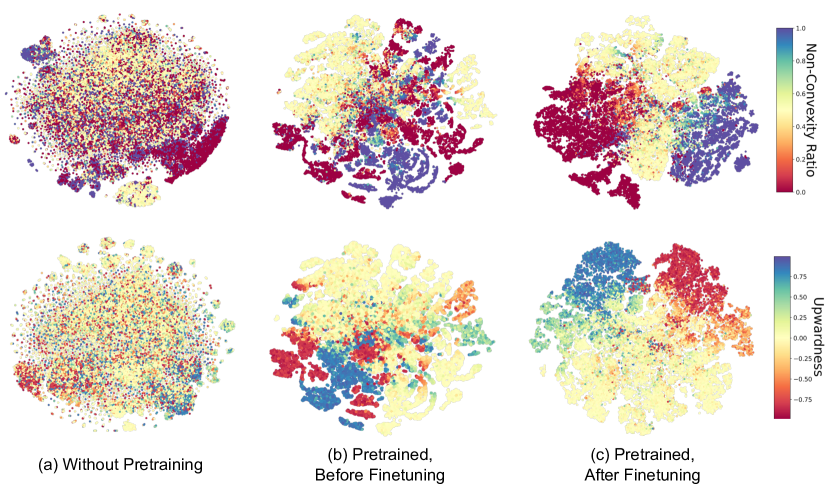
- Latent space analysis confirms that symbolic supervision improves numeric representation quality and vice versa, validating the mutual enhancement through joint pre-training.
Read this paper
Open the full text in the Nubint reader and ask about any passage as you read.
Read this paper on NubintThis review was generated by AI from the original paper. Please check the paper before citing it.