
[Paper Review] Sociocultural Norm Similarities and Differences via Situational Alignment and Explainable Textual Entailment
This paper proposes a human-AI collaborative framework to discover and compare descriptive social norms across Chinese and American cultures using situational alignment and explainable textual entailment. By leveraging Zhihu discussions and the SocialChemistry dataset, it creates a high-quality dataset of 3,069 cross-cultural norm pairs with explanations, demonstrating that existing models under 3B parameters significantly underperform on the new task of explainable social norm entailment.
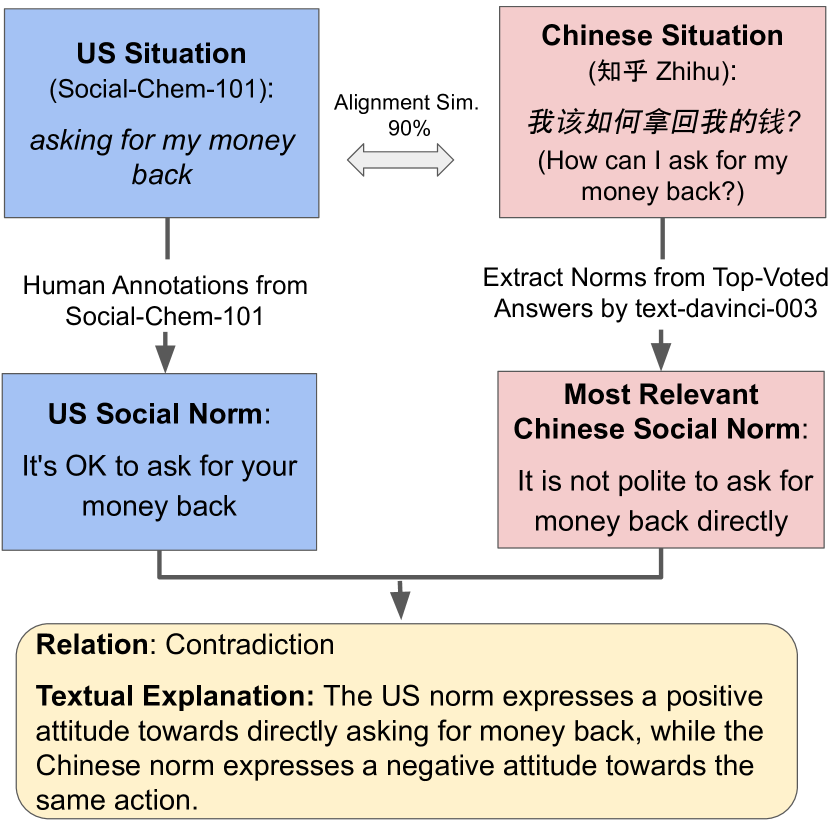
Designing systems that can reason across cultures requires that they are grounded in the norms of the contexts in which they operate. However, current research on developing computational models of social norms has primarily focused on American society. Here, we propose a novel approach to discover and compare descriptive social norms across Chinese and American cultures. We demonstrate our approach by leveraging discussions on a Chinese Q&A platform (Zhihu) and the existing SocialChemistry dataset as proxies for contrasting cultural axes, align social situations cross-culturally, and extract social norms from texts using in-context learning. Embedding Chain-of-Thought prompting in a human-AI collaborative framework, we build a high-quality dataset of 3,069 social norms aligned with social situations across Chinese and American cultures alongside corresponding free-text explanations. To test the ability of models to reason about social norms across cultures, we introduce the task of explainable social norm entailment, showing that existing models under 3B parameters have significant room for improvement in both automatic and human evaluation. Further analysis of cross-cultural norm differences based on our dataset shows empirical alignment with the social orientations framework, revealing several situational and descriptive nuances in norms across these cultures.
Motivation & Objective
- To address the lack of computational models grounded in non-Western cultural norms, particularly Chinese social norms.
- To develop a method for identifying and comparing descriptive social norms across Chinese and American cultures in a situationally aligned manner.
- To create a high-quality, explainable dataset of cross-cultural norm comparisons for downstream reasoning tasks.
- To evaluate the performance of existing language models on a new task—explainable social norm entailment—across cultures.
- To analyze cultural differences in social norms using empirical data aligned with the social orientations framework.
Proposed method
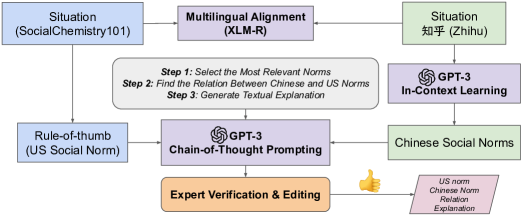
- Align social situations between Chinese (Zhihu) and American (SocialChemistry) cultural contexts using cross-lingual embedding similarity.
- Extract Chinese social norms from top-voted Zhihu answers using few-shot in-context learning with GPT-3.
- Apply Chain-of-Thought (CoT) prompting to generate textual explanations for norm entailment relations between Chinese and American norms.
- Implement a human-AI feedback loop to verify, validate, and edit norm pairs and explanations for quality and cultural accuracy.
- Construct a new dataset of 3,069 situation-aligned norm pairs with entailment relations and free-text explanations.
- Fine-tune and evaluate existing language models on the new task of explainable social norm entailment using automatic and human evaluation.
Experimental results
Research questions
- RQ1How can social norms from Chinese and American cultures be systematically aligned and compared using situational grounding?
- RQ2To what extent do existing language models (under 3B parameters) perform on the task of explainable social norm entailment across cultures?
- RQ3What are the key situational and descriptive nuances in social norms that distinguish Chinese and American cultural orientations?
- RQ4How well do the extracted norm differences align with established cultural frameworks such as the social orientations model?
- RQ5What are the limitations and biases inherent in using online Q&A platforms and LLMs for cross-cultural norm discovery?
Key findings
- The proposed human-AI framework successfully generated a high-quality dataset of 3,069 situation-aligned cross-cultural norm pairs with textual explanations.
- Existing language models with fewer than 3 billion parameters show significant performance gaps on the new task of explainable social norm entailment, both in automatic and human evaluation.
- The dataset enables empirical validation of cultural differences aligned with the social orientations framework, particularly highlighting collectivism, relational determinism, and authority worship in Chinese culture versus individualism in American culture.
- Analysis reveals situational and descriptive nuances in norms, such as differing expectations around family involvement, indirect communication, and hierarchical deference.
- The study identifies key limitations, including potential biases from content moderation on Zhihu, reliance on top-voted answers (which may reflect popularity over accuracy), and language model hallucinations or priming effects.
- The authors release their dataset to encourage future work on intra-cultural norm variation and value pluralism in social norms.
Read this paper
Open the full text in the Nubint reader and ask about any passage as you read.
Read this paper on NubintThis review was generated by AI from the original paper. Please check the paper before citing it.