
[Paper Review] Soft Matching Distance: A metric on neural representations that captures single-neuron tuning
This paper introduces Soft Matching Distance, a rotation-sensitive, permutation-invariant metric for neural representations that generalizes one-to-one neuron matching to networks of unequal sizes using optimal transport theory. It reveals geometric structure in neural tuning missed by rotation-invariant metrics and demonstrates that single-neuron tuning is preserved across artificial and biological networks, outperforming standard measures like linear predictivity in distinguishing model-brain similarities.
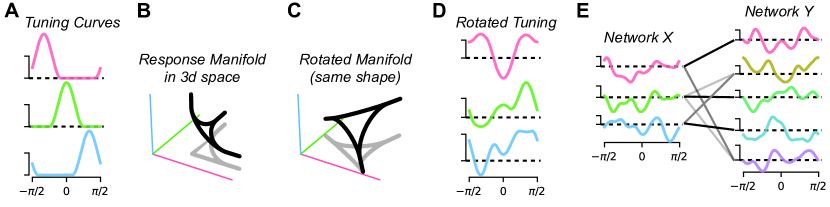
Common measures of neural representational (dis)similarity are designed to be insensitive to rotations and reflections of the neural activation space. Motivated by the premise that the tuning of individual units may be important, there has been recent interest in developing stricter notions of representational (dis)similarity that require neurons to be individually matched across networks. When two networks have the same size (i.e. same number of neurons), a distance metric can be formulated by optimizing over neuron index permutations to maximize tuning curve alignment. However, it is not clear how to generalize this metric to measure distances between networks with different sizes. Here, we leverage a connection to optimal transport theory to derive a natural generalization based on "soft" permutations. The resulting metric is symmetric, satisfies the triangle inequality, and can be interpreted as a Wasserstein distance between two empirical distributions. Further, our proposed metric avoids counter-intuitive outcomes suffered by alternative approaches, and captures complementary geometric insights into neural representations that are entirely missed by rotation-invariant metrics.
Motivation & Objective
- To develop a metric that captures single-neuron tuning in neural representations, which is overlooked by rotation-invariant similarity measures.
- To generalize one-to-one neuron matching—previously limited to same-sized networks—into a framework applicable to networks of different sizes.
- To provide a metric that is symmetric, satisfies the triangle inequality, and avoids counter-intuitive outcomes of alternative rotation-sensitive approaches.
- To empirically assess whether single-neuron tuning is preserved across artificial and biological neural networks.
- To offer a quantitative tool for adjudicating between competing hypotheses: 'tuning matters' versus 'geometry is all you need'.
Proposed method
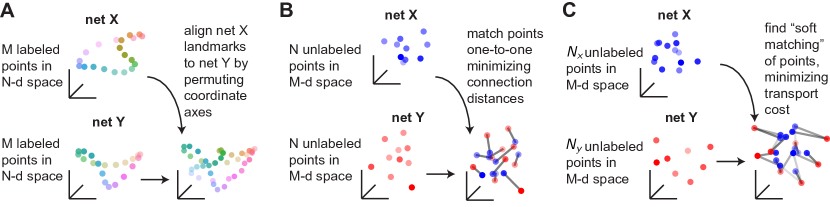
- The method leverages optimal transport theory to compute soft permutations (soft assignments) between neurons in two networks, enabling matching across different-sized networks.
- It formulates the distance as a Wasserstein distance between empirical distributions of tuning curves, ensuring symmetry and the triangle inequality.
- The soft matching is achieved by solving a regularized optimal transport problem, where the cost matrix encodes tuning curve similarity between neurons.
- The approach generalizes the permutation-based Procrustes method of Williams et al. [13] to allow for non-integer, probabilistic neuron assignments.
- The metric is invariant to neuron index permutations but sensitive to rotations, preserving tuning curve geometry.
- The method is applied to compare representations in deep neural networks and fMRI data from human visual cortex.
Experimental results
Research questions
- RQ1Can a metric be developed that captures single-neuron tuning while remaining invariant to neuron index permutations?
- RQ2How can one-to-one neuron matching be generalized to networks of unequal size?
- RQ3Does the soft matching distance reveal geometric structure in neural representations that rotation-invariant metrics miss?
- RQ4Is single-neuron tuning preserved across artificial networks and between artificial and biological neural networks?
- RQ5Can soft matching distance better distinguish between model architectures and brain regions than standard linear predictivity or rotation-invariant metrics?
Key findings
- Soft Matching Distance successfully generalizes one-to-one matching to unequal-sized networks using soft assignments derived from optimal transport.
- The metric is symmetric and satisfies the triangle inequality, making it a valid distance in a metric space.
- On CIFAR10 and CIFAR100, the metric reveals reproducible convergence of activation bases across networks, regardless of random seed, architecture, or training regimen.
- In brain network comparisons, soft matching distance outperformed linear predictivity in distinguishing between convolutional networks and transformers, and in identifying the ventral visual stream as the best match for object categorization models.
- The metric detected significant differences in model-brain similarity that were undetected by rotation-invariant measures like CKA and RSA.
- Empirical results support the hypothesis that single-neuron tuning is preserved above chance levels across artificial and biological networks, suggesting tuning matters beyond just geometric structure.
Read this paper
Open the full text in the Nubint reader and ask about any passage as you read.
Read this paper on NubintThis review was generated by AI from the original paper. Please check the paper before citing it.