
[Paper Review] Software Development Vehicles to enable extended and early co-design: a RISC-V and HPC case of study
The paper presents Software Development Vehicles (SDVs) to enable early co-design of HPC systems, demonstrated on a RISC-V design with a large-vector VPU, using FPGA and software emulation to provide feedback to hardware and system software teams.
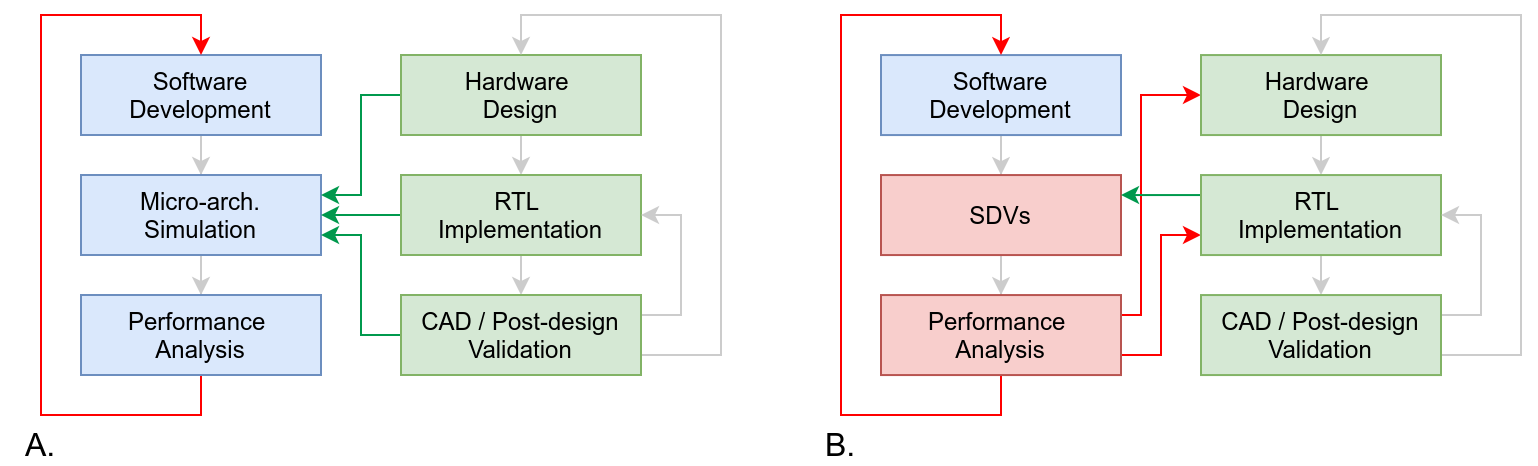
Prototyping HPC systems with low-to-mid technology readiness level (TRL) systems is critical for providing feedback to hardware designers, the system software team (e.g., compiler developers), and early adopters from the scientific community. The typical approach to hardware design and HPC system prototyping often limits feedback or only allows it at a late stage. In this paper, we present a set of tools for co-designing HPC systems, called software development vehicles (SDV). We use an innovative RISC-V design as a demonstrator, which includes a scalar CPU and a vector processing unit capable of operating large vectors up to 16 kbits. We provide an incremental methodology and early tangible evidence of the co-design process that provide feedback to improve both architecture and system software at a very early stage of system development.
Motivation & Objective
- Introduce a methodology that links software development and hardware design early in the HPC prototyping cycle.
- Provide a lean, RTL-based SDV infrastructure that enables porting, testing, benchmarking, and optimizing software without full system simulation.
- Demonstrate the approach on a RISC-V HPC design featuring a scalar core and a large-vector processing unit (VPU).
- Show how software feedback improves both architecture and system software during early RTL iterations.
Proposed method
- Define a three-stage SDV-enabled evaluation workflow: port to scalar RISC-V platforms, vectorization with software/emulation, and performance analysis on FPGA prototype.
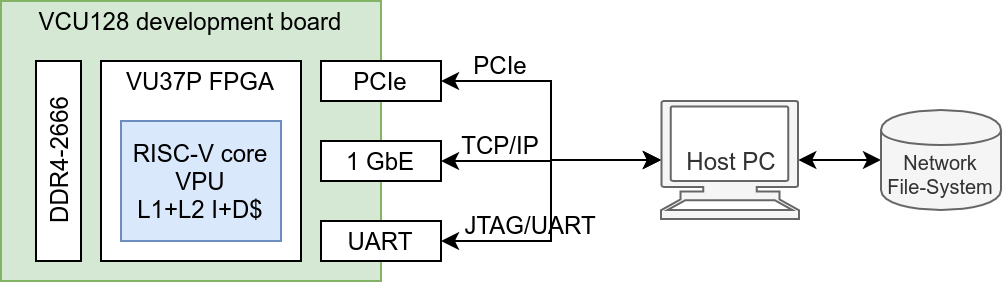
- Assemble and integrate SDV components: RVV-enabled RISC-V platforms (commercial), Vehave RVV emulator, and FPGA-based emulation (VCU128) with RTL instrumentation via hardware counters, tracing (PAPI, Extrae), and ILA signals.
- Collect and analyze instruction-level traces, vector lengths, and hardware counters to guide compiler optimizations, memory access patterns, and RTL adjustments.
- Provide cross-platform compatibility so binaries run on both commercial scalar platforms and FPGA RTL while allowing OS, libraries, and apps to operate in a high-TRL environment.
- Offer visualization and trace tooling (Paraver, Vehave traces, ILA traces) to close the feedback loop between software developers and hardware architects.
Experimental results
Research questions
- RQ1How can SDVs facilitate an early feedback loop from software to hardware during HPC RTL development?
- RQ2Can a lean, RTL-based SDV infrastructure produce useful, timely feedback without full-system simulators?
- RQ3What software and hardware instrumentation are needed to diagnose vectorization potential and RTL performance in a RISC-V HPC design?
- RQ4How does the methodology impact the alignment of compiler, libraries, and applications with emerging vector architectures?
Key findings
- SDVs enable a practical, incremental co-design workflow from scalar porting to vector optimization and FPGA-based performance analysis.
- The approach allows running OS, libraries, and applications on RTL implementations early, accelerating feedback to hardware and software teams.
- Vectorization insights from Vehave traces and ILA data guide compiler rescheduling and memory-access optimizations to better utilize large vector lengths.
- Empirical evaluation with a RISC-V FFT demonstrates how increasing vector length and reworking memory patterns can shift performance characteristics across phases, as observed in FPGA traces.
- The toolchain supports cross-platform binaries and provides detailed observables (instruction traces, vector lengths, hardware counters) to drive RTL and compiler improvements.
Read this paper
Open the full text in the Nubint reader and ask about any passage as you read.
Read this paper on NubintThis review was generated by AI from the original paper. Please check the paper before citing it.