
[Paper Review] SoftZoo: A Soft Robot Co-design Benchmark For Locomotion In Diverse Environments
SoftZoo is a differentiable, physics-based benchmark platform for co-designing soft robots with optimized morphology and control for locomotion across diverse environments such as ice, desert, wetlands, and water. It enables systematic study of design representations, environment-robot interactions, and gradient-based optimization, demonstrating that differentiable physics significantly improves co-design efficiency and reveals key tradeoffs in muscle formation and controller synthesis.
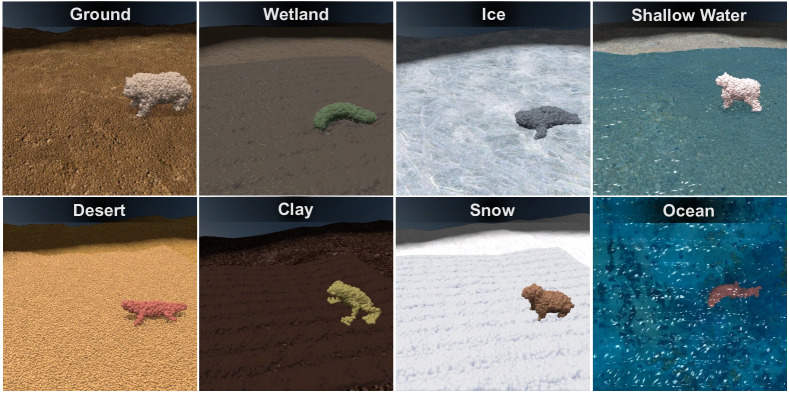
While significant research progress has been made in robot learning for control, unique challenges arise when simultaneously co-optimizing morphology. Existing work has typically been tailored for particular environments or representations. In order to more fully understand inherent design and performance tradeoffs and accelerate the development of new breeds of soft robots, a comprehensive virtual platform with well-established tasks, environments, and evaluation metrics is needed. In this work, we introduce SoftZoo, a soft robot co-design platform for locomotion in diverse environments. SoftZoo supports an extensive, naturally-inspired material set, including the ability to simulate environments such as flat ground, desert, wetland, clay, ice, snow, shallow water, and ocean. Further, it provides a variety of tasks relevant for soft robotics, including fast locomotion, agile turning, and path following, as well as differentiable design representations for morphology and control. Combined, these elements form a feature-rich platform for analysis and development of soft robot co-design algorithms. We benchmark prevalent representations and co-design algorithms, and shed light on 1) the interplay between environment, morphology, and behavior; 2) the importance of design space representations; 3) the ambiguity in muscle formation and controller synthesis; and 4) the value of differentiable physics. We envision that SoftZoo will serve as a standard platform and template an approach toward the development of novel representations and algorithms for co-designing soft robots' behavioral and morphological intelligence.
Motivation & Objective
- Address the lack of comprehensive, standardized platforms for co-designing soft robots that simultaneously optimize morphology and control.
- Enable systematic study of how environment, robot design, and control policies interact in locomotion tasks.
- Provide a unified, differentiable simulation framework to accelerate development of gradient-based co-design algorithms.
- Benchmark various design representations and co-design algorithms to identify key performance factors and failure modes.
- Establish a foundation for future research on morphological and behavioral intelligence in soft robotics through standardized evaluation metrics and environments.
Proposed method
- Introduces a differentiable multiphysics engine based on the Material Point Method (MPM) to simulate complex, naturally-inspired environments including ice, clay, snow, and water.
- Supports multiple robot design representations: SDF-Lerp and Wasserstein barycenter for geometry, with coefficients defining shape composition via Wasserstein distance over shape primitives.
- Enables differentiable control and morphology optimization by providing gradients through the physics engine, allowing end-to-end backpropagation.
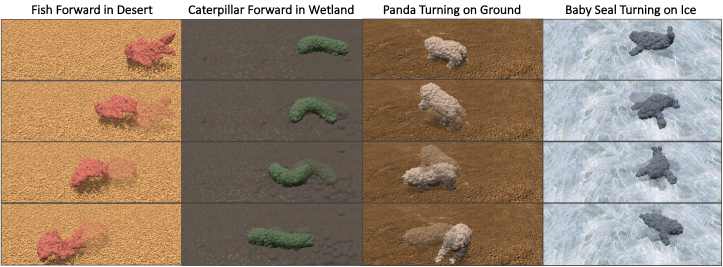
- Defines a suite of locomotion tasks: fast locomotion, agile turning, velocity tracking, and waypoint following, each with environment-specific reward functions.
- Uses biologically-inspired designs (e.g., seal, caterpillar, fish, panda) as initial morphologies to evaluate performance across environments.
- Employs reinforcement learning (PPO) and differentiable physics optimization with gradient-based search, comparing performance across 5 random seeds.
Experimental results
Research questions
- RQ1How do different design representations (e.g., SDF-Lerp vs. Wasserstein barycenter) affect the performance and stability of co-designed soft robots?
- RQ2What is the impact of differentiable physics on the efficiency and effectiveness of co-design algorithms compared to non-differentiable or simplified physics?
- RQ3How do environmental properties (e.g., ice vs. wetland) influence the optimal morphology and control policy for locomotion tasks?
- RQ4To what extent is muscle formation and controller synthesis ambiguous, and how do these ambiguities affect optimization outcomes?
- RQ5In what scenarios do gradient-based co-design methods fail, and what are the failure modes compared to gradient-free methods like RL?
Key findings
- Differentiable physics enables faster convergence and better performance in co-design tasks, especially in complex environments like wetlands and snow, where gradient-based methods outperform RL in sample efficiency.
- The Wasserstein barycenter representation preserves volume better than SDF-Lerp and leads to more stable and higher-performing designs across diverse terrains.
- In path-following tasks, RL with differentiable physics achieved higher success rates (e.g., 0.714 ± 0.072 for Fish in shallow water) compared to baseline methods, demonstrating robustness to environmental variation.
- Gradient-based co-design failed in environments with high non-smoothness or discontinuities (e.g., ice and clay), where small perturbations caused large performance drops, indicating sensitivity to physical model fidelity.
- The study revealed that muscle formation is ambiguous: multiple distinct muscle placements yielded similar performance, suggesting that the design space is highly non-unique and requires careful regularization.
- In agile turning tasks, Fish and Caterpillar designs achieved the highest performance (0.358 ± 0.024 and 0.358 ± 0.024 respectively) in shallow water, indicating that body shape and muscle layout are critical for maneuverability in fluid-like environments.
Better researchstarts right now
From reading papers to final review, dramatically reduce your research time.
No credit card · Free plan available
This review was created by AI and reviewed by human editors.