
[Paper Review] SoK: What don't we know? Understanding Security Vulnerabilities in SNARKs
This paper presents the first comprehensive study of 141 real-world vulnerabilities in SNARK implementations, introducing a four-layer system and threat model, a detailed taxonomy of vulnerabilities across the SNARK stack, and actionable insights into critical flaws such as arithmetic bugs, under-constrained circuits, and insecure instantiations. It reveals that implementation-level issues—especially in low-level DSLs like Circom—pose major threats to core SNARK properties, urging stronger tooling and education to secure the ecosystem.
Zero-knowledge proofs (ZKPs) have evolved from being a theoretical concept providing privacy and verifiability to having practical, real-world implementations, with SNARKs (Succinct Non-Interactive Argument of Knowledge) emerging as one of the most significant innovations. Prior work has mainly focused on designing more efficient SNARK systems and providing security proofs for them. Many think of SNARKs as "just math," implying that what is proven to be correct and secure is correct in practice. In contrast, this paper focuses on assessing end-to-end security properties of real-life SNARK implementations. We start by building foundations with a system model and by establishing threat models and defining adversarial roles for systems that use SNARKs. Our study encompasses an extensive analysis of 141 actual vulnerabilities in SNARK implementations, providing a detailed taxonomy to aid developers and security researchers in understanding the security threats in systems employing SNARKs. Finally, we evaluate existing defense mechanisms and offer recommendations for enhancing the security of SNARK-based systems, paving the way for more robust and reliable implementations in the future.
Motivation & Objective
- To address the lack of holistic understanding of real-world security vulnerabilities in SNARK-based systems.
- To establish a formal system and threat model for reasoning about SNARK deployments, including adversarial capabilities and component interactions.
- To analyze 141 disclosed vulnerabilities from audit reports, disclosures, and bug trackers to identify recurring patterns and root causes.
- To develop a comprehensive taxonomy of SNARK-specific vulnerabilities, distinguishing them from general software flaws.
- To evaluate existing defense mechanisms and identify critical gaps in current practices and tooling.
Proposed method
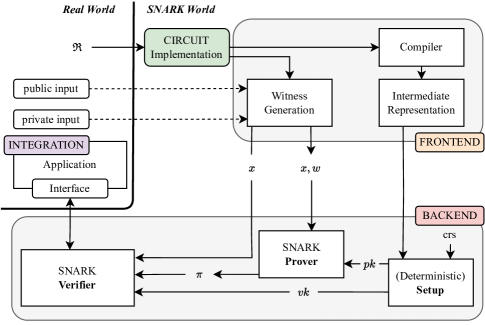
- Constructed a four-layer system model covering theoretical foundations, circuit frameworks, circuit programs, and system deployments to map attack surfaces.
- Defined adversarial roles and threat models, including passive, active, and implementation-level adversaries, to assess real-world threat scenarios.
- Collected and analyzed 141 vulnerabilities from 107 audit reports, 16 disclosures, and public bug trackers spanning 2018–2024.
- Categorized vulnerabilities into distinct classes such as arithmetic bugs, under-constrained circuits, and proof system implementation flaws using a novel taxonomy.
- Evaluated existing defense techniques, including static analysis, formal verification, and consensus-level checks like turnstile enforcement.
- Identified key attack vectors such as soundness bugs enabling infinite coin creation in privacy pools, and highlighted undetectable exploits in zero-knowledge systems.
Experimental results
Research questions
- RQ1What are the primary threat surfaces and adversarial capabilities in real-world SNARK deployments?
- RQ2What are the most prevalent and critical vulnerabilities across the SNARK stack, and how do they differ from general software vulnerabilities?
- RQ3Why do implementation-level flaws—especially in low-level DSLs like Circom—persist despite theoretical security guarantees?
- RQ4How do design and instantiation choices (e.g., cryptographic curves) impact the security of deployed SNARK systems?
- RQ5What are the limitations of current defense mechanisms, and what improvements are needed to prevent undetectable exploits?
Key findings
- 141 vulnerabilities were identified across the SNARK stack, with implementation bugs—especially in arithmetic circuits and input validation—being the most common and critical threat.
- Under-constrained circuits, often due to misinterpretation of logic or lack of high-level abstractions in DSLs like Circom, are a major source of vulnerabilities that undermine soundness and zero-knowledge.
- Implementation errors in proof systems, such as bugs in verifier code (e.g., Gnark’s Plonk verifier), can directly compromise soundness and are often overlooked in audits.
- The 'Frozen Heart' vulnerability exemplifies how a single flaw in a widely used system can enable infinite coin creation in privacy pools, remaining undetected as long as pool balance is preserved.
- Undetectable exploits are a significant concern in privacy-preserving systems, where attacks can evade detection by maintaining apparent consistency in state transitions.
- Insecure cryptographic instantiations—such as weak curves or fields—can expose systems to brute-force attacks, highlighting the need for careful selection in system design.
Read this paper
Open the full text in the Nubint reader and ask about any passage as you read.
Read this paper on NubintThis review was generated by AI from the original paper. Please check the paper before citing it.