
[Paper Review] Solution of physics-based inverse problems using conditional generative adversarial networks with full gradient penalty
This paper proposes a conditional Wasserstein GAN with full gradient penalty (Full-GP) to solve physics-based inverse problems where prior knowledge is given as samples and the forward model is a black-box PDE system. By enforcing 1-Lipschitz continuity on the critic with respect to both input and measurement vectors, the method ensures stronger convergence guarantees and improved sampling accuracy, demonstrated on synthetic and biomechanics-inspired inverse problems with superior posterior estimation compared to prior cWGANs.
The solution of probabilistic inverse problems for which the corresponding forward problem is constrained by physical principles is challenging. This is especially true if the dimension of the inferred vector is large and the prior information about it is in the form of a collection of samples. In this work, a novel deep learning based approach is developed and applied to solving these types of problems. The approach utilizes samples of the inferred vector drawn from the prior distribution and a physics-based forward model to generate training data for a conditional Wasserstein generative adversarial network (cWGAN). The cWGAN learns the probability distribution for the inferred vector conditioned on the measurement and produces samples from this distribution. The cWGAN developed in this work differs from earlier versions in that its critic is required to be 1-Lipschitz with respect to both the inferred and the measurement vectors and not just the former. This leads to a loss term with the full (and not partial) gradient penalty. It is shown that this rather simple change leads to a stronger notion of convergence for the conditional density learned by the cWGAN and a more robust and accurate sampling strategy. Through numerical examples it is shown that this change also translates to better accuracy when solving inverse problems. The numerical examples considered include illustrative problems where the true distribution and/or statistics are known, and a more complex inverse problem motivated by applications in biomechanics.
Motivation & Objective
- Address the challenge of solving high-dimensional, probabilistic inverse problems constrained by physical PDEs when prior information is available only as samples.
- Overcome limitations of traditional MCMC and BNNs in high-dimensional settings and when derivative computation is infeasible due to legacy code.
- Develop a deep learning framework that learns the posterior distribution of inferred parameters conditioned on noisy measurements using only samples and a black-box forward model.
- Improve the robustness and accuracy of conditional generative modeling for inverse problems through a stronger theoretical convergence guarantee.
- Enable accurate uncertainty quantification in complex inverse problems, such as those arising in biomechanics, using a sample-efficient and differentiable training strategy.
Proposed method
- Construct a training dataset of 12,000 paired samples of inferred parameters (x) and corresponding noisy measurements (y) using the prior distribution and a physics-based forward model.
- Train a conditional Wasserstein GAN (cWGAN) where the generator maps a noise vector and a measurement vector to a sample from the posterior distribution of x given y.
- Introduce a full gradient penalty (Full-GP) by enforcing 1-Lipschitz constraint on the critic with respect to both the inferred vector x and the measurement vector y, leading to a critic loss with the full Hessian gradient penalty.
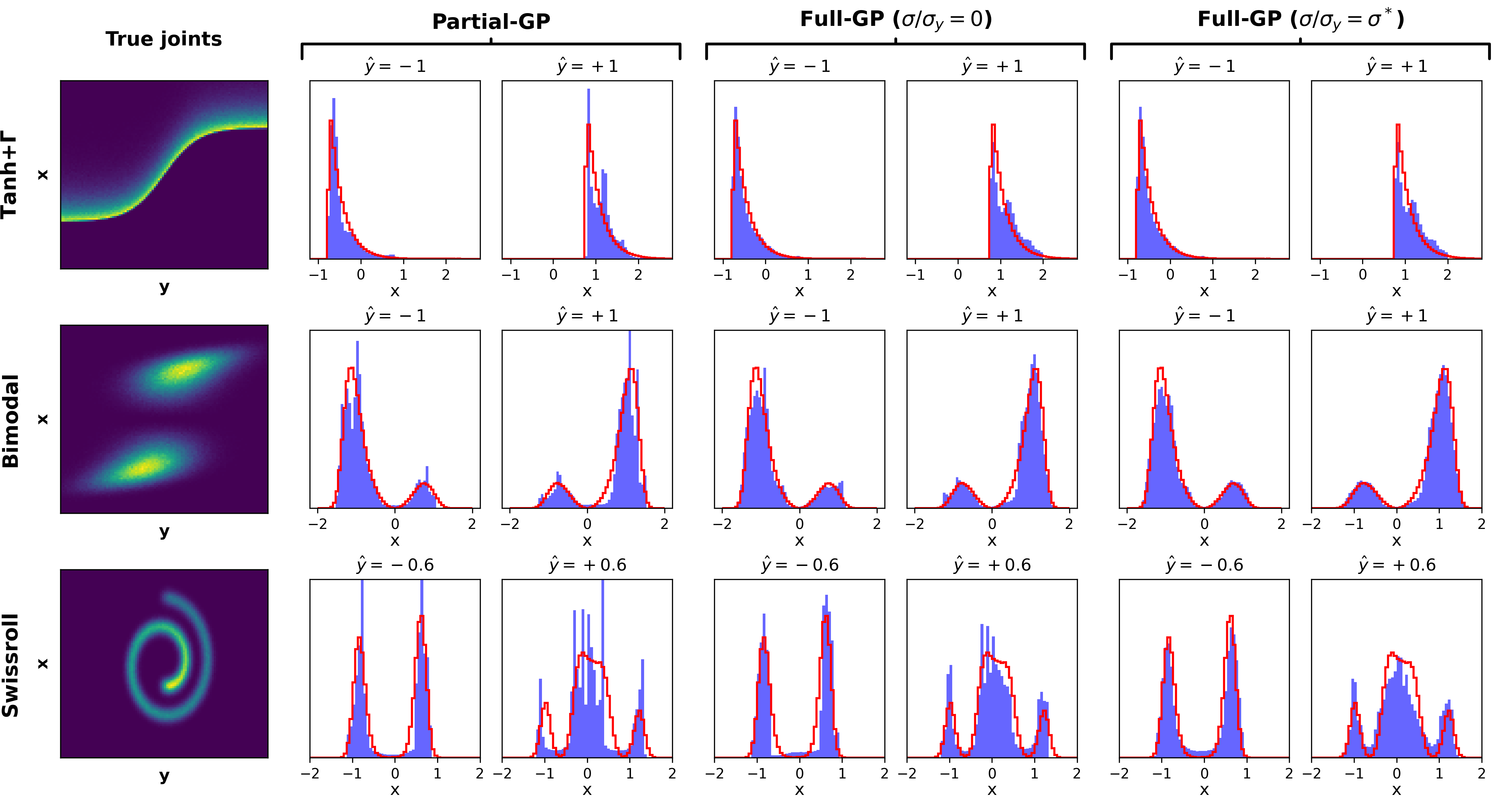
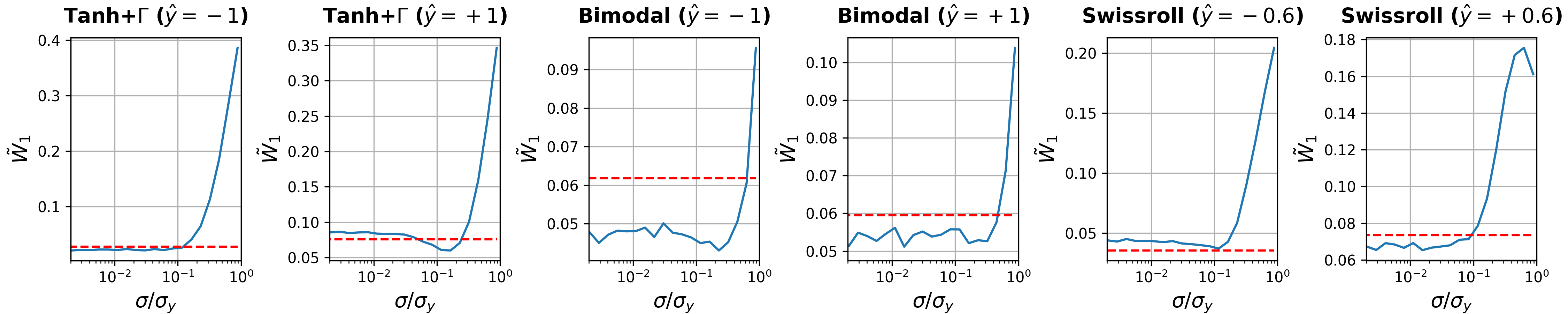
- Use a sampling strategy that generates measurements from a Gaussian distribution tightly centered around the true measurement, improving posterior estimation accuracy.
- Estimate posterior statistics (mean and standard deviation) from 3,000 generated samples using the trained Full-GP cWGAN.
- Apply the method to two test cases: a 2D inverse heat conduction problem and a biomechanics-inspired inverse problem involving optic nerve head shear modulus estimation from wave amplitude data.
Experimental results
Research questions
- RQ1Can a cWGAN with full gradient penalty achieve stronger theoretical convergence to the true posterior distribution in physics-based inverse problems compared to standard cWGANs?
- RQ2How does enforcing 1-Lipschitz continuity on the critic with respect to both input and measurement vectors affect the accuracy and robustness of posterior sampling in high-dimensional inverse problems?
- RQ3To what extent does the proposed sampling strategy—generating measurements from a Gaussian distribution around the true measurement—improve posterior estimation in real-world inverse problems?
- RQ4How does the Full-GP cWGAN perform in comparison to baseline cWGANs when applied to a complex, real-world biomechanics-inspired inverse problem with unknown ground-truth statistics?
- RQ5Can the method effectively quantify uncertainty in regions of high ambiguity, such as boundaries or low-signal areas, in the inferred parameter field?
Key findings
- The Full-GP cWGAN ensures weak convergence of the learned conditional distribution to the true posterior, a theoretical improvement over prior cWGANs that only enforce Lipschitz continuity with respect to the inferred vector.
- The method achieves more accurate posterior mean estimates, closely matching the ground truth shear modulus in the biomechanics-inspired inverse problem for all three test samples.
- Posterior standard deviation estimates correctly identify regions of high uncertainty, such as edges of the optic nerve head, where predictions are less reliable.
- When the measurement noise level increases (σ/σ_Y = 0.31), the predicted posterior standard deviation increases accordingly, reflecting the expected rise in uncertainty and validating the model’s reliability in uncertainty quantification.
- The Full-GP cWGAN outperforms its predecessor in terms of sampling accuracy and robustness, particularly in high-dimensional and complex inverse problems.
- The proposed sampling strategy—using noise-injected measurements from a tight Gaussian distribution—further enhances performance, especially in noisy or ill-posed settings.
Read this paper
Open the full text in the Nubint reader and ask about any passage as you read.
Read this paper on NubintThis review was generated by AI from the original paper. Please check the paper before citing it.