
[Paper Review] Solving Diffusion ODEs with Optimal Boundary Conditions for Better Image Super-Resolution
This paper proposes a plug-and-play sampling method that improves image super-resolution by solving diffusion ODEs with optimally derived boundary conditions (BCs), significantly boosting performance of pre-trained diffusion-based SR models without retraining. By identifying an approximately optimal BC through efficient exploration of a reference HR-LR image set, the method achieves higher-quality, stable results than standard samplers—even surpassing slower, high-step baselines like DDPM-1000.
Diffusion models, as a kind of powerful generative model, have given impressive results on image super-resolution (SR) tasks. However, due to the randomness introduced in the reverse process of diffusion models, the performances of diffusion-based SR models are fluctuating at every time of sampling, especially for samplers with few resampled steps. This inherent randomness of diffusion models results in ineffectiveness and instability, making it challenging for users to guarantee the quality of SR results. However, our work takes this randomness as an opportunity: fully analyzing and leveraging it leads to the construction of an effective plug-and-play sampling method that owns the potential to benefit a series of diffusion-based SR methods. More in detail, we propose to steadily sample high-quality SR images from pre-trained diffusion-based SR models by solving diffusion ordinary differential equations (diffusion ODEs) with optimal boundary conditions (BCs) and analyze the characteristics between the choices of BCs and their corresponding SR results. Our analysis shows the route to obtain an approximately optimal BC via an efficient exploration in the whole space. The quality of SR results sampled by the proposed method with fewer steps outperforms the quality of results sampled by current methods with randomness from the same pre-trained diffusion-based SR model, which means that our sampling method "boosts" current diffusion-based SR models without any additional training.
Motivation & Objective
- To address the instability and randomness in sampling from pre-trained diffusion-based image super-resolution models.
- To identify a principled, deterministic method for selecting boundary conditions (BCs) that yield consistently high-quality SR results.
- To enable stable, high-performance inference using existing pre-trained models without additional training.
- To explore the independence of the optimal BC from input low-resolution images, enabling reuse across diverse inputs.
- To demonstrate that optimal BC selection can outperform standard sampling methods, even those with many more steps.
Proposed method
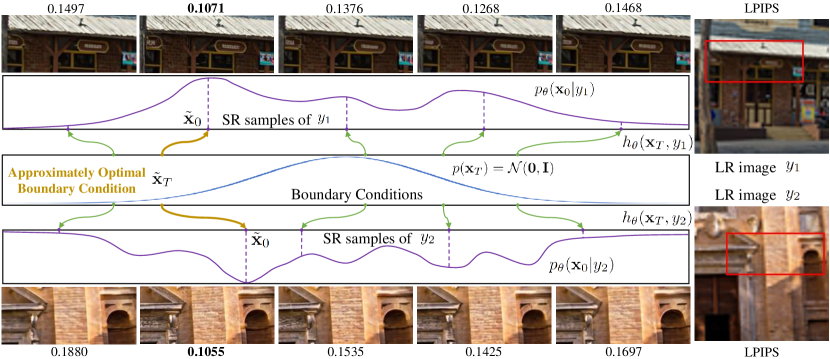
- The method formulates the diffusion process as an ordinary differential equation (ODE) and seeks an optimal initial noise vector (BC) x̃_T that maximizes the probability density of the resulting high-resolution image x̃_0.
- It uses a reference set of HR-LR image pairs (R) to guide the search for the optimal BC, treating the BC as a learnable prior independent of input LR images.
- A candidate set of random BCs (K) is sampled and evaluated using the model’s conditional generation capability to identify the BC that yields the highest-quality SR output on average.
- The optimal BC is estimated via a search procedure that maximizes the likelihood of generating high-quality images under the diffusion ODE solver (e.g., DDIM-100).
- The method is plug-and-play: once the optimal BC is computed, it can be reused to generate high-quality SR images from any unseen LR input without retraining.
- The approach leverages the fact that the optimal BC is independent of the input LR image, enabling generalization across different inputs.
Experimental results
Research questions
- RQ1Can we identify a deterministic, optimal boundary condition for diffusion ODEs that consistently produces high-quality image super-resolution results?
- RQ2Does the optimal boundary condition depend on the input low-resolution image, or can it be shared across different inputs?
- RQ3Can we improve sampling performance of pre-trained diffusion-based SR models without retraining by optimizing the boundary condition?
- RQ4How does the size of the reference and candidate sets affect the quality and stability of the estimated optimal BC?
- RQ5Can a method based on optimal BC selection outperform standard sampling strategies like DDPM-100, even with fewer steps?
Key findings
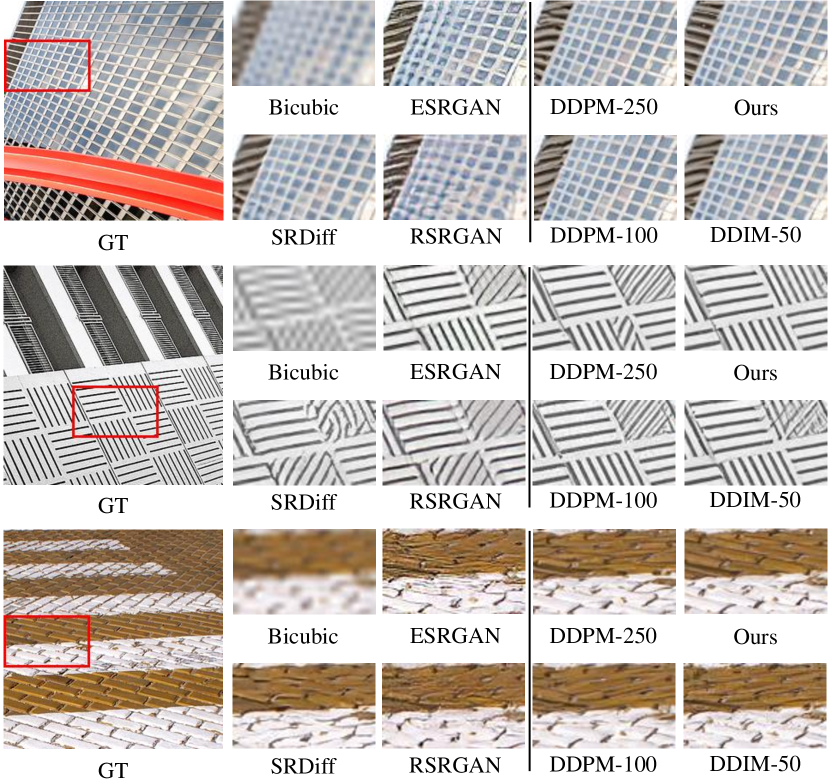
- The proposed method with DDIM-100 outperforms all other sampling methods—including DDPM-1000—on the bicubic-SR benchmark, achieving higher image quality with faster inference.
- On the real-SR benchmark, the method surpasses the official sampling method of StableSR (DDPM-200) while maintaining a faster sampling speed.
- The ablation study shows that increasing the reference set size (R) and candidate set size (K) leads to more stable and higher-quality BC estimation, with performance improving and variance decreasing.
- The estimated optimal BC (x̃_T) is independent of the input LR image, enabling reuse across different inputs without re-computation.
- The method achieves state-of-the-art performance in terms of LPIPS and visual quality, demonstrating that optimal BC selection can effectively 'boost' existing models without retraining.
- The method provides a stable, deterministic sampling strategy that eliminates the randomness inherent in standard diffusion sampling, ensuring consistent high-quality results.
Read this paper
Open the full text in the Nubint reader and ask about any passage as you read.
Read this paper on NubintThis review was generated by AI from the original paper. Please check the paper before citing it.