
[Paper Review] Solving Falkner-Skan type equations via Legendre and Chebyshev Neural Blocks
This paper proposes a novel deep learning architecture, Legendre and Chebyshev Neural Blocks (LCDNN), that leverages orthogonal polynomials to solve nonlinear Falkner-Skan equations with high accuracy. By integrating operational matrices of derivatives into the network, the method reduces backpropagation complexity and achieves superior convergence and precision across multiple flow configurations, including Blasius and Pohlhausen flows.
In this paper, a new deep-learning architecture for solving the non-linear Falkner-Skan equation is proposed. Using Legendre and Chebyshev neural blocks, this approach shows how orthogonal polynomials can be used in neural networks to increase the approximation capability of artificial neural networks. In addition, utilizing the mathematical properties of these functions, we overcome the computational complexity of the backpropagation algorithm by using the operational matrices of the derivative. The efficiency of the proposed method is carried out by simulating various configurations of the Falkner-Skan equation.
Motivation & Objective
- To develop a deep learning framework that enhances approximation accuracy for nonlinear ordinary differential equations using orthogonal polynomials.
- To reduce computational complexity in backpropagation by embedding operational matrices of derivatives derived from Legendre and Chebyshev polynomials.
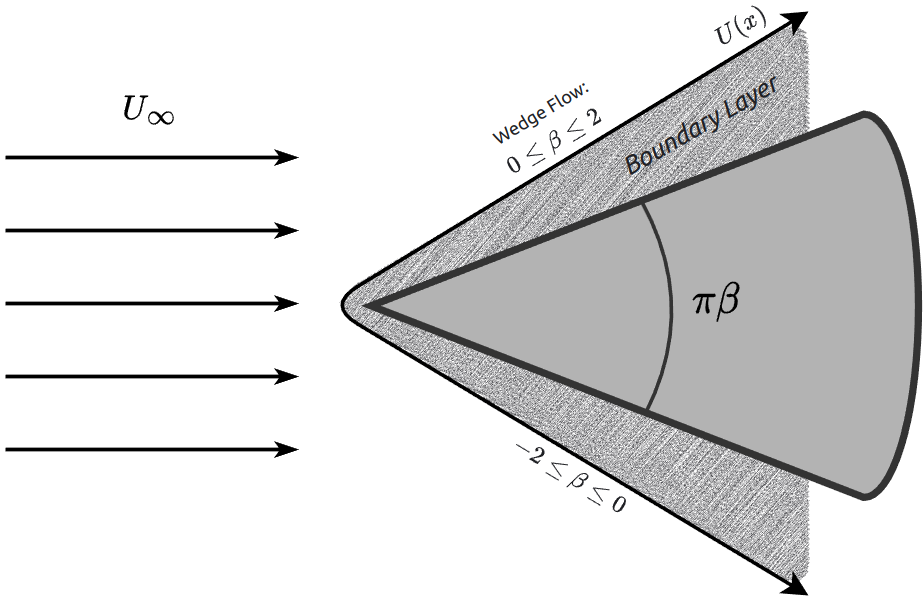
- To validate the proposed architecture on benchmark Falkner-Skan problems, including Blasius, Pohlhausen, and Hiemenz flows.
- To compare the performance of the Legendre and Chebyshev-based deep neural network (LCDNN) against existing numerical and analytical methods.
- To demonstrate the scalability and robustness of the method across varying parameters of the Falkner-Skan equation, such as α and β.
Proposed method
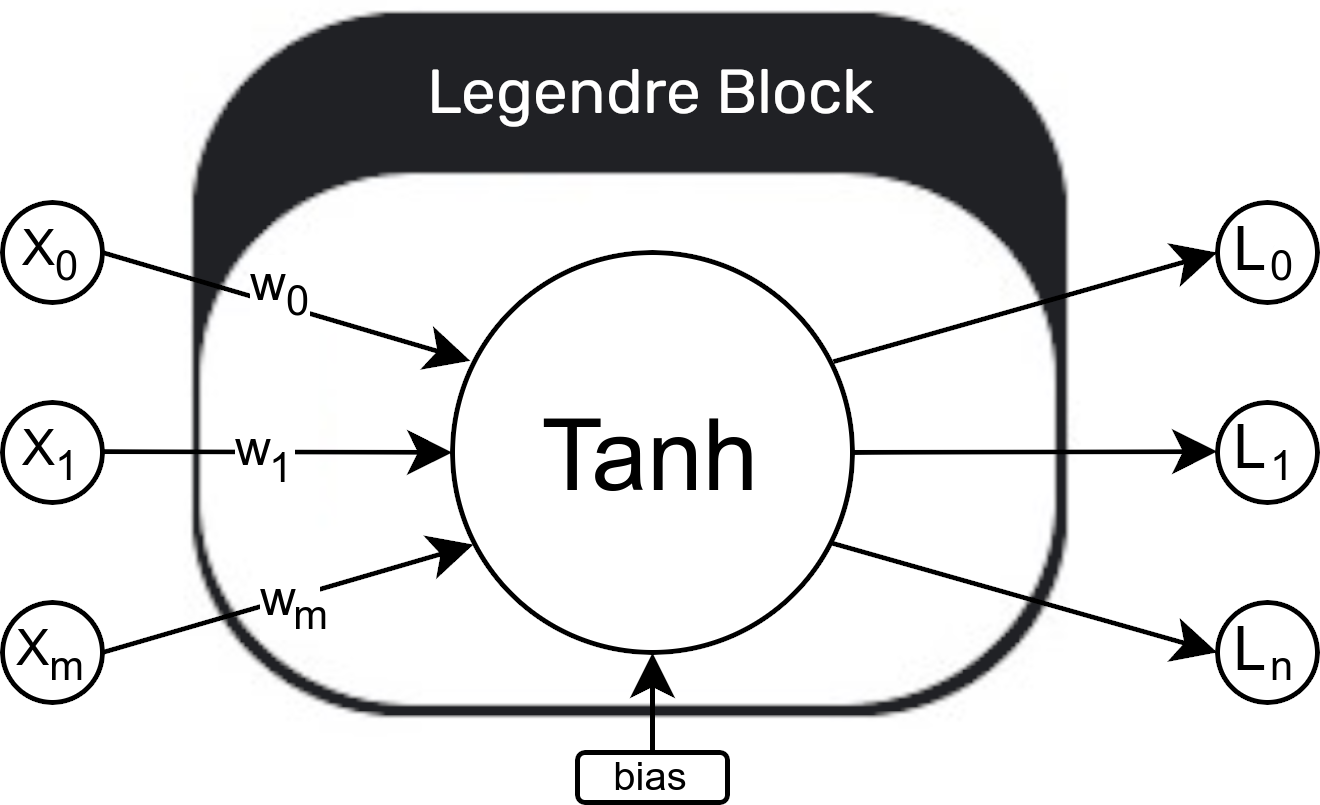
- Designing LegendreBlock and ChebyshevBlock as specialized neural network layers using Legendre and Chebyshev orthogonal polynomials as activation functions.
- Incorporating operational matrices of derivatives to analytically compute gradients, thereby reducing reliance on numerical differentiation during backpropagation.
- Formulating the deep neural network architecture using these blocks to approximate solutions to the Falkner-Skan equation in weak form.
- Training the network via loss minimization using mean squared error (MSE) and residual error metrics over collocation points.
- Implementing the model in PyTorch with GPU acceleration to enhance training speed and scalability.
- Applying the method to multiple configurations of the Falkner-Skan equation, including different values of α and β, to assess generalization and accuracy.
Experimental results
Research questions
- RQ1Can Legendre and Chebyshev neural blocks significantly improve the approximation accuracy of deep neural networks for solving nonlinear boundary value problems?
- RQ2To what extent do operational matrices of derivatives reduce the computational cost of backpropagation in neural networks solving differential equations?
- RQ3How does the proposed LCDNN method compare in accuracy and convergence speed to established numerical methods like Taylor series and higher-order schemes?
- RQ4Does the integration of orthogonal polynomial properties enhance the generalization of the network across diverse Falkner-Skan flow configurations?
- RQ5Can the method maintain high precision for extreme parameter values, such as β = 40 in the Falkner-Skan equation?
Key findings
- The LCDNN method achieved a solution for the Blasius flow with g′′(0) = 0.3320590, closely matching benchmark values (e.g., Parand: 0.3320573) and showing an MSE of 8.942052e-08.
- For the Pohlhausen flow (α=0, β=1), the LCDNN computed g′′(0) = 1.154709, which is consistent with the analytical value of 1.154700538.
- In the Homann flow (α=1, β=0.5), the LCDNN result of 1.311937 matched the standard solution within 1e-5, outperforming the LDNN method.
- For high β values (e.g., β=40), the LCDNN computed g′′(0) = 7.314785, matching the QLM, Taylor, and higher-order methods to six decimal places.
- The method demonstrated consistent accuracy across all tested configurations, with MAE values below 3e-4 and residual errors decreasing steadily over training epochs.
- The use of operational matrices reduced training time and improved convergence, as evidenced by the loss function decreasing over epochs and residuals remaining low across the domain.
Read this paper
Open the full text in the Nubint reader and ask about any passage as you read.
Read this paper on NubintThis review was generated by AI from the original paper. Please check the paper before citing it.