
[Paper Review] Some New Copula Based Distribution-free Tests of Independence among Several Random Variables
This paper proposes a novel copula-based, distribution-free test of independence among multiple random variables that is invariant under strictly monotone transformations and permutations. By employing a multi-scale approach with a Gaussian kernel estimator and bandwidth selection, the method achieves large-sample consistency and outperforms existing tests in detecting non-monotone dependencies.
Over the last couple of decades, several copula based methods have been proposed in the literature to test for the independence among several random variables. But these existing tests are not invariant under monotone transformations of the variables, and they often perform poorly if the dependence among the variables is highly non-monotone in nature. In this article, we propose a copula based measure of dependency and use it to construct some new distribution-free tests of independence. The proposed measure and the resulting tests, all are invariant under permutations and monotone transformations of the variables. Our dependency measure involves a kernel function, and we use the Gaussian kernel for that purpose. We adopt a multi-scale approach, where we look at the results obtained for several choices of the bandwidth parameter associated with the Gaussian kernel and aggregate them judiciously. Large sample properties of the dependency measure and the resulting tests are derived under appropriate regularity conditions. Several simulated and real data sets are analyzed to compare the performance of the proposed tests with some popular tests available in the literature.
Motivation & Objective
- To develop a dependency measure and associated test of independence that is invariant under strictly monotone transformations and permutations of the variables.
- To address the limitations of existing copula-based tests that perform poorly under highly non-monotone dependence structures.
- To introduce a multi-scale approach using a kernel-based estimator with adaptive bandwidth selection to enhance detection power across diverse dependence patterns.
- To establish large-sample consistency of the proposed test under regularity conditions.
- To compare the proposed method empirically with established tests (e.g., dCov, HSIC, Hoeffding’s φ) on simulated and real data.
Proposed method
- Proposes a copula-based dependency measure $ I_{\sigma}(\mathbf{X}) $ defined via a Gaussian kernel function with bandwidth $ \sigma $, measuring dependence between the copula of $ \mathbf{X} $ and the independent copula.
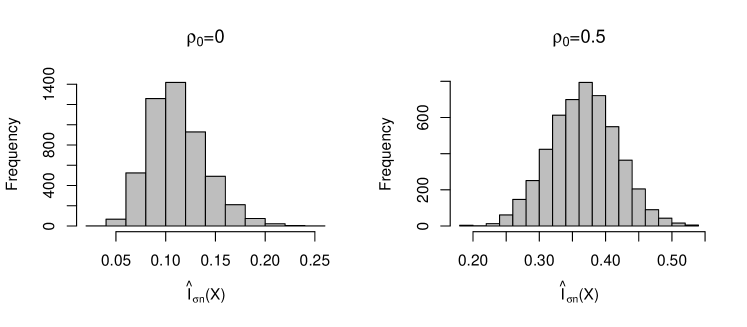
- Constructs a nonparametric estimator $ \widehat{I}_{\sigma,n}(\mathbf{X}) $ using empirical copulas and kernel-based covariance-like statistics.
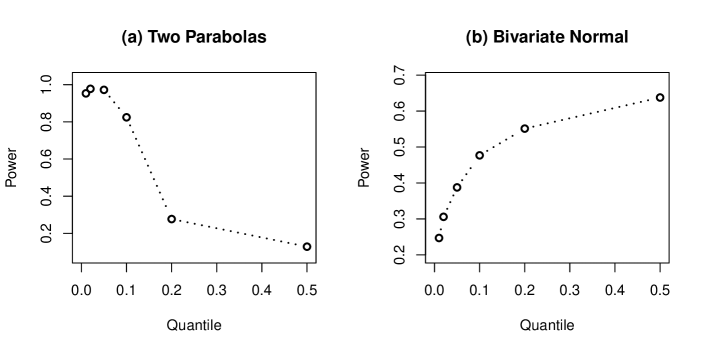
- Applies a multi-scale strategy by evaluating the test statistic across multiple bandwidths $ \sigma^{(1)}, \dots, \sigma^{(m)} $, then aggregating results via maximum or sum-based test statistics.
- Uses p-value aggregation via the Benjamini-Hochberg procedure to control the false discovery rate (FDR) in multiple testing across bandwidths.
- Establishes almost sure convergence of the estimator to the true dependency measure and proves consistency of the resulting tests under the null and alternative hypotheses.
- Employs theoretical lemmas and convergence results to show that the estimator is consistent and the test is asymptotically powerful under dependence.
Experimental results
Research questions
- RQ1Can a copula-based dependency measure be constructed that is invariant under strictly monotone transformations and permutations of the variables?
- RQ2How can a multi-scale kernel-based approach improve detection of non-monotone dependence structures compared to single-bandwidth methods?
- RQ3Does the proposed test achieve large-sample consistency under both the null hypothesis of independence and the alternative of dependence?
- RQ4How does the performance of the proposed test compare to established methods like dCov, HSIC, and Hoeffding’s φ in detecting various types of dependence?
- RQ5Can the multi-scale aggregation of bandwidth-specific p-values lead to a more powerful and robust test under diverse dependence patterns?
Key findings
- The proposed dependency measure $ I_{\sigma}(\mathbf{X}) $ satisfies all Dependence Axioms of Schweizer et al. (1981) in the bivariate case and is invariant under permutations and strictly monotone transformations.
- The estimator $ \widehat{I}_{\sigma,n}(\mathbf{X}) $ converges almost surely to the true dependency measure $ I_{\sigma}(\mathbf{X}) $ as sample size $ n \to \infty $, under regularity conditions.
- The multi-scale test statistics $ T_{\text{max}} $ and $ T_{\text{sum}} $, based on multiple bandwidths, are consistent: they converge to zero almost surely under independence and to positive values under dependence.
- The FDR-adjusted p-value aggregation method ensures that the test’s power approaches 1 as sample size increases, under the alternative hypothesis.
- Simulated and real data analyses demonstrate that the proposed test outperforms existing methods—especially in detecting non-monotone dependence—where traditional rank-based or single-scale tests fail.
- Theoretical results confirm that the test remains distribution-free under the null hypothesis of independence, due to the use of empirical copulas and permutation-invariant kernel statistics.
Read this paper
Open the full text in the Nubint reader and ask about any passage as you read.
Read this paper on NubintThis review was generated by AI from the original paper. Please check the paper before citing it.