
[Paper Review] Sorting multibay block stacking storage systems
This paper proposes a two-stage solution approach for the multibay unit-load pre-marshalling problem (MUPMP) in block stacking warehouses using autonomous mobile robots (AMRs), optimizing both move count and travel time. It introduces an exact constraint programming (CP) model for the second stage, significantly improving solution quality and enabling efficient sorting of real-world warehouse configurations with multiple bays and up to four access directions per bay.
Autonomous mobile robots (AMRs) are increasingly used to automate operations in intralogistics. One crucial feature of AMRs is their availability, allowing them to operate 24/7. This work addresses the multibay unit load pre-marshalling problem, which extends pre-marshalling from a single bay to larger warehouse configurations with multiple bays. Pre-marshalling leverages off-peak time intervals to sort a block stacking warehouse in anticipation of future orders. These larger warehouse configurations require not only the minimization of the number of moves but also the consideration of distance or time when making sorting decisions. Our proposed solution for the multibay unit load pre-marshalling problem is based on our two-step approach that first determines the access direction for each stack and then finds a sequence of moves to sort the warehouse. In addition to adapting the existing approach that integrates a network flow model and an extended A* algorithm, we additionally present an exact constraint programming approach for the second stage of the problem-solving process. The results demonstrate that the presented solution approach effectively enhances the access time of unit loads and reduces the sorting effort for block stacking warehouses with multiple bays.
Motivation & Objective
- Address the scalability and operational efficiency of pre-marshalling in large block stacking warehouses with multiple bays and AMRs.
- Extend the single-bay unit-load pre-marshalling problem (UPMP) to a multibay setting with inter-bay travel considerations.
- Minimize total move time and access delay by integrating travel distance into sorting decisions for improved AMR utilization.
- Develop and evaluate an exact constraint programming (CP) approach for the second stage of the solution process to ensure optimal move sequences.
- Publish benchmark datasets to support reproducibility and future research in multibay warehouse optimization.
Proposed method
- Apply a two-stage approach: first determine optimal access directions for each stack, then sequence moves to minimize total travel time.
- Use a network flow model in the first stage to assign access directions based on retrieval priorities and spatial constraints.
- Employ an extended A* algorithm for heuristic move sequence generation in the second stage, considering AMR travel distances.
- Introduce an exact constraint programming (CP) model as an alternative to the heuristic A* for optimal move sequence computation.
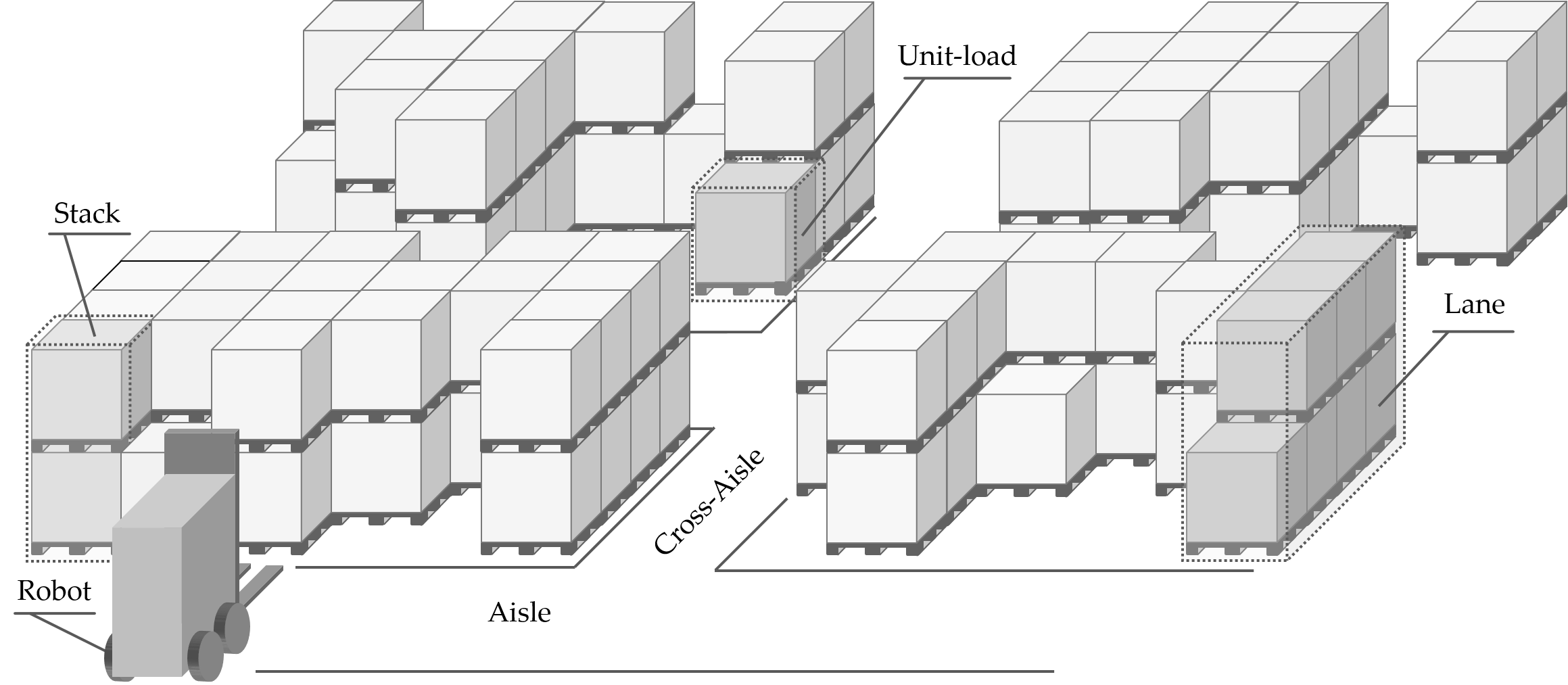
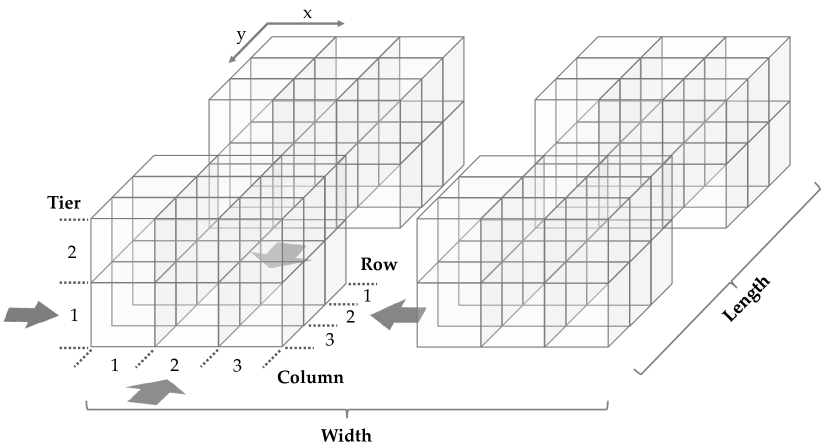
- Model the warehouse as a grid of bays with lanes and stacks, where unit loads are blocked by higher-priority loads beneath them.
- Incorporate AMR constraints: single-load capacity, inability to reach over stacks, and travel time between bays via aisles.
Experimental results
Research questions
- RQ1How can the unit-load pre-marshalling problem be effectively extended from a single bay to multiple interconnected bays with shared AMR fleets?
- RQ2To what extent does considering travel time between bays improve the efficiency of pre-marshalling compared to minimizing only move count?
- RQ3Can an exact constraint programming approach outperform heuristic methods in terms of solution quality for the move sequence stage?
- RQ4How do varying warehouse configurations (e.g., bay size, load density, retrieval priority distribution) affect solution performance and scalability?
- RQ5What is the practical feasibility of solving real-world-sized MUPMP instances using the proposed two-stage framework?
Key findings
- The proposed two-stage approach effectively reduces access time and sorting effort in multibay block stacking warehouses, even under high load densities.
- The exact constraint programming (CP) model consistently outperformed the heuristic A* approach in solution quality, particularly on complex instances with high blocking and travel complexity.
- For 5x5 and 6x6 bay configurations with 80% load density, the CP model solved 90% of instances within 3600 seconds, with average solution times under 3000 seconds.
- On 5x5-6x6 and 6x6-6x6 configurations with 90% load density, the CP model solved 5 out of 10 instances within the time limit, demonstrating scalability to large instances.
- The A* heuristic achieved faster computation times on smaller instances but produced suboptimal solutions compared to CP, especially in high-density scenarios.
- The authors released benchmark datasets for the MUPMP, enabling reproducibility and future comparison of solution methods in multibay warehouse optimization.
Read this paper
Open the full text in the Nubint reader and ask about any passage as you read.
Read this paper on NubintThis review was generated by AI from the original paper. Please check the paper before citing it.