
[Paper Review] Sources of Hallucination by Large Language Models on Inference Tasks
This paper identifies two pretraining-induced biases that drive hallucinations in LLMs during natural language inference: memorization of attested hypotheses and corpus-frequency-based entailment. It shows these biases cause false positives and degrade performance on non-conforming samples across LLaMA, GPT-3.5, and PaLM.
Large Language Models (LLMs) are claimed to be capable of Natural Language Inference (NLI), necessary for applied tasks like question answering and summarization. We present a series of behavioral studies on several LLM families (LLaMA, GPT-3.5, and PaLM) which probe their behavior using controlled experiments. We establish two biases originating from pretraining which predict much of their behavior, and show that these are major sources of hallucination in generative LLMs. First, memorization at the level of sentences: we show that, regardless of the premise, models falsely label NLI test samples as entailing when the hypothesis is attested in training data, and that entities are used as ``indices'' to access the memorized data. Second, statistical patterns of usage learned at the level of corpora: we further show a similar effect when the premise predicate is less frequent than that of the hypothesis in the training data, a bias following from previous studies. We demonstrate that LLMs perform significantly worse on NLI test samples which do not conform to these biases than those which do, and we offer these as valuable controls for future LLM evaluation.
Motivation & Objective
- Identify biases in LLM natural language inference that lead to hallucinations.
- Distinguish memorization-based and corpus-statistic biases as pretraining artifacts.
- Evaluate how these biases affect predictions on attested hypotheses and frequency-based entailment.
Proposed method
- Conduct behavioral NLI experiments across LLaMA-65B, GPT-3.5, and PaLM-540B using controlled dataset transformations.
- Define Attestation Bias (Λ) as dependence on hypothesis attestation in training data and measure with attestation prompts.
- Define Relative Frequency Bias (Φ) based on premise vs hypothesis frequency in training corpora using Google N-grams as a proxy.
- Use Levy/Holt and RTE-1 style prompts with three-way NLI choices and minimal few-shot exemplars to probe memory and bias effects.
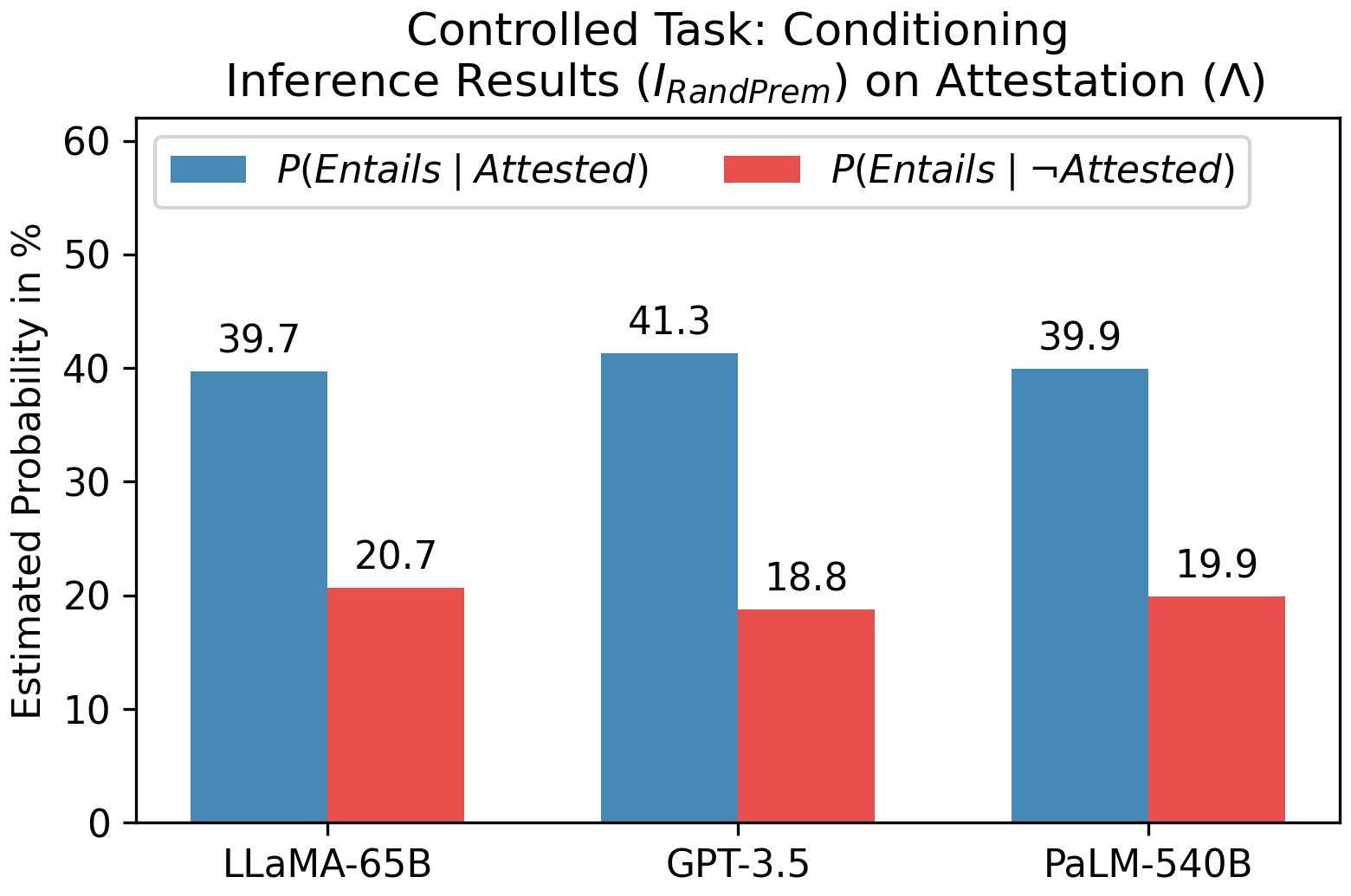
- Apply dataset transformations (I_RandPrem, I_GenArg, I_RandArg, I_RandArg↑/↓) to separate memory effects from surface signals.
- Assess impact via recall/precision metrics and AUC_norm across bias-consistent vs adversarial subsets.
Experimental results
Research questions
- RQ1Do LLMs rely on propositional memory of training data when solving NLI tasks?
- RQ2Are named entities acting as memory indices crucial for recall in inference?
- RQ3Does corpus-frequency bias drive entailment judgments independent of semantic content?
- RQ4How do these biases affect model performance on samples that conform vs. contradict the biases?
Key findings
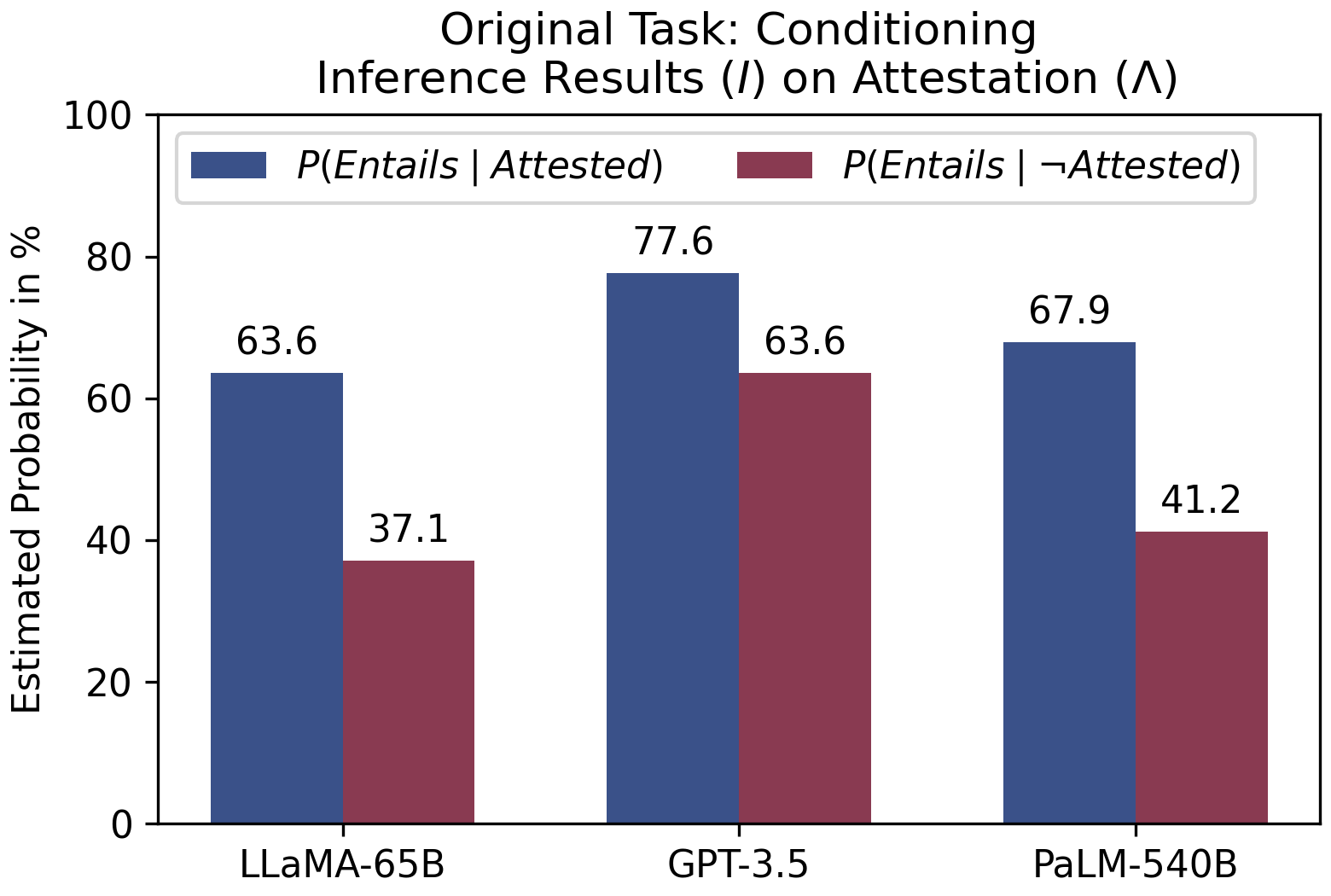
- LLMs show higher Entail predictions when the hypothesis is attested in training data, indicating an Attestation Bias (Λ).
- Replacing entities with generic or random ones degrades recall, suggesting named entities serve as memory indices for recall.
- Models exhibit a Relative Frequency Bias (Φ) where entailment is more likely when the premise is less frequent than the hypothesis in training data.
- Across LLaMA, GPT-3.5, and PaLM, memory- and frequency-based biases cause substantial false positives and reduce performance on adversarial samples.
- Attestation and frequency biases persist across model families and are tied to pretraining objectives rather than fine-tuning or RLHF.
- When evaluating with bias-consistent vs bias-adversarial subsets, conventional NLI scores can be misleading about true reasoning ability.
Read this paper
Open the full text in the Nubint reader and ask about any passage as you read.
Read this paper on NubintThis review was generated by AI from the original paper. Please check the paper before citing it.