
[Paper Review] Sparse4D v3: Advancing End-to-End 3D Detection and Tracking
Sparse4D v3 advances end-to-end 3D object detection and tracking by introducing temporal instance denoising, quality estimation, and decoupled attention mechanisms, achieving state-of-the-art performance on nuScenes with 71.9% NDS and 67.7% AMOTA using EVA02-Large backbone and future frame fusion.
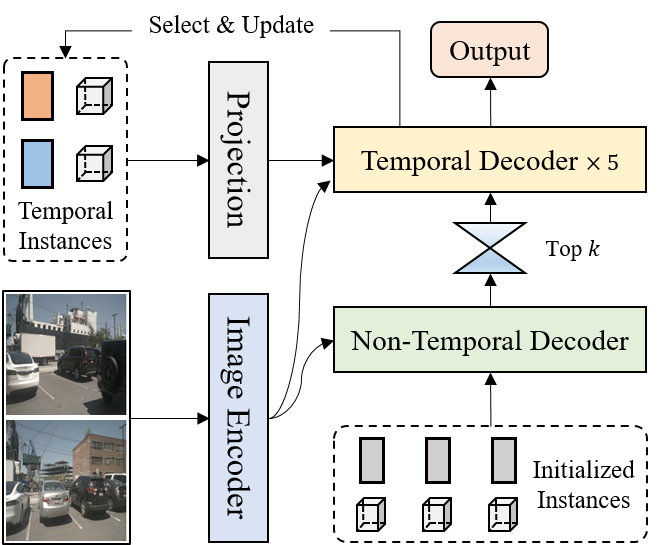
In autonomous driving perception systems, 3D detection and tracking are the two fundamental tasks. This paper delves deeper into this field, building upon the Sparse4D framework. We introduce two auxiliary training tasks (Temporal Instance Denoising and Quality Estimation) and propose decoupled attention to make structural improvements, leading to significant enhancements in detection performance. Additionally, we extend the detector into a tracker using a straightforward approach that assigns instance ID during inference, further highlighting the advantages of query-based algorithms. Extensive experiments conducted on the nuScenes benchmark validate the effectiveness of the proposed improvements. With ResNet50 as the backbone, we witnessed enhancements of 3.0\%, 2.2\%, and 7.6\% in mAP, NDS, and AMOTA, achieving 46.9\%, 56.1\%, and 49.0\%, respectively. Our best model achieved 71.9\% NDS and 67.7\% AMOTA on the nuScenes test set. Code will be released at \url{https://github.com/linxuewu/Sparse4D}.
Motivation & Objective
- Address the instability and poor convergence in sparse-based 3D detection due to one-to-one positive matching and sparse sampling.
- Improve detection performance by introducing auxiliary training tasks: temporal instance denoising and quality estimation.
- Enhance attention mechanism stability through decoupled attention to reduce feature interference in query-based attention.
- Extend the detector into an end-to-end tracker without modifying training or loss functions, enabling direct instance ID assignment during inference.
- Achieve state-of-the-art performance on the nuScenes benchmark through architectural and training improvements.
Proposed method
- Introduce temporal instance denoising as an auxiliary task to stabilize positive sample matching and increase positive sample quantity during training.
- Add quality estimation head to refine confidence scores, improving detection ranking and metric performance.
- Propose decoupled attention by replacing query-feature addition with concatenation, reducing erroneous attention weights and improving feature aggregation.
- Implement end-to-end 3D multi-object tracking by assigning instance IDs during inference, eliminating the need for separate data association or tracking head.
- Leverage future frame feature fusion and EVA02-Large backbone to further boost performance in cloud-based inference settings.
- Maintain detector training unchanged while integrating tracking functionality, ensuring no additional fine-tuning or ground-truth ID supervision is required.
Experimental results
Research questions
- RQ1Can auxiliary training tasks like temporal instance denoising and quality estimation improve the convergence and performance of sparse-based 3D detectors?
- RQ2Does decoupled attention reduce feature interference and improve attention map reliability in query-based 3D detection?
- RQ3Can a query-based 3D detector be extended into an end-to-end tracker without modifying the training process or loss functions?
- RQ4To what extent can future frame feature fusion and a larger backbone further enhance detection and tracking performance?
- RQ5Does the proposed framework achieve state-of-the-art performance on the nuScenes benchmark for both detection and tracking tasks?
Key findings
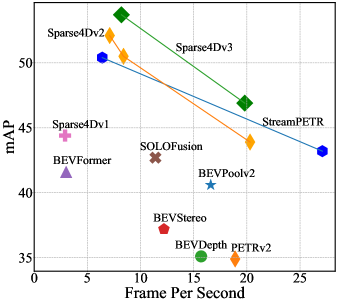
- With ResNet50 backbone, Sparse4D v3 achieves 46.9% mAP, 56.1% NDS, and 49.0% AMOTA on nuScenes validation set—improving by 3.0%, 2.2%, and 7.6% respectively over Sparse4Dv2.
- Using EVA02-Large backbone and 8 future frames, the model reaches 68.2% mAP, 71.9% NDS, and 67.7% AMOTA on the nuScenes test set, surpassing some lidar-based models like TransFusion-L in NDS and mAVE.
- The ablation study confirms that each component—temporal denoising, quality estimation, and decoupled attention—contributes to performance gains, with quality estimation reducing mAVE by 0.055 and improving AMOTA by 0.076.
- The decoupled attention mechanism effectively suppresses incorrect attention weights, as shown in visualizations where attention no longer correlates unrelated objects like pedestrians with target vehicles.
- The end-to-end tracker achieves predefined instance-to-tracking regression without additional training or loss, demonstrating seamless integration of detection and tracking.
- Future frame fusion reduces mAVE by 5.67% and increases NDS by 3.23%, while switching to EVA02-Large backbone boosts mAP by 5.98% compared to ResNet101.
Read this paper
Open the full text in the Nubint reader and ask about any passage as you read.
Read this paper on NubintThis review was generated by AI from the original paper. Please check the paper before citing it.