
[Paper Review] SparseFusion: Fusing Multi-Modal Sparse Representations for Multi-Sensor 3D Object Detection
SparseFusion proposes a novel 3D object detection framework that fuses sparse instance-level features from LiDAR and camera modalities using a lightweight self-attention module after transforming camera candidates into the LiDAR coordinate space. It achieves state-of-the-art performance on nuScenes with the fastest inference speed by avoiding dense representations and mitigating negative transfer via semantic and geometric cross-modality transfer modules.
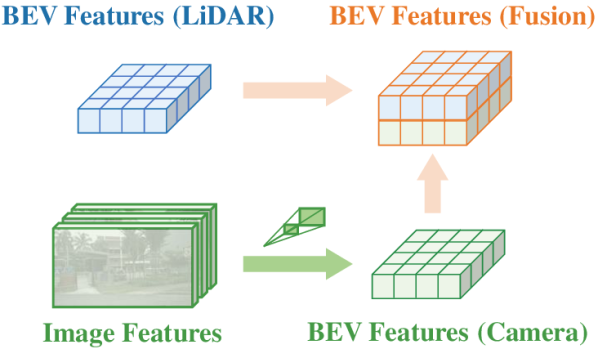
By identifying four important components of existing LiDAR-camera 3D object detection methods (LiDAR and camera candidates, transformation, and fusion outputs), we observe that all existing methods either find dense candidates or yield dense representations of scenes. However, given that objects occupy only a small part of a scene, finding dense candidates and generating dense representations is noisy and inefficient. We propose SparseFusion, a novel multi-sensor 3D detection method that exclusively uses sparse candidates and sparse representations. Specifically, SparseFusion utilizes the outputs of parallel detectors in the LiDAR and camera modalities as sparse candidates for fusion. We transform the camera candidates into the LiDAR coordinate space by disentangling the object representations. Then, we can fuse the multi-modality candidates in a unified 3D space by a lightweight self-attention module. To mitigate negative transfer between modalities, we propose novel semantic and geometric cross-modality transfer modules that are applied prior to the modality-specific detectors. SparseFusion achieves state-of-the-art performance on the nuScenes benchmark while also running at the fastest speed, even outperforming methods with stronger backbones. We perform extensive experiments to demonstrate the effectiveness and efficiency of our modules and overall method pipeline. Our code will be made publicly available at https://github.com/yichen928/SparseFusion.
Motivation & Objective
- To address the inefficiency and noise introduced by dense representations in multi-sensor 3D detection.
- To overcome negative transfer between LiDAR and camera modalities due to domain gaps.
- To develop a fusion strategy that operates exclusively on sparse instance-level features rather than dense scene representations.
- To improve inference speed without sacrificing detection accuracy by avoiding computationally heavy dense feature generation.
- To validate the effectiveness of sparse fusion through ablation and benchmarking on nuScenes.
Proposed method
- SparseFusion uses parallel 3D object detectors to extract sparse instance-level features from LiDAR point clouds and camera images independently.
- It disentangles object representations to transform camera candidates into the LiDAR coordinate space, enabling unified 3D fusion.
- A lightweight self-attention module fuses the transformed sparse candidates in a shared 3D space for final detection.
- Semantic and geometric cross-modality transfer modules are applied before modality-specific detectors to reduce domain gap and negative transfer.
- The method avoids dense feature generation by fusing only relevant sparse instance features, improving efficiency and reducing noise.
- View transformation of camera candidates into LiDAR space is critical for accurate cross-modality alignment and performance.
Experimental results
Research questions
- RQ1Can sparse instance-level features from LiDAR and camera modalities be effectively fused without relying on dense representations?
- RQ2How does fusing sparse candidates compare to existing dense-to-dense or sparse-to-dense fusion strategies in terms of accuracy and speed?
- RQ3To what extent do semantic and geometric cross-modality transfer modules mitigate negative transfer between modalities?
- RQ4Does eliminating dense feature generation improve inference efficiency while maintaining or improving detection performance?
- RQ5How does the choice of fusion mechanism—e.g., self-attention vs. MLP or optimal transport—affect final detection accuracy?
Key findings
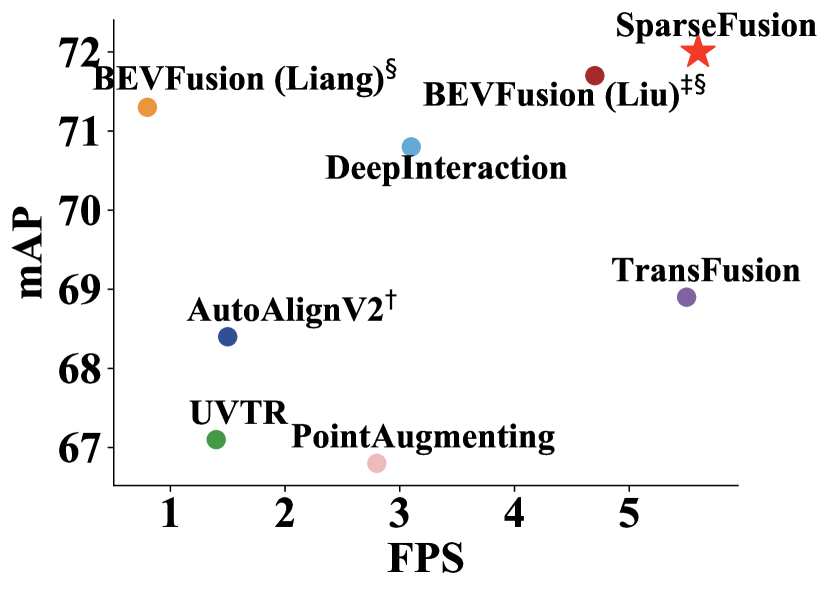
- SparseFusion achieves 68.8% NDS and 66.4% mAP on the nuScenes benchmark, setting a new state-of-the-art performance.
- It runs at the fastest inference speed among all methods, outperforming models with stronger backbones.
- Ablation studies show that self-attention fusion outperforms MLP, cross-attention, and optimal transport baselines.
- The view transformation of camera candidates into LiDAR space improves mAP by 0.8 percentage points and NDS by 0.5 points.
- The geometric and semantic transfer modules significantly improve performance, with semantic transfer providing the largest gain.
- A sequential detector pipeline is outperformed by the parallel detector design, validating the necessity of modality-specific feature extraction.
Read this paper
Open the full text in the Nubint reader and ask about any passage as you read.
Read this paper on NubintThis review was generated by AI from the original paper. Please check the paper before citing it.