
[Paper Review] SparseGPT: Massive Language Models Can Be Accurately Pruned in One-Shot
SparseGPT presents a one-shot pruning method that can sparsify giant GPT-family models (e.g., OPT-175B, BLOOM-176B) to 50–60% unstructured sparsity with negligible accuracy loss, without any retraining.
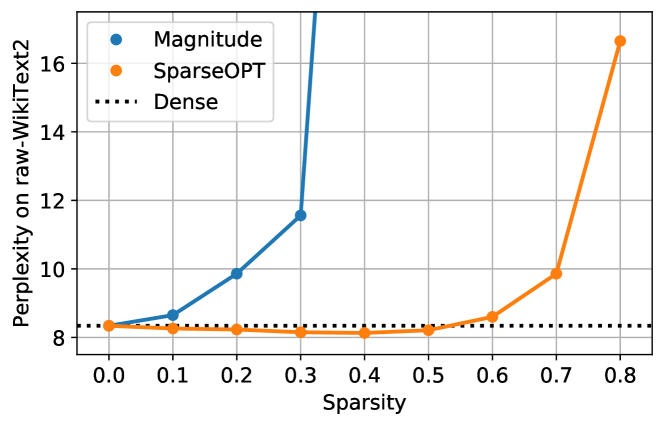
We show for the first time that large-scale generative pretrained transformer (GPT) family models can be pruned to at least 50% sparsity in one-shot, without any retraining, at minimal loss of accuracy. This is achieved via a new pruning method called SparseGPT, specifically designed to work efficiently and accurately on massive GPT-family models. We can execute SparseGPT on the largest available open-source models, OPT-175B and BLOOM-176B, in under 4.5 hours, and can reach 60% unstructured sparsity with negligible increase in perplexity: remarkably, more than 100 billion weights from these models can be ignored at inference time. SparseGPT generalizes to semi-structured (2:4 and 4:8) patterns, and is compatible with weight quantization approaches. The code is available at: https://github.com/IST-DASLab/sparsegpt.
Motivation & Objective
- Motivate the need to compress massive GPT-scale models to reduce deployment cost and inference latency without retraining.
- Introduce SparseGPT, a scalable one-shot pruning method tailored for 10–100+ billion parameter transformers.
- Show that larger models are more compressible and can be pruned to high sparsity with small accuracy loss.
- Demonstrate compatibility of SparseGPT with semi-structured sparsity patterns and with weight quantization, enabling joint sparsification and quantization.
Proposed method
- Reduce the pruning problem to large-scale sparse regression instances solved by a new approximate sparse-regression solver.
- Develop a fast reconstruction technique that uses an adaptive, per-layer Hessian-based update to preserve input-output relations after pruning.
- Synchronize Hessians across rows by reusing inverse Hessians through a sequence of column-wise updates, achieving O(d_hidden^3) overall cost per layer.
- Employ an adaptive masking strategy that blocks columns into chunks for non-uniform sparsity distribution across layers, guided by OBS-based error estimates.
- Extend to semi-structured sparsity (2:4, 4:8) by adjusting block processing to enforce sparsity constraints within blocks.
- Enable joint sparsification and quantization by integrating weight quantization into the pruning pass and propagating its effects in the updates.
Experimental results
Research questions
- RQ1Can one-shot pruning achieve substantial sparsity on GPT-scale models without retraining?
- RQ2How far can unstructured and semi-structured sparsity be pushed on trillion-parameter-scale transformer families with minimal accuracy loss?
- RQ3Is the pruning performance correlated with model size, i.e., are larger models more compressible?
- RQ4Can sparsification be effectively combined with weight quantization in a single pass without accuracy degradation?
- RQ5What practical masking strategies best distribute sparsity non-uniformly across layers for large LLMs?
Key findings
- SparseGPT achieves 50–60% unstructured sparsity on OPT-175B and BLOOM-176B in one shot with minor perplexity degradation.
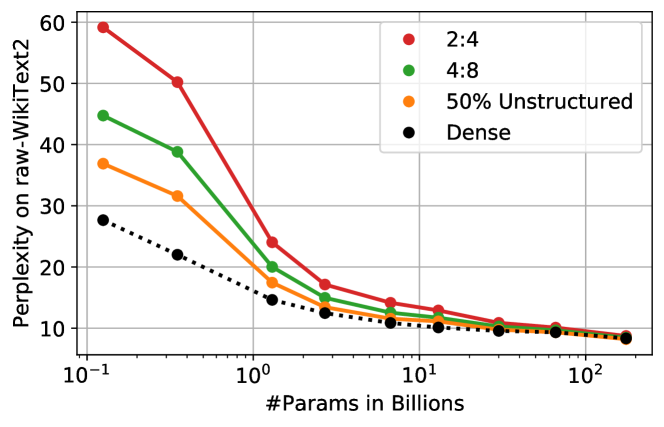
- Larger models exhibit greater compressibility, suffering less accuracy loss at a fixed sparsity than smaller counterparts.
- 2:4 and 4:8 semi-structured sparsity can be achieved with small additional accuracy loss on very large models, compared to unstructured sparsity.
- Joint sparsification and 4-bit weight quantization can be done in a single pass with negligible perplexity increase for very large models.
- SparseGPT runs on a single A100 GPU, pruning OPT-175B and BLOOM-176B in under 4.5 hours, demonstrating practical scalability.
Read this paper
Open the full text in the Nubint reader and ask about any passage as you read.
Read this paper on NubintThis review was generated by AI from the original paper. Please check the paper before citing it.