
[Paper Review] Sparser is Faster and Less is More: Efficient Sparse Attention for Long-Range Transformers
This paper proposes SparseK Attention, a differentiable, sparse attention mechanism that selects a fixed number of key-value pairs per query using a learnable scoring network and a differentiable top-k mask operator. It achieves linear time complexity and constant memory during inference, outperforming prior methods in speed and efficiency while maintaining strong performance on long-context language modeling and downstream tasks.
Accommodating long sequences efficiently in autoregressive Transformers, especially within an extended context window, poses significant challenges due to the quadratic computational complexity and substantial KV memory requirements inherent in self-attention mechanisms. In this work, we introduce SPARSEK Attention, a novel sparse attention mechanism designed to overcome these computational and memory obstacles while maintaining performance. Our approach integrates a scoring network and a differentiable top-k mask operator, SPARSEK, to select a constant number of KV pairs for each query, thereby enabling gradient-based optimization. As a result, SPARSEK Attention offers linear time complexity and constant memory footprint during generation. Experimental results reveal that SPARSEK Attention outperforms previous sparse attention methods and provides significant speed improvements during both training and inference, particularly in language modeling and downstream tasks. Furthermore, our method can be seamlessly integrated into pre-trained Large Language Models (LLMs) with minimal fine-tuning, offering a practical solution for effectively managing long-range dependencies in diverse applications.
Motivation & Objective
- Address the quadratic computational and memory costs of self-attention in long-context Transformers.
- Overcome limitations of prior learnable sparse attention methods, including super-linear training complexity and high KV memory overhead.
- Enable efficient, gradient-based training and inference for long-range sequence modeling in autoregressive decoders.
- Achieve both computational efficiency and memory efficiency by decoupling KV selection from query access and enabling incremental, irreversible masking.
- Integrate seamlessly into pre-trained LLMs with minimal fine-tuning for practical deployment.
Proposed method
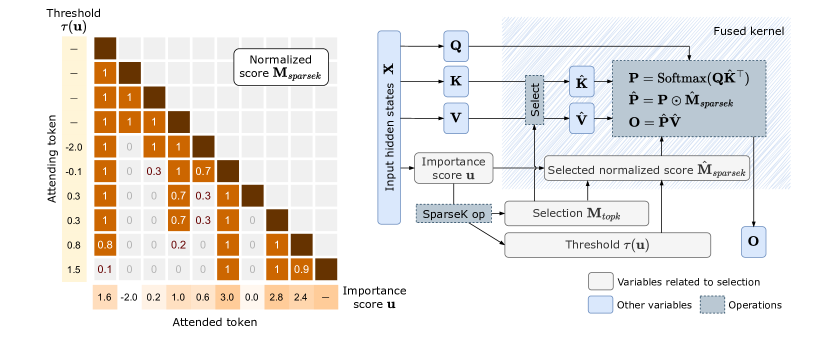
- Introduce a scoring network that evaluates KV pair importance independently of queries, enabling query-independent selection.
- Propose a differentiable top-k mask operator, SparseK, which computes exact soft gates in linear time using a thresholding mechanism.
- Fuse KV selection and attention computation into a single Triton kernel for IO-aware optimization and improved speed.
- Apply the same sparsity level during both training and inference, ensuring consistent efficiency and avoiding re-computation.
- Enable incremental evaluation of KV pairs during autoregressive decoding, maintaining linear complexity.
- Design a backward-pass kernel that fuses gradient computation with SparseK for memory and speed efficiency.
Experimental results
Research questions
- RQ1Can a differentiable sparse attention mechanism achieve linear time complexity during both training and inference in long-context Transformers?
- RQ2Does separating KV scoring from query access enable constant memory footprint during inference while maintaining performance?
- RQ3How does the proposed SparseK operator compare to existing learnable sparse attention methods in terms of training speed and inference efficiency?
- RQ4To what extent can SparseK be integrated into pre-trained LLMs with minimal fine-tuning for long-context tasks?
- RQ5Can the method scale to long context lengths (e.g., 16K tokens) while outperforming full attention in speed and accuracy?
Key findings
- SparseK Attention reduces training-time complexity from quadratic to linear, achieving 68.9% relative training time compared to full attention on Pythia-160M with 8192 context length.
- The method achieves constant memory cost during inference by enabling immediate removal of masked KV pairs, eliminating redundant storage.
- On 4096-token sequences with 1024 selected KV pairs per query, the Triton kernel outperforms FlashAttention in speed due to fused computation and sparsity-aware access.
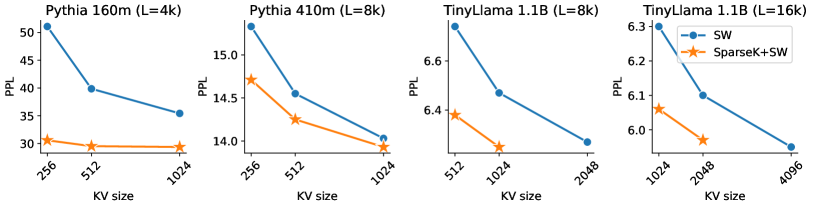
- SparseK matches or exceeds the performance of full attention and other sparse methods on language modeling and downstream tasks at equivalent context lengths.
- The method enables seamless integration into pre-trained models like GPT-2 and Pythia with minimal fine-tuning, demonstrating practical deployability.
- Visualization confirms that the soft selection mechanism learns meaningful attention patterns, with higher scores concentrated on semantically relevant tokens.
Read this paper
Open the full text in the Nubint reader and ask about any passage as you read.
Read this paper on NubintThis review was generated by AI from the original paper. Please check the paper before citing it.