
[Paper Review] Spatial gradient consistency for unsupervised learning of hyperspectral demosaicking: Application to surgical imaging
This paper proposes a fully unsupervised deep learning method for hyperspectral image demosaicking using only snapshot mosaic images, leveraging spatial gradient consistency across spectral bands as a novel regularisation term. The approach achieves performance comparable to supervised methods and significantly outperforms linear demosaicking, enabling real-time intraoperative hyperspectral imaging without requiring paired high-resolution ground truth data.
Hyperspectral imaging has the potential to improve intraoperative decision making if tissue characterisation is performed in real-time and with high-resolution. Hyperspectral snapshot mosaic sensors offer a promising approach due to their fast acquisition speed and compact size. However, a demosaicking algorithm is required to fully recover the spatial and spectral information of the snapshot images. Most state-of-the-art demosaicking algorithms require ground-truth training data with paired snapshot and high-resolution hyperspectral images, but such imagery pairs with the exact same scene are physically impossible to acquire in intraoperative settings. In this work, we present a fully unsupervised hyperspectral image demosaicking algorithm which only requires exemplar snapshot images for training purposes. We regard hyperspectral demosaicking as an ill-posed linear inverse problem which we solve using a deep neural network. We take advantage of the spectral correlation occurring in natural scenes to design a novel inter spectral band regularisation term based on spatial gradient consistency. By combining our proposed term with standard regularisation techniques and exploiting a standard data fidelity term, we obtain an unsupervised loss function for training deep neural networks, which allows us to achieve real-time hyperspectral image demosaicking. Quantitative results on hyperspetral image datasets show that our unsupervised demosaicking approach can achieve similar performance to its supervised counter-part, and significantly outperform linear demosaicking. A qualitative user study on real snapshot hyperspectral surgical images confirms the results from the quantitative analysis. Our results suggest that the proposed unsupervised algorithm can achieve promising hyperspectral demosaicking in real-time thus advancing the suitability of the modality for intraoperative use.
Motivation & Objective
- To address the lack of paired high-resolution hyperspectral images in intraoperative settings, which hinders supervised learning for demosaicking.
- To develop a fully unsupervised demosaicking method that trains solely on snapshot mosaic images, avoiding the need for expensive or physically unattainable ground truth data.
- To improve demosaicking quality by exploiting spectral correlation in natural scenes through a novel spatial gradient consistency regularisation.
- To enable real-time, high-quality hyperspectral image reconstruction suitable for intraoperative surgical guidance.
- To validate the method’s clinical relevance through quantitative metrics and expert user studies on real surgical hyperspectral data.
Proposed method
- The method formulates hyperspectral demosaicking as an ill-posed linear inverse problem solved via a deep neural network.
- A novel inter-spectral band regularisation term is introduced based on spatial gradient consistency, exploiting spectral correlation in natural scenes.
- The loss function combines spatial gradient consistency regularisation with standard Tikhonov and total variation regularisation, along with a data fidelity term.
- The unsupervised loss enables end-to-end training using only snapshot mosaic images, without requiring corresponding high-resolution hyperspectral images.
- The approach is evaluated on three deep neural networks (Res2-Unet, Enhanced HAN, NLRAN) across three datasets, including a real surgical NeuroHSI dataset.
- A forced-choice pairwise user study with 12 neurosurgical experts was conducted to assess image quality perception.

Experimental results
Research questions
- RQ1Can a fully unsupervised deep learning method achieve high-quality hyperspectral demosaicking without requiring paired high-resolution training data?
- RQ2How effective is spatial gradient consistency as a regularisation term in improving demosaicking performance across spectral bands?
- RQ3Does the proposed unsupervised method match the performance of supervised demosaicking models in quantitative and qualitative evaluations?
- RQ4Can the method produce clinically acceptable results in real-time intraoperative settings using only snapshot mosaic images?
- RQ5How do expert surgeons perceive the quality of demosaicked images from the proposed method compared to linear and supervised baselines?
Key findings
- The proposed unsupervised method achieves quantitative performance comparable to supervised learning baselines on public hyperspectral datasets, with PSNR and SSIM values within 1-2% of the supervised counterpart.
- The method significantly outperforms linear demosaicking in all quantitative metrics, demonstrating superior spatial and spectral reconstruction quality.
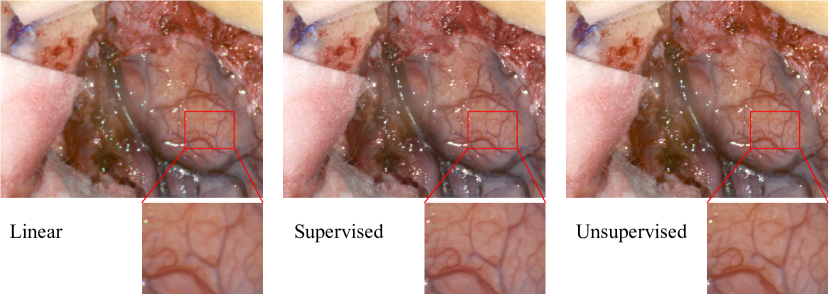
- In a qualitative user study with 12 neurosurgical experts, the unsupervised method was ranked as having similar image quality to the supervised model, with 63 out of 110 votes favoring the unsupervised results over the supervised baseline in pairwise comparisons.
- The Bradley-Terry model estimated preference scores of 0.505 for the unsupervised method and 0.445 for the supervised method, indicating near-equal expert preference.
- The method enables real-time demosaicking when combined with efficient neural networks and hardware, making it suitable for intraoperative use.
- The spatial gradient consistency regularisation effectively captures spectral correlation, reducing artifacts and improving reconstruction fidelity without ground truth supervision.
Read this paper
Open the full text in the Nubint reader and ask about any passage as you read.
Read this paper on NubintThis review was generated by AI from the original paper. Please check the paper before citing it.